31 August 2010

The Fascist Offensive

I've also found that when attempting to understand an issue, whether it relates to a current political situation, or a competitive business situation, to resort to two research methods:

1. Reach back and read what history has taught us.
2. Research and attempt to understand what competitors have to say about a mutual competitor... as the saying goes "The enemy of my enemy is my friend"

I've been doing some historical reading as it relates to the growth of Fascism in Germany & Italy in the 1920's & 1930's and I found the following article from "Seventh World Congress of the Communist International" from August 2, 1935 and I felt that it warranted some pondering:

The development of fascism, and the fascist dictatorship itself, assume different forms in different countries, according to historical, social and economic conditions and to the national peculiarities, and the international position of the given country. In certain countries, principally those in which fascism has no broad mass basis and in which the struggle of the various groups within the camp of the fascist bourgeoisie itself is rather acute, fascism does not immediately venture to abolish parliament, but allows the other bourgeois parties, as well as the Social-Democratic Parties, to retain a modicum of legality. In other countries, where the ruling bourgeoisie fears an early outbreak of revolution, fascism establishes its unrestricted political monopoly, either immediately or by intensifying its reign of terror against and persecution of all rival parties and groups. This does not prevent fascism, when its position becomes particularly acute, from trying to extend its basis and, without altering its class nature, trying to combine open terrorist dictatorship with a crude sham of parliamentarism.

The accession to power of fascism is not an ordinary succession of one bourgeois government by another, but a substitution of one state form of class domination of the bourgeoisie -- bourgeois democracy -- by another form -- open terrorist dictatorship. It would be a serious mistake to ignore this distinction, a mistake liable to prevent the revolutionary proletariat from mobilizing the widest strata of the working people of town and country for the struggle against the menace of the seizure of power by the fascists, and from taking advantage of the contradictions which exist in the camp of the bourgeoisie itself. But it is a mistake, no less serious and dangerous, to underrate the importance, for the establishment of fascist dictatorship, of the reactionary measures of the bourgeoisie at present increasingly developing in bourgeois-democratic countries -- measures which suppress the democratic liberties of the working people, falsify and curtail the rights of parliament and intensify the repression of the revolutionary movement.

Comrades, the accession to power of fascism must not be conceived of in so simplified and smooth a form, as though some committee or other of finance capital decided on a certain date to set up a fascist dictatorship. In reality, fascism usually comes to power in the course of a mutual, and at times severe, struggle against the old bourgeois parties, or a definite section of these parties, in the course of a struggle even within the fascist camp itself -- a struggle which at times leads to armed clashes, as we have witnessed in the case of Germany, Austria and other countries. All this, however, does not make less important the fact that, before the establishment of a fascist dictatorship, bourgeois governments usually pass through a number of preliminary stages and adopt a number of reactionary measures which directly facilitate the accession to power of fascism. Whoever does not fight the reactionary measures of the bourgeoisie and the growth of fascism at these preparatory stages is not in a position to prevent the victory of fascism, but, on the contrary, facilitates that victory.

The Social-Democratic leaders glossed over and concealed from the masses the true class nature of fascism, and did not call them to the struggle against the increasingly reactionary measures of the bourgeoisie. They bear great historical responsibility for the fact that, at the decisive moment of the fascist offensive, a large section of the working people of Germany and of a number of other fascist countries failed to recognize in fascism the most bloodthirsty monster of finance capital, their most vicious enemy, and that these masses were not prepared to resist it.

What is the source of the influence of fascism over the masses? Fascism is able to attract the masses because it demagogically appeals to their most urgent needs and demands. Fascism not only inflames prejudices that are deeply ingrained in the masses, but also plays on the better sentiments of the masses, on their sense of justice and sometimes even on their revolutionary traditions. Why do the German fascists, those lackeys of the bourgeoisie and mortal enemies of socialism, represent themselves to the masses as "Socialists," and depict their accession to power as a "revolution"? Because they try to exploit the faith in revolution and the urge towards socialism that lives in the hearts of the mass of working people in Germany.

Fascism acts in the interests of the extreme imperialists, but it presents itself to the masses in the guise of champion of an ill-treated nation, and appeals to outraged national sentiments, as German fascism did, for instance, when it won the support of the masses of the petty bourgeoisie by the slogan "Down with the Versailles Treaty."

Fascism aims at the most unbridled exploitation of the masses but it approaches them with the most artful anti-capitalist demagogy, taking advantage of the deep hatred of the working people against the plundering bourgeoisie, the banks, trusts and financial magnates, and advancing those slogans which at the given moment are most alluring to the politically immature masses. In Germany -- "The general welfare is higher than the welfare of the individual," in Italy -- "Our state is not a capitalist, but a corporate state," in Japan -- "For Japan without exploitation," in the United States -- "Share the wealth," and so forth.

Fascism delivers up the people to be devoured by the most corrupt and venal elements, but comes before them with the demand for "an honest and incorruptible government." Speculating on the profound disillusionment of the masses in bourgeois-democratic governments, fascism hypocritically denounces corruption.

It is in the interests of the most reactionary circles of the bourgeoisie that fascism intercepts the disappointed masses who desert the old bourgeois parties. But it impresses these masses by the vehemence of its attacks on the bourgeois governments and its irreconcilable attitude to the old bourgeois parties.

Surpassing in its cynicism and hypocrisy all other varieties of bourgeois reaction, fascism adapts its demagogy to the national peculiarities of each country, and even to the peculiarities of the various social strata in one and the same country. And the mass of the petty bourgeoisie and even a section of the workers, reduced to despair by want, unemployment and the insecurity of their existence, fall victim to the social and chauvinist demagogy of fascism.

Fascism comes to power as a party of attack on the revolutionary movement of the proletariat, on the mass of the people who are in a state of unrest; yet it stages its accession to power as a "revolutionary" movement against the bourgeoisie on behalf of "the whole nation" and for the "salvation" of the nation. One recalls Mussolini's "march" on Rome, Pilsudski's "march" on Warsaw, Hitler's National-Socialist "revolution" in Germany, and so forth.

But whatever the masks that fascism adopts, whatever the forms in which it presents itself, whatever the ways by which it comes to power

Fascism is a most ferocious attack by capital on the mass of the working people;
Fascism is unbridled chauvinism and predatory war;
Fascism is rabid reaction and counter-revolution;
Fascism is the most vicious enemy of the working class and of all working people.


-----

"...Every woman adores a Fascist,
The boot in the face, the brute
Brute heart of a brute like you."

Disguised Fascism Seen as a Menace

"When and if fascism comes to America it will not be labeled "made in Germany"; it will not be marked with a swastika; it will not even be called fascism; it will, of course, be called "Americanism," Professor Halford E. Luccock of the Divinity School of Yale University said yesterday morning in a sermon at the Riverside Church, Riverside Drive and 122d Street.

"The high-sounding phrase "the American way" will be used by interested groups, intent on profit, to cover a multitude of sins against the American and Christian tradition, such as lawless violence, tear gas and shotguns, denial of civil liberties," he said. "There is an obligation resting on us all to dedicate our minds to the hard task of thinking in terms of Christian objectives and values, so that we may be saved from moral confusion.

"For never, probably, has there been a time when there was a more vigorous effort to surround social and international questions with such a fog of distortion and prejudice and hysterical appeal to fear. We have touched a new low in a Congressional investigation this summer, used by some participating in it to whip up fear and prejudice against many causes of human welfare, such as a concern for peace and the rights of labor to bargain collectively.

Professor Luccock, who preached on the theme "Keeping Life Out of Confusion", continued:
"The old prayer in the Psalms, 'Let me never be put to confusion,' seems a strange one in a day when there seems to be little else but confusion in a puzzled world. We ought to recognize that uncertainty of mind is not all a bad thing. It is a sign that your mind is still alive, still sensitive. If you are not at all confused in this day you are dead mentally and spiritually.

"There is of course the peace of the cemetery. If you want that you can have it. But you will pay for such complacent serenity with blind eyes which do not see the world's fear and agony; with deaf ears, into which the still sad music of humanity never comes; with deadened nerves and unsensitized conscience.

"We will never be brought to confusion, even in such a baffling and muddled world as ours, if we have a faith in a God of love as the ultimate power in the universe. The words 'God is love' have this deep meaning: that everything that is against love is ultimately doomed and damned."

- New York Times, September 12, 1938, Page 15
______________________________________
"Fascism in America will attempt to advance under the banner of Americanism and anti-Fascism."

"It is a peculiarity of the development of American fascism that at the present stage it comes forward principally in the guise of an opposition to fascism, which it accuses of being an "un-American" trend imported from abroad. In contradistinction to German fascism, which acts under anti-constitutional slogans, American fascism tries to portray itself as the custodian of the Constitution and "American democracy." It does not as yet represent a directly menacing force"

- Georgi Dimitrov (1882-1949). Seventh Congress of the Comintern (1935).

05 August 2010

WikiLeaks


Below find some information about the latest in the ongoing saga of WikiLeaks. Click the Bold Links for more information:

WikiLeaks aftermath
By Shuja Nawaz
August 6, 2010

IN STAND-UP comedy and politics, timing is critical. There was nothing “funny ha-ha’’ about the recent leak of US documents about the Afghanistan war implicating Pakistan and its Inter-Services Intelligence agency. But there was plenty of what the British call “funny peculiar’’ for sure.

The leaks followed a period of growing confidence of the ISI and Pakistan in their quest to work with Afghan President Hamid Karzai to rebuild relationships marked by severe historical distrust. How Afghanistan and Pakistan overcome the challenge posed by intelligence reports linking the ISI to hostile events in Afghanistan will determine Pakistan’s relations in the neighborhood and with the United States, as well as the trajectory of US withdrawal from the region. President Karzai’s press conference following the leak indicates that some damage has been done already to the nascent Pakistan-Afghan entente......
____________________________________________________________________

Pentagon demands Wikileaks return Afghanistan document
5 August 2010 Last updated at 22:11 ET
BBC News

The Pentagon has demanded that Wikileaks remove a trove of secret documents on the Afghanistan war from its website and cancel plans to publish anything more it holds.

But a Pentagon spokesman acknowledged the already-leaked documents' viral spread across the internet made it unlikely they could ever be quashed.

"We are asking them to do the right thing," spokesman Geoff Morrell said.

Wikileaks called Mr Morrell "obnoxious" and appealed for public donations.

The US military documents released last month detail civilian deaths, friendly-fire episodes and other ground-level incidents.

They include allegations the Pakistani intelligence service has backed the Taliban insurgents' fight against the US-led coalition and the Afghan government, and indicate Taliban fighters have acquired surface-to-air missiles. ......

____________________________________________________________________

Politician: Execution OK for Wikileaks source
August 3, 2010 9:48 AM PDT

A Republican congressman who's a member of the House Intelligence Committee lashed out at Wikileaks this week, saying the Web site's alleged source should be executed for treason.

Rep. Mike Rogers of Michigan told a local radio station on Monday (MP3 audio) that he believes that Bradley Manning, the Army intelligence specialist who is suspected of being a source for the document-sharing Web site, should be charged with treason.
When the WHMI interviewer suggested that treason in war is a capital crime, Rogers replied: "Yes, and I would have absolutely, I would support it 100 percent. He put soldiers at risk who are out there fighting for their country, and he put people who are cooperating with the United States government clearly at risk."

Rogers added: "If you have an 18- or 19-year-old over there, you want to get your hands on this private first class yourself. I know I do." .....
____________________________________________________________________

Opinion: It's a WikiLeaks World, Get Used to It
(Aug. 5) -- No matter where right or wrong lie in the posting of classified military reports on WikiLeaks.org, one lesson should be clear: This is how it's going to be. Technology will continue to undercut secrecy -- not just in the military, but in all large organizations.

Government and corporate leaders who aren't ahead of this problem may already have trouble on their hands they don't know about.

When 90,000 pages of documents chronicling the Afghan war went online last week, their potential effects on military planning and security caused the White House to strongly condemn their posting as "irresponsible." Differing more than slightly, Salon commentator Glenn Greenwald praised WikiLeaks.org as "one of the most valuable and important organizations in the world."

While there is universal agreement that over-classification in the U.S. government is a problem, leaking government documents isn't a good way to fix it. Nevertheless, a pair of related technology trends will continue to push this "fix" in a disorderly way if it's not solved methodically.

Technology: First, individuals today have tremendous power to collect, transmit and process information. Average people have hand-held computers and phones, huge-capacity flash memory thumb drives, and so on. The tech-savvy have even more powerful information devices, familiarity with encryption, and anonymization tools. We have overcome the natural conditions that made easy-to-censor hand-written letters a minimal threat to "operational security" in World War II.

Culture: Cultural trends are coming into play as well. Military service-members today live in a culture of information sharing that might baffle their senior officers. They expect to be in touch with the outside world during their tours. Their service is long and difficult enough without quarantining them in a communications bubble for protracted periods. Indeed, doing so would undermine military effectiveness by cutting deeply into the morale of young men and women whose stateside lives are "always connected." This is the generation that knows the value and power of sharing information.

So what's to be done? .....

07 March 2010

Armenia and reality


IMHO, there is a time and a place to when we should be realists and recognize those moments in history when to speak out about something that is "right" and when the timing of our speaking out can put our sons in and daughters in harm's way. Correcting history is the luxury of a stable and strong power, not that of one overstretched militarily and economically.

Perhaps the place to begin is here:
Top of the Agenda: Turkey Balks at U.S. Genocide Vote on Armenia
Turkey recalled its ambassador (CSMonitor) to the United States over a disagreement on how to refer to the mass killings of Armenians during World War I. The U.S. House of Representatives' Foreign Affairs Committee passed a resolution requiring official use of the term "Armenian genocide" in referring to the killings. "We condemn this resolution accusing Turkey of a crime that it had not committed," the Turkish prime minister's office said in a written statement. Turkey had warned that passing the bill could disrupt positive relations with Washington and damage Turkish-Armenian reconciliation.

U.S. Secretary of State Hillary Clinton telephoned fellow Democrat and House Foreign Affairs Committee Chairman Howard Berman before the vote to say the measure could harm efforts (Telegraph) to normalize Turkish-Armenian relations, the White House said. Despite this appeal, Berman went ahead with the committee debate and vote. It remains unclear whether the bill will reach a floor vote.


What is this all about?
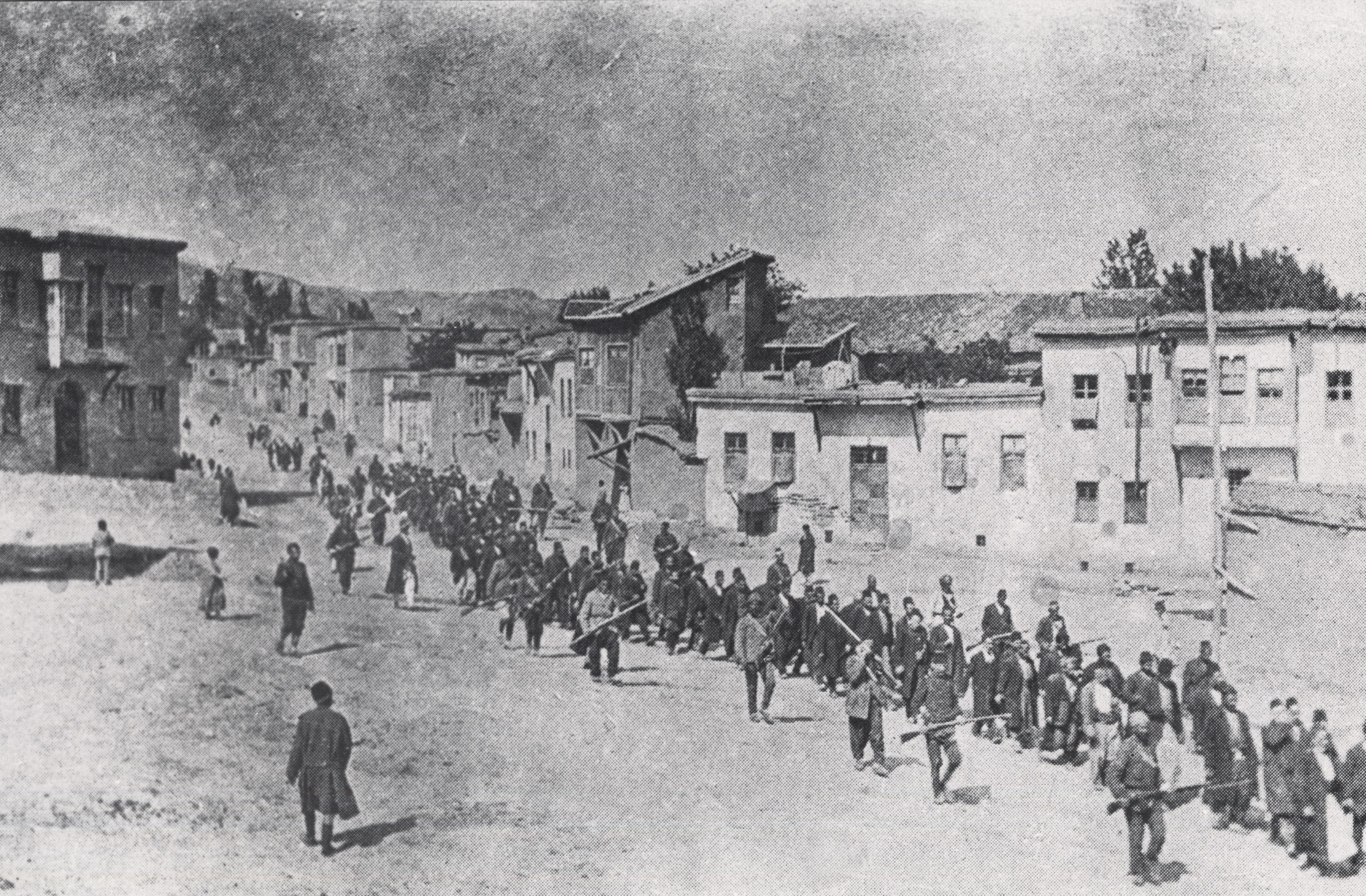
The Armenian Genocide (Armenian: Հայոց Ցեղասպանություն, translit.: Hayoc’ C’eġaspanowt’yown; Turkish: Ermeni Soykırımı) – also known as the Armenian Holocaust, the Armenian Massacres and, by Armenians, as the Great Calamity (Մեծ Եղեռն, Meç Eġeṙn, Armenian pronunciation: [mɛts jɛˈʁɛrn]) – was the deliberate and systematic destruction (genocide) of the Armenian population of the Ottoman Empire during and just after World War I. It was characterized by the use of massacres, and the use of deportations involving forced marches under conditions designed to lead to the death of the deportees, with the total number of Armenian deaths generally held to have been between one and 1.5 million. Other ethnic groups were similarly attacked by the Ottoman Empire during this period, including Assyrians and Greeks, and some scholars consider those events to be part of the same policy of extermination.[6]
It is widely acknowledged to have been one of the first modern genocides, as scholars point to the systematic, organized manner in which the killings were carried out to eliminate the Armenians. Indeed, the word genocide was coined in order to describe these events. It is the second most-studied case of genocide after the Holocaust.

The starting date of the genocide is conventionally held to be April 24, 1915, the day that Ottoman authorities arrested some 250 Armenian intellectuals and community leaders in Constantinople. Thereafter, the Ottoman military uprooted Armenians from their homes and forced them to march for hundreds of miles, depriving them of food and water, to the desert of what is now Syria. Massacres were indiscriminate of age or gender, with rape and other sexual abuse commonplace.

The Republic of Turkey, the successor state of the Ottoman Empire, denies the word genocide is an accurate description of the events (see, Denial of the Armenian Genocide). In recent years, it has faced repeated calls to accept the events as genocide. To date, twenty countries have officially recognized the events of the period as genocide, and most genocide scholars and historians accept this view. The majority of Armenian diaspora communities were founded as a result of the Armenian genocide.


And after you read through that analysis pick up some of the backstory here:

Armenia and reality
By Ron Kampeas · March 5, 2010
M.J. Rosenberg at the Huffington Post sees the vote yesterday in the House Foreign Affairs Committee recognizing the Armenian genocide as a genocide as typical of Israel lobby machinations:

The lobby has always opposed deeming the Armenian slaughter a genocide largely because Turkey has (or had) good relations with Israel. And the lobby, and its Congressional acolytes, did not want to harm those relations.

But, since the Gaza war, Turkish-Israeli relations have deteriorated. The Turks, like pretty much every other nation on the planet, were appalled by the Israeli onslaught against the Gazans. And said so.

Ever since, the Netanyahu government has made a point to stick it to the Turks.

That battle is now being carried to Washington. The Israelis are trying to teach the Turks a lesson. If the Armenian resolution passes both houses and goes into effect, it will not be out of some newfound compassion for the victims of the Armenian genocide and their descendants, but to send a message to Turkey: if you mess with Israel, its lobby will make Turkey pay a price in Washington.

And, just maybe, the United States will pay it too.

I think this assessment is wrong, but I first have to admit a degree of culpability; M.J. bases this assessment on a parsing of a brief I wrote on the vote, and his parsing is fair enough; there's just so much I could pack into the brief, and stuff I left out might have led him to different conclusions.

First, let me make clear: I don't think Israel or the pro-Israel lobby is behind this vote. What I was trying to report in the brief is that while Israel and the pro-Israel lobby helped squelch previous efforts to pass this non-binding resolution, this year -- based on a bunch of conversations I've had over the past year -- I can safely say that the pro-Israel community is hanging back and telling the lawmakers, "Do what you feel is right. We're not spending political capital on the Turks this season."

I honestly did not get the sense that anyone in the pro-Israel lobby is eager for this resolution to pass; just that they did not feel motivated to burn themselves by helping to kill it.

In fact, this resolution carried in committee at least once before -- in 2007 -- and it carried because seven out of eight Jews on committee voted for it. (The single Jew who voted against was Robert Wexler of Florida, who was a friend of the Turkish lobby.)

So if the Jewish members favored the "genocide" label in the past, why did I choose to make a news item of yesterday's vote? Because there was a subtle -- but significant -- difference this time. Last time, the chairman of the panel, the late Tom Lantos of California, did not sponsor the bill -- but he ended up voting for it, after agonizing about it in his opening remarks. So too did the other six Jews who voted to call the massacres a genocide. And some of them explicitly agonized because of Turkey's good relations (at least then) with Israel. "This has been tough for me," Gary Ackerman of New York said then. Eliot Engel of New York voted "with a heavy heart."

This time, Lantos' successor as chairman, Howard Berman of California, did not dither at all and, in fact, co-sponsored the bill. And despite his urgings, it passed by a much tighter margin than in 2007: 23-22 yesterday as opposed to 27-21 in 2007. (It never reached the full House in that session.) This year, Wexler's out of Congress, and all seven Jews on the panel were in the "aye" column.

So what does this really tell us about the Israel lobby? It says, first of all, that its frontline -- Congress' Jewish members (and please, this is not unusual, Hispanic groups look to Hispanic members as their frontline, etc.) -- will at times defy the lobby's wishes. They did so in 2007, when pro-Israel groups lobbied very, very hard against the resolution. That they felt freer to vote in favor yesterday is significant, but the bigger picture underscores that they are not the lobby's pawns.

It also means that lobbies align themselves with existing interests. Previous defeats of the bill -- whether in committee, or by keeping the resolution from reaching the House floor -- were not the Israel lobby's alone. As M.J. notes, the Obama administration, like its predecessors, lobbied hard against the bill. Notably, Republicans on the committee who are seen as stalwarts of the pro-Israel lobby voted nay both times, including Ileana Ros-Lehtinen of Florida and Mike Pence of Indiana, and presumably for the same reason: They have close ties to the Pentagon, which, because of Turkey's NATO membership, does not want it to pass.

It also means that there are other, competing, lobbies. Adam Schiff of California, the perennial sponsor of this resolution, happens to be Jewish -- and also happens to represent an Armenian-heavy constituency in California. Berman is and Lantos was, not coincidentally, also Californians.

But finally, it means that American foreign policy -- and this is something we wonks forget -- is driven, perhaps to a greater degree than in any other country, by conscience. By moral choice.

I'm not saying yesterday's vote is the correct moral choice. The doctrine of "realism" in foreign policy implies legitimate moral choices of self-interest -- and this vote may not be in Amerca's self-interest. And I don't know whether the resolution will go farther than the committee -- Nancy Pelosi, the House speaker, kept it from the House floor in 2007, and may do so again.

But there's no question what recent Jewish theory teaches out about the Armenian genocide: That it was, indeed, a genocide. In 1986, I took Yad Vashem's 3-week intensive study course on the Shoah, and I'll never forget what Yehuda Bauer -- the preeminent Shoah scholar -- taught us: The Armenian genocide was the Holocaust's "cousin if not its brother." What persuaded him, he said, was evidence that the Ottomans looked to physicians to facilitate the massacres -- a precursor of the science the Germans used to speed up their genocide just decades later.

Yesterday's vote might not have been in U.S. interests, according to a "realist" foreign policy read. It probably was not in Israel's interests, despite the recent coolness between Israel and Turkey. (Notably, one Israeli voice who has consistently defied his country's "realist" approach and advocated for recognizing the Armenian genocide as such is Yossi Sarid -- also a father of the peace movement.)

American support for Israel has never had a purely "realist," or self-interested, cast -- and via Goldblog, Walter Russell Mead at the American Interest makes this case better than I ever could. The support has been, mostly. a moral choice, whatever you make of the morality.

And whatever one makes of the wisdom of the vote yesterday -- or in 2007 -- I remember feeling immensely moved as seven Jewish members voted not in the "realist" interests of the State Department or the Pentagon or of Israel; but in the interests of never again denying that a genocide occurred.

22 January 2010

Haiti & Isolationism

FB Poster 1: " you know what FUCK HAITI! if we had a disaster and needed help what other country is gonna help us out!? my point exactly..... what a joke! 10% of our country is unemployed bc all of our work is being sent to other countries bc their gonna do it for the fraction of the hourly rate.. Fuckin scabs! Ahhhh"

FB Poster 1: "10% of our country is unemployed bc all of our work is being sent to other countries bc their gonna do it for the fraction of the hourly rate.. Fuckin scabs! Ahhhh"

FB Poster 2: "i was thinkin the same thing im sick of hearing all about it

FB Poster 1: "Well let's see.. We're gonna fly them to the U.S. Do they have green card? Nope! Then will take care of them, give them free housing, loans and jobs (our jobs) and free education.. Would they do the same for us? NO!"

FB Poster 2: "exactly."

FB Poster 3 : "I feel the same...hate to say it but yea....lol"

FB Poster 1: "ya dude in a since it sucks what happened...... but seriously its outa control and over rated.... if we were in the same perdicament we would never get all the money, food and drugs needed to save our lives unless it came from the U.S. and the first thing they'd ask.... do you have health insurance sur? lol

Bernard Martin Isolationism: National policy of avoiding political or economic entanglements with other countries. Isolationism has been a recurrent theme in U.S. history. It was given expression in the Farewell Address of Pres. George Washington and in the early 19th-century Monroe Doctrine. The term is most often applied to the political atmosphere in the U.S. in the 1930s.

The failure of Pres. Woodrow Wilson's internationalism, liberal opposition to war as an instrument of policy, and the rigours of the Great Depression were among the reasons for Americans' reluctance to concern themselves with the growth of fascism in Europe.

The Johnson Act (1934) and the Neutrality acts (1935) effectively prevented economic or military aid to any country involved in the European disputes that were to escalate into World War II. U.S. isolationism encouraged the British in their policy of appeasement and contributed to French paralysis in the face of the growing threat posed by Nazi Germany.

In essence, not participating in world politics lead to the rise of Hitler and WWII.

Haiti is on an island that was once called "Hispaniola" Christopher Columbus landed at Môle Saint-Nicolas on 5 December 1492, and claimed the island of Hispaniola for Spain that day in and effort to find TRADE ROUTES to the orient. Instead he "found" the America's and the vast wealth of raw materials here.

The British East India in the 1750's began global economic trading. This also lead to the colonization of the America's and many many immigrants coming here for work. The first shots of the FIRST global war were fired @ Fort Necessity just south of Pittsburgh and was the foundation of the Seven Years War fought around the world basically over economic issues.

So, the basis of the foundation of the United States resides in global trade. The model created by the Founding Fathers made us the biggest and richest kid on the block. Essentially, not helping the Haitians would be like the entire city of Pittsburgh burning to the ground and the very richest people saying "F 'em" It would not go over well and those kids whose parents died would raise kids who hated America.... The "Rich Peeple" (kinda like the situation currently in the Middle East.)

You're probably correct that we wouldn't get much help if a natural disaster struck one of our major cities... at least no where near the same level as we are providing for Haiti. But that's 'cause we're still the richest country on the planet.

By most economic measures, Haiti is the poorest country in the Americas. It had a nominal GDP of 7.018 billion USD in 2009, with a GDP per capita of 790 USD, about $2 per person per day. I'm pretty sure that they don't take any jobs from the US since about 66% of all Haitians work in the agricultural sector, which consists mainly of small-scale subsistence farming.

FB Poster 1: "Ok well thanks for the info.. My outlook on haitians are a lot different now.. I guess I'm not a irritated as much now.. Ha ha"

Bernard Martin Understanding where jobs go and why:
The textile trade is a great example of why jobs migrate to "lower cost" producers.

As a direct result of colonization of the America's the British Trade Unions (remember that they started them) was pretty angry with the the folks in New England for taking there jobs from them because they had cheaper labor. Several years later the people in New England where pretty upset with the Southern States for taking their jobs away. ... moving forward in history the textile industry moved to China and the folks down South where upset. In the past several years the Chinese have become rather perturbed that they have lost the textile business to India and Viet Nam.

This brief snippet of history was related to me by the Indian Ambassador to the US several years ago... The most interesting part of the story was the final part: he fully expected the textile industry to next move to Afrika or another "low cost producer" Such is the nature of history repeating itself.

12 December 2009

Week in review: Copenhagen and the sceptics

At some point you have to ask: "Should we be following the money?" Why do you think the Saudi's would prefer to deny that climate change is happening?

Week in review: Copenhagen and the sceptics
Paul Woodward, Online Correspondent
Last Updated: December 11. 2009 11:44AM UAE / December 11. 2009 7:44AM GMT


On Monday the long-awaited Copenhagen climate summit opened amid renewed attacks on the scientific findings that demonstrate climate change.

"The debate, set off by the circulation of several thousand files and e-mail messages stolen from one of the world's foremost climate research institutes, has led some who oppose limits on greenhouse gas emissions, and at least one influential country, Saudi Arabia, to question the scientific basis for the Copenhagen talks," The New York Times said.

"The uproar has threatened to complicate a multiyear diplomatic effort already ensnared in difficult political, technical and financial disputes that have caused leaders to abandon hopes of hammering out a binding international climate treaty this year.

"In recent days, an array of scientists and policy makers have said that nothing so far disclosed - the correspondence and documents include references by prominent climate scientists to deleting potentially embarrassing e-mail messages, keeping papers by competing scientists from publication and making adjustments in research data - undercuts decades of peer-reviewed science."

George Monbiot wrote: "The denial industry, which has no interest in establishing the truth about global warming, insists that these emails, which concern three or four scientists and just one or two lines of evidence, destroy the entire canon of climate science.

"Even if you were to exclude every line of evidence that could possibly be disputed - the proxy records, the computer models, the complex science of clouds and ocean currents - the evidence for man-made global warming would still be unequivocal. You can see it in the measured temperature record, which goes back to 1850; in the shrinkage of glaciers and the thinning of sea ice; in the responses of wild animals and plants and the rapidly changing crop zones.

"No other explanation for these shifts makes sense. Solar cycles have been out of synch with the temperature record for 40 years. The Milankovic cycle, which describes variations in the Earth's orbit, doesn't explain it either. But the warming trend is closely correlated with the accumulation of heat-trapping gases in the atmosphere. The impact of these gases can be demonstrated in the laboratory. To assert that they do not have the same effect in the atmosphere, a novel and radical theory would be required. No such theory exists. The science is not fixed - no science ever is - but it is as firm as science can be. The evidence for man-made global warming remains as strong as the evidence linking smoking to lung cancer or HIV to Aids."

Even so, commentators such as Mona Charen, writing at National Review claimed on Tuesday: "contrary to the dire predictions of climate alarmists, there has been no measurable increase in world temperatures since 1998."

The same day, ABC News reported: "The current decade likely ranks as the hottest since temperature records began in the 1850s, the UN World Meteorological Organization announced today.

"2009 may rank as the fifth-warmest year on record, the WMO said, although the final rank won't be available until next year. 1998 holds the rank as the hottest year. It was characterised by an unusually strong El Nino, a giant patch of warm water along the equator in the Pacific that appears periodically and can strongly affect the wind currents flowing over it."

Characteristic of a popular line of attack - against the messengers rather than the message - Bret Stephens at The Wall Street Journal believes he has detected a "totalitarian impulse" driving those who call for reductions in carbon emissions.

An editorial in The Washington Post said: "Many - including us - find global warming deniers' claims irresponsible and their heated criticism of climate scientists unconvincing."

The paper then ran a commentary by former Republican vice-presidential candidate, Sarah Palin, who, making no distinction between weather and climate, asserted: "we can't say with assurance that man's activities cause weather changes," and went on to say, "any potential benefits of proposed emissions reduction policies are far outweighed by their economic costs."

Meanwhile, in an unexpected development, The National reported on Wednesday: "The UAE made waves at the Copenhagen climate talks yesterday by putting its name to a joint statement calling on developed countries to commit to deep cuts in greenhouse gas emissions.

"The document, which was also signed by Cape Verde, Costa Rica, Iceland, Singapore and Slovenia, is one of the strongest statements on climate change to come from an oil-producing nation.

"Members of Opec, the petroleum exporters, have generally sought to downplay the issue of global warming.

"However, yesterday's communique took a definitive stand in what was hailed as a bold departure.

" 'Humankind is confronted with the consequences of its past actions,' the statement read. 'Scientific evidence clearly shows that anthropogenic greenhouse gas emissions contribute significantly to global warming. The potential risks of unmitigated climate change are enormous.'"

Reporting from the front line of climate change, The Diplomat magazine described the impact already felt in Pacific island nations.

"Chief Bernard Tunim confronts the issue head-on: 'We didn't create global warming but we are its first victims. The industrialised world must take decisive action at the Copenhagen summit before it's too late for everyone.'

"Standing in knee-deep water on Piul Island, Chief Bernard points to a decaying coconut stump nearly 200 metres offshore from the beach we are standing on.

" 'That used to be our shoreline only 10 or 15 years ago,' he says. 'Look how the sea is eating us away. We are only a small island, the king tides have already swamped our gardens and soon we'll have to leave. The future of my island is now only for fish, not people.'

"Piul is one of 5 atolls that make up the Carteret Islands group in Papua New Guinea, where the 3,000 islanders who live on these beautiful yet vulnerable atolls are being recognised as the world's first climate change refugees.

"Preparations are being made to relocate them to nearby Bougainville, a large mountainous island, over the next year or two. For them, talk about climate change and rising seas is not an abstract concept but one that's a hard reality."

12 September 2009

Israel's Other War

I thought that this article was rather interesting. It's interesting to think about how the ultra conservative groups make sole claim to the country's economic success and keeping it on the '"right path" (no pun intended). What I think many fail to realize is that for any venture to be a success it is a matter of making sure all the cylinders are firing in order: It's a system that you need to constantly ix and adapt. Over time the system will encounter new problems, new roadblocks and new technology. How successful a system will be over time is dependent upon how those hurdles and opportunities are addressed over the course of time. History is the only judge. Hindsight is 20/20.

An excerpt from the article below. As always the link above in the title:

Israel's Other War
by Carl Horowitz

For nearly 50 years it has been an article of faith among American conservatives that liberty and tradition are mutually reinforcing. Not only is there no inherent conflict between the two, the argument goes, but each works to the other’s benefit. As a corollary, religious observance, or at least cultural traits acquired through it, provides the moral basis for capitalist success. George Gilder, Irving Kristol, Daniel Lapin, the late Frank Meyer (the original “fusionist”), Michael Novak – these and other conservative authors have advanced this now-familiar view. A rapidly growing and incendiary divide among Israeli Jews, however, is putting this shibboleth to the test.

Welcome to Israel’s “other” war. It’s really a civil war in nascent form, one that pits modernity against extreme tradition. The conflict hasn’t gotten too much attention here. Yet if fully realized, it may well prove that country’s undoing. And we throughout the free world will be poorer for it.

10 May 2009

The Murtha we know and the Washington fairy tale

MARK PASQUERILLA | The Murtha we know and the Washington fairy tale

By MARK PASQUERILLA
For The Tribune-Democrat
April 19, 2009 11:25 pm

— Jack Murtha is the ultimate UPS man – he has humbly delivered for us for more than 30 years.
Our western Pennsylvania region has been spared some of the harsh reckoning of this recession, largely due to Mr. Murtha’s work to transform the economy in our region.
When I moved back to town in 1981, we faced a tough economic decline.
Ten thousand steelworkers were put on the street, and you could meet them in Central Park waiting to be called back to work. These jobs left the area forever, and only through hard teamwork did we build a new economy. While our nation fights this current recession, we face a more unique challenge – sinister extremist forces of the left and right want to pick your congressman.
I love fairy tales, but not Washington fairy tales. Here is the fairy tale: That only our congressman takes campaign donations from lobbyists and defense firm employees and PACS, and that only our congressman writes earmarks.
First of all, an earmark comes from the basic constitutional rights of congressmen, and 90 percent of congressmen asked for earmarks in the current budget. Do you believe in the Constitution, our sacred law that insures your rights to carry a gun, own property and freedom of worship? Then you should want your congressman to appropriate and do earmarks, as guaranteed by our Constitution and the Founding Fathers, as a check against an imperial presidency.
Here is the other side of the Washington fairy tale. Many of our biggest local employers are involved in defense and government contracting. The biggest firms, such as DRS, employ a government-relations person (usually a former House or Senate staffer) and several lobbying firms. How can local firms such as Concurrent Technologies Corp., JWF Industries and L. Robert Kimball compete nationally if they do not retain lobbyists like the big guys?
Well the high and mighty in Washington, New York and Boston have no faith in our local work force. They believe nothing of any good can come from here. When something exceptional is produced in our region, they believe it must be a fraud.
I am sick of Washington fairy tales.
Most of Mr. Murtha’s caucus took donations from the defunct lobbying firm PMA. In fact PMA, during the 2007-2008 election cycle, according to Opensecrets.org, was the largest contributor to U.S. Reps. Mike Doyle of Pittsburgh, Micheal Capuano of Boston, Carolyn McCarthy of Long Island and Norm Dicks of Washington state. Dicks is the second-ranking member on Mr. Murtha’s defense appropriations committee.
Mr. Murtha’s caucus is no profile in courage. Why won’t Mr. Doyle go on the record to defend his mentor, Jack Murtha?
So the time has come for us to stand by our man – the ultimate delivery man, the man who has helped transform our economy and protect us from recession. Can you trust the people in Washington, the same folks who gave us the banking collapse and the bailout to protect your interests? Can you trust the Washington elite media, New York billionaires and the Rockefeller foundation with this region’s economic future?
No – you can only trust Jack Murtha.
Lastly, to my right-wing friends: I am a card-carrying Republican and neo-con. Maybe under George W. Bush, those interested in our nation’s defense could take Mr. Murtha for granted. Under Barack Obama, those who believe we need a strong defense to protect us from our enemies absolutely need to support Jack.
The ultimate aim of those left-wing extremist forces that want to hurt our congressman and his committee may be to cut our nation’s defense budget and therefore weaken our nation’s defense.
You may not agree with every statement he has made, but Mr. Murtha has spent his long career working for nothing more than jobs in this district and to build up our nation’s defense.
Jack deserves our bipartisan support from these sinister forces.

Copyright © 1999-2008 cnhi, inc.

15 November 2008

Let's hope Obama won't be a 'friend of Israel'

Last update - 01:48 09/11/2008
Gideon Levy / Let's hope Obama won't be a 'friend of Israel'
By Gideon Levy

Tags: Occupation, Israel News

The march of parochialism started right away. The tears of excitement invoked by U.S. president-elect Barack Obama's wonderful speech had not yet dried, and back here people were already delving into the only real question they could think to ask: Is this good or bad for Israel? One after another, the analysts and politicians got up - all of them representing one single school of thought, of course  and began prophesizing.

They spoke with the caution that the situation required, gritting their teeth as though their mouths were full of pebbles, trying to soothe all the fears and concerns. They searched and found signs in Obama: The promising appointment of the Israeli ex-patriots' son, whose father belonged to the Irgun, and maybe also Dennis Ross and Dan Kurtzer and Martin Indyk, who may, God willing, be included in the new administration.

But in the background, a dark cloud hovered above. Careful, danger. The black man, who had associated with Palestinian expats, who speaks of human rights, who favors diplomacy over war, who even wants to engage Iran in dialogue, who will allocate more funding for America's social needs than to weapons exports. He may not be the sort of "friend of Israel" that we have come to love in Washington, the kind of friend we have grown accustomed to.

What's the panic all about? The truth needs to be said: At the base of all of these fears is the angst that this president will push Israel to end the occupation and move toward peace.

Well, maybe Obama will not be a "friend of Israel." May the great change he is promising not omit his country's Mideast policy. May Obama herald not only a new America, but also a new Middle East.

When we say that someone is a "friend of Israel" we mean a friend of the occupation, a believer in Israel's self-armament, a fan of its language of strength and a supporter of all its regional delusions. When we say someone is a "friend of Israel" we mean someone who will give Israel a carte blanche for any violent adventure it desires, for rejecting peace and for building in the territories.

Israel's greatest friend in the White House, outgoing U.S. President George W. Bush, was someone like that. There is no other country where this man, who brought a string of disasters down upon his own nation and the world, would receive any degree of prestige and respect. Only in Israel.

Only in Israel does the prime minister place George Bush's portrait in his den, in his private home. Only in Israel does the prime minister travel to visit him in the White House.

That's because Bush was a friend of Israel. Israel's greatest friend. Bush let it embark on an unnecessary war in Lebanon. He did not prevent the construction of a single outpost. He may have encouraged Israel, in secret, to bomb Iran. He did not pressure Israel to move ahead with peace talks, he even held up negotiations with Syria, and he did not reproach Israel for its policy of targeted killings.

Bush also supported the siege on Gaza and participated in the boycott of Hamas, which was elected in a democratic election initiated by his own administration.

That's just how we like U.S. presidents. They give us a green light to do as we please. They fund, equip and arm us, and sit tight. Such is the classic friend of Israel, a friend who is an enemy, and enemy of peace and an enemy to Israel.

Let us now hope that Obama will not be like them. That he will reveal himself to be a true friend of Israel. That he will put his whole weight behind a deep American involvement in the Middle East, that he will try to solve the Iranian issue through negotiation - the only effective means. That he will help end the siege on Gaza and the boycott of Hamas, that he will push Israel and Syria to make peace, that he will spur Israel and the Palestinians to reach a settlement.

We should hope Obama will help Israel help itself, because that is how friendship is measured. That he will criticize its policy when he must, because that, too, is a test of true friendship.

Let him use his clout to end the occupation and dismantle the settlement project. Let him remember that human and civil rights also apply to the Palestinians, not only to black Americans. And apropos world peace, he needs to start with peace in the Middle East, home to the most dangerous of conflicts, which has been threatening the world for a century now, and is feeding international terrorism.

A true friend of Israel needs to remember that Israel may be "the only democracy in the Middle East," but not in its own backyard. That next to Sderot, which he visited, is Gaza. That "common values" must not include a cruel occupation. That friendship does not mean blind and automatic support.

Let him speak with Iran, Hezbollah and Hamas, as often as he can and with whomever is willing to talk. And let him do it before the next war, not after it. Let him remember that he has the power to do all that.

Changing the Middle East was in the power of each and every U.S. president, who could have pressured Israel and put an end to the occupation. Most of them kept their hands off as if it were a hot potato, all in the name of a wonderful friendship.

So bring us an American president who is not another dreadful "friend of Israel," an Obama who won't blindly follow the positions of the Jewish lobby and the Israeli government. You did promise change, did you not?

11 October 2008

Propaganda

Think about some of these as the elections move forward

"I have the greatest admiration for your propaganda. Propaganda in the West is carried out by experts who have had the best training in the world — in the field of advertising - and have mastered the techniques with exceptional proficiency ... Yours are subtle and persuasive; ours are crude and obvious ... I think that the fundamental difference between our worlds, with respect to propaganda, is quite simple. You tend to believe yours ... and we tend to disbelieve ours."
- Soviet correspondent based five years in the U.S.
Propaganda Quotes

"The real rulers in Washington are invisible and exercise power from behind the scenes."
- Justice Felix Frankfurter (1882-1965) U.S. Supreme Court Justice
Propaganda Quotes

"It's been demonstrated that well within two minutes of watching television, most people enter a hypnotic alpha state bordering on theta. Viewers in this state are no longer able to critically evaluate, discern, or pass judgment from their own moral database on the material being viewed. The information just flows, unimpeded, into their subconscious year in and year out."
- Jeff Rense, talk-radio host
Propaganda Quotes

"If you tell a lie big enough and keep repeating it, people will eventually come to believe it. The lie can be maintained only for such time as the State can shield the people from the political, economic and/or military consequences of the lie. It thus becomes vitally important for the State to use all of its powers to repress dissent, for the truth is the mortal enemy of the lie, and thus by extension, the truth is the greatest enemy of the State."
- Joseph Goebbels, Nazi Propaganda Minister

U.S. Study Is Said to Warn of Crisis in Afghanistan

"..Afghanistan is in a "downward spiral" and cast serious doubt on the ability of the Afghan Government to stem the rise in the Taliban's influence"

An article worth checking out

03 September 2008

Reporter bashing, Palin in Church and Richard Holbrooke

I happened across some interesting links:

Seems somewhat scary how the press corp is being handled by the police.  I knew it was a dangerous occupation in other countries but I did not realize that it was such an issue here in the US.

The Democratic Convention
http://abcnews.go.com/Blotter/Conventions/story?id=5668622&page=1

The Republican Convention
http://www.democracynow.org/2008/9/2/amy_goodman_two_democracy_now_producers

The second one is a bit more scary when you see the footage of the Chief reporter running out from the convention and then asking questions and immediately arrested after just watching the arrest of the camerawoman screaming “Press!” with the camera rolling. 

VP Candidate Palin Church video
http://www.huffingtonpost.com/2008/09/02/palins-church-may-have-sh_n_123205.html


The Next President
Mastering a Daunting Agenda
Richard Holbrooke
From Foreign Affairs, September/October 2008
Summary: The next U.S. president will inherit a more difficult set of international challenges than any predecessor since World War II.
http://www.foreignaffairs.org/20080901faessay87501/richard-holbrooke/the-next-president.html

17 August 2008

A Free Press? Not This Time

A Free Press? Not This Time
Washington Post
By Olga Ivanova
Friday, August 15, 2008; Page A21
I wish I could fly back to Russia. I have been in the United States for a year, and I am studying and working here to get experience in American journalism, known worldwide for its independence and professionalism. But in recent days it has felt as though I am too late, that the journalism of Watergate is well behind us and that reporting is no longer fair and balanced.

For years I have respected American newspapers for being independent. But no longer. Coverage of the conflict between Russia and Georgia has been unprofessional, to say the least. I was surprised and disappointed that the world's media immediately took the side of Georgian President Mikheil Saakashvili last week.

American newspapers have run story after story about how "evil" Russia invaded a sovereign neighboring state. Many accounts made it seem as though the conflict was started by an aggressive Russia invading the Georgian territory of South Ossetia. Some said that South Ossetia's capital, Tskhinvali, was destroyed by the Russian army. Little attention was paid to the chronology of events, the facts underlying the conflict.

Last week, Georgia's president invaded South Ossetia during the night, much as Adolf Hitler invaded Russia in 1941. Within hours, Georgian troops destroyed Tskhinvali, a city of 100,000, and they killed more than 2,000 civilians. Almost all of the people who died that night were Russian citizens. They chose to become citizens of Russia years ago, when Georgia refused to recognize South Ossetia as a non-Georgian territory.

The truth is that, in this case, Russian aggression actually made some sense. Russia defended its citizens....

(the rest of the story at the link in the title....Normally I don't comment on article but the conclusion is spot on:)

.....I think that both the Russian and Georgian governments attacked civilians. I blame the governments for this war. But I am also saddened by the unfair coverage of the conflict from Russian and American media. If this is what freedom of the press looks like, then I no longer want to believe in this freedom. I prefer to stay neutral and independent, just like a professional journalist has to do.

The writer, a master's degree candidate at Duquesne University, is an intern at The Post.
_______________________________________________________________________
Another interesting article in Asia Times:
_______________________________________________________________________
http://www.atimes.com/atimes/Central_Asia/JH12Ag02.html
Russia bids to rid Georgia of its folly
Aug 12, 2008
By John Helmer

MOSCOW - One word explains why the United States, the North Atlantic Treaty Organization (NATO) and the European Union have obliged themselves to sit on their hands, while Russia's defends its citizens, and national interests, in the Caucasus, and liberates Georgians from the folly of their unpopular president, Mikheil Saakashvili. That word is Kosovo.

Russia sent troops into the breakaway Georgian region of South Ossetia to take on Georgian troops that had advanced into the territory. Four days of heavy fighting have seen thousands of casualties and the Georgian forces withdrawing. Russian troops were reported on Monday to be continuing fighting in parts of Georgia, including around the capital Tbilisi.

For all Russians, not only those with relatives in Ossetia, the near-total destruction by Georgian guns of Tskhinvali is a war crime. The deaths of about 2,000 civilians in the Georgian attack, and the forced flight of about 35,000 survivors from the town - the last census of Tskhinvali's population reported 30,000 - has been described by Russian leaders, and is understood by Russian public opinion, as a form of genocide. Ninety percent of the town's population are Russian citizens.

To Russians, the Georgian attack of August 8 looks like the very same "ethnic cleansing", which the US and European powers have treated as a crime against humanity, when committed on the former territory of federal Yugoslavia.

....Public opinion in Georgia already pins the blame on Saakashvili for the folly and loss of the Ossetian adventure. Even before it began last week, opposition leaders were calling for an end to the militarization of the country. However, as one opposition leader said on Monday, the bombing has to stop, "Otherwise, the Russians are making Saakashvili the victim."

(the rest of the story at the link above the title)

_______________________________________________________________________
Another interesting article in Asia Times, and this was written early in the conflict before most news coverage and the "opinion" that Olga Ivanova speaks about in her Washington Post atricle.
http://www.atimes.com/atimes/Central_Asia/JH12Ag01.html

see below. this was hot off the press around the time President Bush was flying back from China
_______________________________________________________________________

Saakashvili overplays his hand
By Brian Whitmore

In an effort to prod the West to Tbilisi's side in its rapidly escalating armed conflict with Russia, Georgian President Mikheil Saakashvili is invoking the ghosts of Cold War battles past - Moscow's suppression of the 1956 Hungarian uprising, the 1968 Warsaw Pact invasion of Czechoslovakia, and the Soviet incursion into Afghanistan in 1979.

The Georgian leader's strategy is clear. Tbilisi's small army is no match for the Russian military machine. Saakashvili's only chance of success in his bid to regain control of the Moscow-backed breakaway region of South Ossetia, therefore, is to globalize the conflict and turn it into a central front of a new struggle between Moscow and the West.

"What Russia has been doing against Georgia for the last two days represents an open aggression, unprecedented in modern times," Saakashvili said in a televised address on August 8. "It is a direct challenge for the whole world. If Russia is not stopped today by the whole world, tomorrow Russian tanks might reach any European capital. I think everyone has understood this by now."

So far, the West has not taken the bait. The United States and the European Union are sending envoys to Georgia to try to broker a ceasefire and Western leaders have issued predictable statements calling on both sides to show restraint.

Most European leaders, wary of antagonizing Moscow, have strived to come across as more or less balanced in the conflict. Even Georgia's closest ally in the West, the United States, has thus far offered little more than rhetorical support.

Speaking in Beijing on August 9, US President George W Bush stepped up Washington's criticism of Moscow, calling for a halt to the shelling of Georgian targets. "Georgia is a sovereign nation and its territorial integrity must be respected," Bush said. "We have urged an immediate halt to the violence and a stand-down by all troops. We call for an end to the Russian bombings and a return by the parties to the status quo of August 6."

Trying to move West
Since coming to power after the country's 2003 Rose Revolution, Saakashvili has relentlessly sought to move Georgia into the Western orbit and out of Moscow's sphere of influence. To do that, however, the Georgian leader needed to resolve the standoffs over the pro-Moscow regions of South Ossetia and Abkhazia, which broke from Georgia with Russian assistance following wars in the early 1990s.

Prior to Saakashvili's rise, Russia was the only international player in South Ossetia and Abkhazia, with troops in both regions under a Commonwealth of Independent States-sanctioned "peacekeeping" mission.

"Saakashvili has been trying to internationalize the conflicts in Georgia since he has come to office," says Sabine Freizer, the Europe program director for the International Crisis Group, a Brussels-based think-tank. "It has been very much his strategy to make this an international conflict between the traditional West and Russia, speaking in language of the Cold War and saying that this is really the last frontier. He's been racking up those kind of expressions in the past few days, but this is really nothing new."

The United States has been largely receptive to Saakashvili's efforts, championing Tbilisi's attempt to join NATO, helping to train Georgia's armed forces, and offering diplomatic support on the Abkhaz and South Ossetian conflicts.

Europe, on the other hand, has been largely divided. Some EU members like Germany and France, wary of antagonizing Moscow, have been reluctant to offer Georgia anything more than lukewarm support. Newer member states like Poland, the Czech Republic, and the Baltic states, with fresh memories of Soviet domination, have been more forceful in support of Tbilisi.

Georgia moved into South Ossetia on August 7 in a large-scale operation to regain control of the Moscow-backed separatist region, following days of clashes in which both sides exchanged gun and mortar fire. Each side accuses the other of initiating the hostilities. The offensive sparked a furious reaction from Russia, which sent troops, military aircraft, and tanks to repel Georgian forces. It was the Russian military's first offensive outside its borders since the 1991 Soviet breakup.

It came as no surprise that the strongest European condemnation of Russia's incursion into South Ossetia thus far came from Lithuanian Foreign Minister Petras Vaitekunas, who said Moscow crossed "red lines" and committed "aggression and an outrageous violation of international law". Poland, likewise, has called for an emergency summit on South Ossetia.

Some analysts say that with the West divided, Saakashvili may have felt the need to try to resolve the conflicts in Georgia's favor quickly, before the Bush administration - which has been a very strong supporter of Tbilisi - leaves office:

"Why precisely now? What made Saakashvili decide that this was the right moment politically? In my opinion, one of the reasons is that Mikheil Saakashvili believes the current US administration has certain obligations toward him and the next presidential administration - particularly if this is a Democratic administration - won't feel it has any of these obligations and may modify the overall stance on Georgia," Fyodor Lukyanov, editor in chief of the Moscow-based journal Russia in Global Affairs, told RFE/RL's Russian Service in a recent interview.

If that is indeed the case, Saakashvili appears to have badly miscalculated by failing to anticipate Russia's robust response. And now that the long-simmering confrontation has escalated from a diplomatic and political clash into armed conflict, the West's options are increasingly limited.

"I really think he [Saakashvili] has taken it a step too far because if we were really going to push back the Russians, you would need something like a military intervention and that is not going to happen," Freizer says.

Analysts say the West does have some leverage over Russia. The EU, for example, could suspend negotiations over a Partnership and Cooperation Agreement with Moscow; the NATO-Russia Council could be dissolved; Russia could be prevented from joining the World Trade Organization, or even kicked out of the Group of Eight.

But its energy wealth, and the influence that buys, will likely prevent anything more than a mild rebuke. Moreover, the United States and the European Union badly need Russia's cooperation on issues like curbing Iran's nuclear program.

But in the end, Moscow's efforts to be viewed as a responsible global player will certainly suffer a serious blow due to the conflict.
"Russia's image is going to take a battering," Freizer says. "Russia has been trying increase its international legitimacy as a defender of international law, not only in the Caucasus but also we've been seeing this in the Balkans as well with the positions Russia has been taking on Kosovo. It is going to be more difficult for them to stand in front of the Security Council as the big defender of international law while they're bombing civilian targets and Georgian cities."

RFE/RL's Georgian and Russian services contributed to this report.

Copyright (c) 2007, RFE/RL Inc. Reprinted with the permission of Radio Free Europe/Radio Liberty, 1201 Connecticut Ave NW, Washington DC 20036

The beginning of cold war phase 2.0

Bush tells Russia to get out of Georgia but Madvadev wants America to get out of Georgia – the beginning of cold war phase 2.0
Sudhir Chadda
Aug. 17, 2008

Russian President Madvadev has sent a chilling signal through his military. Bush Administration never anticipated an aggressive Russian Army and Air Force taking on Georgia with very little intelligence from the Central Intelligence Agency.

US President George Bush has to do something otherwise other East European and Central Asian nations that are looking at US for getting out of the Russian clutch will lose their confidence in US.

Military option is a nonstarter. No the net result is the start of another cold war – Phase 2.0.

President Bush warned Russia on Saturday against trying to pry loose two separatist regions in Georgia and said Moscow must end military operations in the West-leaning democracy that once was part of the Soviet empire.

Can Russia really take control of its surrounding? IS US that weak with Iraq and Afghanistan’s prolonged confrontation? It is a test of US and Russia. Russia has the power and money of oil. Nationalism is Russia is now centered on bring US down to earth.

But do not underestimate US Military power either. US can theoretically surround Russian with Nuclear missiles and escalate the cold war.

Other than oil Russia is still weak. Russian military got a real boost from Georgian military operations but still it is no match to US military.

The key lies in US military resources. If US deploys its military (no matter how small a contingent) in Georgia, Poland and other countries at risk, Russians will think twice before launching an attack.

The war of words (typical) of cold war has started. But this cold war has the real danger of getting transformed into a real hot war all on a sudden.

05 June 2008

McCain: I'd Spy on Americans Secretly, Too

McCain: I'd Spy on Americans Secretly, Too
By Ryan Singel June 03, 2008 | 5:06:25 PMCategories: Election '08, NSA

If elected president, Senator John McCain would reserve the right to run his own warrantless wiretapping program against Americans, based on the theory that the president's wartime powers trump federal criminal statutes and court oversight, according to a statement released by his campaign Monday.
McCain's new tack towards the Bush administration's theory of executive power comes some 10 days after a McCain surrogate stated, incorrectly it seems, that the senator wanted hearings into telecom companies' cooperation with President Bush's warrantless wiretapping program, before he'd support giving those companies retroactive legal immunity.
As first reported by Threat Level, Chuck Fish, a full-time lawyer for the McCain campaign, also said McCain wanted stricter rules on how the nation's telecoms work with U.S. spy agencies, and expected those companies to apologize for any lawbreaking before winning amnesty.
But Monday, McCain adviser Doug Holtz-Eakin, speaking for the campaign, disavowed those statements, and for the first time cast McCain's views on warrantless wiretapping as identical to Bush's.
[N]either the Administration nor the telecoms need apologize for actions that most people, except for the ACLU and the trial lawyers, understand were Constitutional and appropriate in the wake of the attacks on September 11, 2001. [...]
We do not know what lies ahead in our nation’s fight against radical Islamic extremists, but John McCain will do everything he can to protect Americans from such threats, including asking the telecoms for appropriate assistance to collect intelligence against foreign threats to the United States as authorized by Article II of the Constitution.
The Article II citation is key, since it refers to President Bush's longstanding arguments that the president has nearly unlimited powers during a time of war. The administration's analysis went so far as to say the Fourth Amendment did not apply inside the United States in the fight against terrorism, in one legal opinion from 2001.
McCain's new position plainly contradicts statements he made in a December 20, 2007 interview with the Boston Globe where he implicitly criticized Bush's five-year secret end-run around the Foreign Intelligence Surveillance Act.
"I think that presidents have the obligation to obey and enforce laws that are passed by Congress and signed into law by the president, no matter what the situation is," McCain said.
The Globe's Charlie Savage pushed further, asking , "So is that a no, in other words, federal statute trumps inherent power in that case, warrantless surveillance?" To which McCain answered, "I don't think the president has the right to disobey any law."
McCain's embrace of extrajudicial domestic wiretapping is effectively a bounce-back from Fish's comments, made at the Computers, Freedom and Privacy conference in Connecticut last month. When liberal blogs picked up the story that McCain had moved to the left on wiretapping, the McCain campaign issued a letter insisting that he still supported unconditional immunity, as well as new rules that would expand the nation's spy powers.
The campaign's response was consistent with McCain's past positions and votes. But it riled Andrew McCarthy at the conservative National Review Online, who read the campaign's position as a disavowal of Bush's warrantless wiretapping program, and a wimpy surrender of executive power to Congress.
"What does it mean when he says Sen. McCain does not want the telecoms put into this position again?" McCarthy asked. "Is he saying that in a time of national crisis, the president should not be permitted to ask the telecoms for assistance that is arguably beyond what is prescribed in a statute?"
That's when the campaign issued the letter explaining McCain's new views of executive power, and revealing that McCain would, in certain future circumstances, rely on the same theory of executive power in wartime.
A spokesperson for McCain's camp did not respond to a request Monday for an explanation of the difference between the new policy and the December interview.

07 May 2008

More commercial bee colonies lost

SAN FRANCISCO, California (AP) -- A survey of bee health released Tuesday revealed a grim picture, with 36.1 percent of the nation's commercially managed hives lost since last year.

Last year's survey commissioned by the Apiary Inspectors of America found losses of about 32 percent.

As beekeepers travel with their hives this spring to pollinate crops around the country, it's clear the insects are buckling under the weight of new diseases, pesticide drift and old enemies like the parasitic varroa mite, said Dennis vanEngelsdorp, president of the group.

This is the second year the association has measured colony deaths across the country. This means there aren't enough numbers to show a trend, but clearly bees are dying at unsustainable levels and the situation is not improving, said vanEngelsdorp, also a bee expert with the Pennsylvania Department of Agriculture.

"For two years in a row, we've sustained a substantial loss," he said. "That's an astonishing number. Imagine if one out of every three cows, or one out of every three chickens, were dying. That would raise a lot of alarm."

The survey included 327 operators who account for 19 percent of the country's approximately 2.44 million commercially managed beehives. The data is being prepared for submission to a journal.

About 29 percent of the deaths were due to colony collapse disorder, a mysterious disease that causes adult bees to abandon their hives. Beekeepers who saw CCD in their hives were much more likely to have major losses than those who didn't.

"What's frightening about CCD is that it's not predictable or understood," vanEngelsdorp said.

On Tuesday, Pennsylvania Agriculture Secretary Dennis Wolff announced that the state would pour an additional $20,400 into research at Pennsylvania State University looking for the causes of CCD. This raises emergency funds dedicated to investigating the disease to $86,000.

The issue also has attracted federal grants and funding from companies that depend on honeybees, including ice-cream maker Haagen-Dazs.

Because the berries, fruits and nuts that give about 28 of Haagen-Dazs' varieties flavor depend on honeybees for pollination, the company is donating up to $250,000 to CCD and sustainable pollination research at Penn State and the University of California, Davis

17 April 2008

Obama’s modest proposal: no hue, no cry?

Obama’s modest proposal: no hue, no cry?

by Greg Zsidisin
Monday, April 7, 2008
[Editor’s Note: This is part 1 of a three-part article.]

If elected President, Senator Barack Obama plans to delay Project Constellation for at least five years, putting the saved money into a new $10-billion-a-year education program that would, in essence, nationalize early-education for children under five years old to prepare them for the rigors of kindergarten and beyond.

Why single out the space budget to cut for this program? “NASA is no longer associated with inspiration,” Obama told a campaign rally audience in March. The silence from space advocacy groups in response to this policy, made public in November, has been deafening. As I have discovered in recent weeks, Obama is personally adamant about this approach, if the details of its implementation remain hazy.

The proposal
Obama’s education platform document, released last November, ends with the following paragraph (emphasis added):

IX. A COMMITMENT TO FISCAL RESPONSIBILITY
Barack Obama’s early education and K-12 plan package costs about $18 billion per year. He will maintain fiscal responsibility and prevent any increase in the deficit by offsetting cuts and revenue sources in other parts of the government. The early education plan will be paid for by delaying the NASA Constellation Program for five years, using purchase cards and the negotiating power of the government to reduce costs of standardized procurement, auctioning surplus federal property, and reducing the erroneous payments identified by the Government Accountability Office, and closing the CEO pay deductibility loophole. The rest of the plan will be funded using a small portion of the savings associated with fighting the war in Iraq.

The trouble is, it’s not really clear exactly what part(s) of the NASA budget Obama would cut to pay for getting the under-four set into pre-K programs.
The “early education plan” in question is a proposed “Zero to Five Plan” aimed at nationalizing an Obama-supported program in Illinois. This plan would create a “Presidential Early Learning Council”, fund and expand state funded pre-K programs, encourage universal pre-school in all states, and even “expand evidence-based home visiting programs to all low-income, first-time mothers” to “help improve the mental and physical health of the family.” Existing pre-K efforts aren’t good enough: “Pre-kindergarten for four-year-olds is important, but it is not enough to ensure children will arrive at school ready to learn.”

The trouble is, it’s not really clear exactly what part(s) of the NASA budget Obama would cut to pay for getting the under-four set into pre-K programs. Obama’s separately released quasi-official space policy does indeed leave out any mention of the Moon or Mars, Constellation’s intended ultimate destinations. However, it states support for development of the Ares 1 rocket and Orion Crew Exploration Vehicle (CEV). “As president, Obama will support the development of this vital new platform to ensure that the United States’ reliance on foreign space capabilities is limited to the minimum possible time period. The CEV will be the backbone of future missions, and is being designed with technology that is already proven and available.”

Since Constellation is focused in its early years on Ares 1 and CEV development, what exactly will be deleted? Specific lunar exploration planning? Downstream work on the Ares 5 heavy-lift rocket? These aren’t specified, but in any event cutting them will provide no real benefit in the earlier years of an Obama administration.

It is probably fair to point out here that there are two other presidential candidates, and both have refreshingly provided specific – if not precise – statements on space.

In a short page on his campaign website, presumptive Republican nominee John McCain says he is “proud to have sponsored legislation authorizing funding consistent with the President’s vision for the space program, which includes a return of astronauts to the Moon in preparation for a manned mission to Mars.” This convoluted statement, which seems to imply that he wants us to continue to work on Constellation’s Moon/Mars goals, falls under the airy lead quote attributed to McCain: “Let us now embark upon this great journey into the stars to find whatever may await us.”

Clinton, meanwhile, in a science policy statement issued on Sputnik’s 50th anniversary, said she wants “a balanced strategy of robust human spaceflight, expanded robotic spaceflight, and enhanced space science activities.” While she hasn’t endorsed Moon/Mars, she has spoken of the need to develop the Ares launch vehicle. Her policy does imply that she might seek a reorienting of NASA priorities, in that it specifically calls for more money for Earth monitoring, climate change studies, and aeronautics.

Obama in Wyoming
As fate would have it, I had the chance to ask Obama about his policy at a recent town hall meeting in Wyoming. In an unlikely scenario, both he and Clinton were stumping through this lightly populated, heavily Republican state in their tight battle for convention delegates. While Clinton did not take questions at her Casper rally, Obama did.

It was clear to me that, at least as of early March 2008, Barack Obama is vocally insistent that we should forget about the Moon or Mars.
Frankly, Obama showed himself to be eloquent, forthright, smart, and engaging. Watching him in person, it was easy to see why he has become the frontrunner for the Democratic nomination. Personally, I now have no doubt he would be a formidable opponent to John McCain in the general election.

Mine was the third question after his short speech, after one off-mike query that I think was an autograph request, and another about the plight of Native American children on Wyoming’s Wind River Reservation.

After a brief summary of the policy, I asked, “Why are you specifically pitting the space program against education, and where’s the vision in shutting down the [human] space program?”

My question, and Senator Obama’s response, were included in several newspaper accounts. As recounted by John McCormick of the Chicago Tribune:

During the question-and-answer portion of an event at a recreational center here, Obama was asked about the nation's space program.

“I grew up on Star Trek,” Obama said. “I believe in the final frontier.”

But Obama said he does not agree with the way the space program is now being run and thinks funding should be trimmed until the mission is clearer.

“NASA has lost focus and is no longer associated with inspiration,” he said. “I don't think our kids are watching the space shuttle launches. It used to be a remarkable thing. It doesn't even pass for news anymore.”

Obama seemed to resent my question. A little later, he addressed another on energy, and spoke of the need for an alternative energy effort. He concluded by turning to my direction and saying pointedly, “And that, sir, is what our next Apollo Program should be.”

It was clear to me that, at least as of early March 2008, Barack Obama is vocally insistent that we should forget about the Moon or Mars, and use the money to fund part of his Zero-to-Five Plan.

Where is everybody?
Even if this policy were merely election-year posturing, even if Congress would squelch such a plan, the space community faces a good possibility of having four or eight years under an antagonistic President who considers space little more than a budget target.

If enacted, of course, it would have a significant impact on the future of space, especially coming as it does with the scheduled end of the shuttle in 2010, concerns over a space workforce “brain drain” akin to that after Apollo, and uncertainty over the future course of space exploration.

Wouldn’t spaceflight advocates at least respond to the notion that exploration is superfluous enough to be de-funded to pay a fraction of the cost of a pre-K education initiative?

Wouldn’t those inclined to see the current Moon/Mars effort scrapped for something else, such as a “better” space effort, or a movement towards more commercial spaceflight, use this as an opportunity to advocate their visions?

For a variety of reasons, the answer appears to be basically “No.” I decided to find out why, and that will be the subject of Part 2 of this article.

Greg Zsidisin organized a number grassroots space demonstrations and rallies for the National Space Society, including one outside the 1992 Democratic National Convention in Manhattan. The views expressed here are strictly his own.

Stage Set for Transfer of CIA Records to National Archives

A memorandum of understanding (pdf) signed this month by the Director of the Central Intelligence Agency and the National Archivist is expected to enable the transfer of many permanently valuable historical CIA records that are 50 years old or older to the custody of the National Archives (NARA), officials of both agencies said today.

Up to now, “we haven’t had a framework” for such transfers, said Joe Lambert, the new CIA chief information officer. And so, with few exceptions, “we haven’t transferred anything [to the Archives] in the past.” (Exceptions include certain CIA records related to the JFK assassination, Nazi war crimes, and a few other topics, as well as translations of foreign news reports.)

The new memorandum “lays the groundwork for routine transfer of CIA records” to the National Archives once they become 50 years old, said Assistant Archivist Michael J. Kurtz. “This will institutionalize the process.”

The memorandum itself does not seem very promising. It imposes a number of binding requirements on NARA officials, including referral to CIA of any request for records that have not already been approved for public release. No binding requirements are imposed on CIA, beyond an open-ended commitment to “review” any such requests.

But Allen Weinstein, the Archivist of the United States, said the memorandum would pave the way for regular transfers of CIA records to the Archives, and would ultimately result in improved public access to those records.

“Access is a multi-step process,” said Gary M. Stern, General Counsel at the National Archives. “Getting the records into the Archives is the first step.”

Having “listened carefully to the words and the music, I was convinced that this [agreement] would serve the public interest,” said Dr. Weinstein. “I wouldn’t have signed it otherwise.”

The memorandum’s words, at least, can be found here: fas.org/sgp/othergov/intel/nara-cia.pdf

CIA is expected to provide to NARA an index of records subject to transfer in the next few weeks, with actual transfers to follow sometime thereafter.

A March 2000 National Archives evaluation of “Records Management in the Central Intelligence Agency” provided some detailed insight into the subject.

At that time, NARA held that “CIA retention of permanent files for 50 years is no longer appropriate” and should be reduced to something closer to 30 years. But by default and inaction, 50 year retention of records by CIA has now become the goal that the agencies are striving for.

13 April 2008

Behind Obama and Clinton

For some time I have been trying to find out "who's on the team" of the Presidential candidates. Trying to determine who influences the candidates positions. The following is some of what I have found:

Behind Obama and Clinton
Thu, 07 Feb 2008 09:34:24 -0600
By Stephen Zunes
Who's whispering in their ears says a lot
Voters on the progressive wing of the Democratic Party are rightly disappointed by the similarity of the foreign policy positions of the two remaining Democratic Party presidential candidates, Senator Hillary Clinton and Senator Barack Obama. However, there are still some real discernable differences to be taken into account. Indeed, given the power the United States has in the world, even minimal differences in policies can have a major difference in the lives of millions of people.
As a result, the kind of people the next president appoints to top positions in national defense, intelligence, and foreign affairs is critical. Such officials usually emerge from among a presidential candidate’s team of foreign policy advisors. So, analyzing who these two finalists for the Democratic presidential nomination have brought in to advise them on international affairs can be an important barometer for determining what kind for foreign policies they would pursue as president. For instance, in the case of the Bush administration, officials like Donald Rumsfeld, Paul Wolfowitz, and Richard Perle played a major role in the fateful decision to invade Iraq by convincing the president that Saddam Hussein was an imminent threat and that American forces would be treated as liberators.
The leading Republican candidates have surrounded themselves with people likely to encourage the next president to follow down a similarly disastrous path. But what about Senators Barack Obama and Hillary Clinton? Who have they picked to help them deal with Iraq war and the other immensely difficult foreign policy decisions that they’ll be likely to face as president?
Contrasting Teams
Senator Clinton’s foreign policy advisors tend to be veterans of President Bill Clinton’s administration, most notably former secretary of state Madeleine Albright and former National Security Adviser Sandy Berger. Her most influential advisor – and her likely choice for Secretary of State – is Richard Holbrooke. Holbrooke served in a number of key roles in her husband’s administration, including U.S. ambassador to the UN and member of the cabinet, special emissary to the Balkans, assistant secretary of state for European and Canadian affairs, and U.S. ambassador to Germany. He also served as President Jimmy Carter’s assistant secretary of state for East Asia in propping up Marcos in the Philippines, supporting Suharto’s repression in East Timor, and backing the generals behind the Kwangju massacre in South Korea.
Senator Barack Obama’s foreign policy advisers, who on average tend to be younger than those of the former first lady, include mainstream strategic analysts who have worked with previous Democratic administrations, such as former national security advisors Zbigniew Brzezinski and Anthony Lake, former assistant secretary of state Susan Rice, and former navy secretary Richard Danzig. They have also included some of the more enlightened and creative members of the Democratic Party establishment, such as Joseph Cirincione and Lawrence Korb of the Center for American Progress, and former counterterrorism czar Richard Clarke. His team also includes the noted human rights scholar and international law advocate Samantha Power – author of a recent New Yorker article on U.S. manipulation of the UN in post-invasion Iraq – and other liberal academics. Some of his advisors, however, have particularly poor records on human rights and international law, such as retired General Merrill McPeak, a backer of Indonesia’s occupation of East Timor, and Dennis Ross, a supporter of Israel’s occupation of the West Bank.
Contrasting Issues
While some of Obama’s key advisors, like Larry Korb, have expressed concern at the enormous waste from excess military spending, Clinton’s advisors have been strong supporters of increased resources for the military.
While Obama advisors Susan Rice and Samantha Power have stressed the importance of U.S. multilateral engagement, Albright allies herself with the jingoism of the Bush administration, taking the attitude that “If we have to use force, it is because we are America! We are the indispensable nation. We stand tall, and we see further into the future.”
While Susan Rice has emphasized how globalization has led to uneven development that has contributed to destabilization and extremism and has stressed the importance of bottom-up anti-poverty programs, Berger and Albright have been outspoken supporters of globalization on the current top-down neo-liberal lines.
Obama advisors like Joseph Cirincione have emphasized a policy toward Iraq based on containment and engagement and have downplayed the supposed threat from Iran. Clinton advisor Holbrooke, meanwhile, insists that “the Iranians are an enormous threat to the United States,” the country is “the most pressing problem nation,” and Iranian President Mahmoud Ahmadinejad is like Hitler.
Iraq as Key Indicator
Perhaps the most important difference between the two foreign policy teams concerns Iraq. Given the similarities in the proposed Iraq policies of Senator Hillary Clinton and Senator Barack Obama, Obama’s supporters have emphasized that their candidate had the better judgment in opposing the invasion beforehand. Indeed, in the critical months prior to the launch of the war in 2003, Obama openly challenged the Bush administration’s exaggerated claims of an Iraqi threat and presciently warned that a war would lead to an increase in Islamic extremism, terrorism, and regional instability, as well as a decline in America’s standing in the world.
Senator Clinton, meanwhile, was repeating as fact the administration’s false claims of an imminent Iraqi threat. She voted to authorize President Bush to invade that oil-rich country at the time and circumstances of his own choosing and confidently predicted success. Despite this record and Clinton’s refusal to apologize for her war authorization vote, however, her supporters argue that it no longer relevant and voters need to focus on the present and future.
Indeed, whatever choices the next president makes with regard to Iraq are going to be problematic, and there are no clear answers at this point. Yet one’s position regarding the invasion of Iraq at that time says a lot about how a future president would address such questions as the use of force, international law, relations with allies, and the use of intelligence information.
As a result, it may be significant that Senator Clinton’s foreign policy advisors, many of whom are veterans of her husband’s administration, were virtually all strong supporters of President George W. Bush’s call for a U.S. invasion of Iraq. By contrast, almost every one of Senator Obama’s foreign policy team was opposed to a U.S. invasion.
Pre-War Positions
During the lead-up to the war, Obama’s advisors were suspicious of the Bush administration’s claims that Iraq somehow threatened U.S. national security to the extent that it required a U.S. invasion and occupation of that country. For example, Zbigniew Brzezinski, national security advisor in the Carter administration, argued that public support for war “should not be generated by fear-mongering or demagogy.”
By contrast, Clinton’s top advisor and her likely pick for secretary of state, Richard Holbrooke, insisted that Iraq remained “a clear and present danger at all times.”
Brzezinski warned that the international community would view the invasion of a country that was no threat to the United States as an illegitimate an act of aggression. Noting that it would also threaten America’s leadership, Brzezinski said that “without a respected and legitimate law-enforcer, global security could be in serious jeopardy.” Holbrooke, rejecting the broad international legal consensus against offensive wars, insisted that it was perfectly legitimate for the United States to invade Iraq and that the European governments and anti-war demonstrators who objected “undoubtedly encouraged” Saddam Hussein.
Another key Obama advisor, Joseph Cirincione of the Carnegie Endowment, argued that the goal of containing the potential threat from Iraq had been achieved, noting that “Saddam Hussein is effectively incarcerated and under watch by a force that could respond immediately and devastatingly to any aggression. Inside Iraq, the inspection teams preclude any significant advance in WMD capabilities. The status quo is safe for the American people.”
By contrast, Clinton advisor Sandy Berger, who served as her husband’s national security advisor, insisted that “even a contained Saddam” was “harmful to stability and to positive change in the region,” and therefore the United States had to engage in “regime change” in order to “fight terror, avert regional conflict, promote peace, and protect the security of our friends and allies.”
Meanwhile, other future Obama advisors, such as Larry Korb, raised concerns about the human and material costs of invading and occupying a heavily populated country in the Middle East and the risks of chaos and a lengthy counter-insurgency war.
And other top advisors to Senator Clinton – such as her husband’s former Secretary of State Madeleine Albright – confidently predicted that American military power could easily suppress any opposition to a U.S. takeover of Iraq. Such confidence in the ability of the United States to impose its will through force is reflected to this day in the strong support for President Bush’s troop surge among such Clinton advisors (and original invasion advocates) as Jack Keane, Kenneth Pollack, and Michael O’Hanlon. Perhaps that was one reason that, during the recent State of the Union address, when Bush proclaimed that the Iraqi surge was working, Clinton stood and cheered while Obama remained seated and silent.
These differences in the key circles of foreign policy specialists surrounding these two candidates are consistent with their diametrically opposed views in the lead-up to the war.
National Security
Not every one of Clinton’s foreign policy advisors is a hawk. Her team also includes some centrist opponents of the war, including retired General Wesley Clark and former Ambassador Joseph Wilson.
On balance, it appears likely that a Hillary Clinton administration, like Bush’s, would be more likely to embrace exaggerated and alarmist reports regarding potential national security threats, to ignore international law and the advice of allies, and to launch offensive wars. By contrast, a Barack Obama administration would be more prone to examine the actual evidence of potential threats before reacting, to work more closely with America’s allies to maintain peace and security, to respect the country’s international legal obligations, and to use military force only as a last resort.
Progressive Democrats do have reason to be disappointed with Obama’s foreign policy agenda. At the same time, as The Nation magazine noted, members of Obama’s foreign policy team are “more likely to stress ’soft power’ issues like human rights, global development and the dangers of failed states.” As a result, “Obama may be more open to challenging old Washington assumptions and crafting new approaches.”
And new approaches are definitely needed.
Stephen Zunes is a professor of politics and international studies at the University of San Francisco and an analyst at Foreign Policy In Focus, where this article was republished from with permission.