This will be getting some airplay.... or will it?
WATCHING LEBANON
Washington’s interests in Israel’s war.
by SEYMOUR M. HERSH
Issue of 2006-08-21
Posted 2006-08-14
In the days after Hezbollah crossed fro Lebanon into Israel, on July 12th, to kidna two soldiers, triggering an Israeli air attack o Lebanon and a full-scale war, the Bus Administration seemed strangely passive. “It’s moment of clarification,” President George W Bush said at the G-8 summit, in St. Petersburg on July 16th. “It’s now become clear why w don’t have peace in the Middle East.” H described the relationship between Hezbolla and its supporters in Iran and Syria as one o the “root causes of instability,” an subsequently said that it was up to thos countries to end the crisis. Two days later despite calls from several governments for th United States to take the lead in negotiations t end the fighting, Secretary of Stat Condoleezza Rice said that a ceasefire shoul be put off until “the conditions are conducive.
The Bush Administration, however, was closely involved in the planning of Israel’s retaliatory attacks. President Bush and Vice-President Dick Cheney were convinced, current and former intelligence and diplomatic officials told me, that a successful Israeli Air Force bombing campaign against Hezbollah’s heavily fortified underground-missile and command-and-control complexes in Lebanon could ease Israel’s security concerns and also serve as a prelude to a potential American preëmptive attack to destroy Iran’s nuclear installations, some of which are also buried deep underground.
Israeli military and intelligence experts I spoke to emphasized that the country’s immediate security issues were reason enough to confront Hezbollah, regardless of what the Bush Administration wanted. Shabtai Shavit, a national-security adviser to the Knesset who headed the Mossad, Israel’s foreign-intelligence service, from 1989 to 1996, told me, “We do what we think is best for us, and if it happens to meet America’s requirements, that’s just part of a relationship between two friends. Hezbollah is armed to the teeth and trained in the most advanced technology of guerrilla warfare. It was just a matter of time. We had to address it.”
Hezbollah is seen by Israelis as a profound threat—a terrorist organization, operating on their border, with a military arsenal that, with help from Iran and Syria, has grown stronger since the Israeli occupation of southern Lebanon ended, in 2000. Hezbollah’s leader, Sheikh Hassan Nasrallah, has said he does not believe that Israel is a “legal state.” Israeli intelligence estimated at the outset of the air war that Hezbollah had roughly five hundred medium-range Fajr-3 and Fajr-5 rockets and a few dozen long-range Zelzal rockets; the Zelzals, with a range of about two hundred kilometres, could reach Tel Aviv. (One rocket hit Haifa the day after the kidnappings.) It also has more than twelve thousand shorter-range rockets. Since the conflict began, more than three thousand of these have been fired at Israel.
According to a Middle East expert with knowledge of the current thinking of both the Israeli and the U.S. governments, Israel had devised a plan for attacking Hezbollah—and shared it with Bush Administration officials—well before the July 12th kidnappings. “It’s not that the Israelis had a trap that Hezbollah walked into,” he said, “but there was a strong feeling in the White House that sooner or later the Israelis were going to do it.”
The Middle East expert said that the Administration had several reasons for supporting the Israeli bombing campaign. Within the State Department, it was seen as a way to strengthen the Lebanese government so that it could assert its authority over the south of the country, much of which is controlled by Hezbollah. He went on, “The White House was more focussed on stripping Hezbollah of its missiles, because, if there was to be a military option against Iran’s nuclear facilities, it had to get rid of the weapons that Hezbollah could use in a potential retaliation at Israel. Bush wanted both. Bush was going after Iran, as part of the Axis of Evil, and its nuclear sites, and he was interested in going after Hezbollah as part of his interest in democratization, with Lebanon as one of the crown jewels of Middle East democracy.”
Click the link in the title above for the rest of the article. Their is more....


10 August 2006
Exposure to Degrading Versus Nondegrading Music Lyrics and Sexual Behavior Among Youth
This page features research conducted by RAND Health research staff that has been published in a scholarly journal.
Exposure to Degrading Versus Nondegrading Music Lyrics and Sexual Behavior Among Youth
Martino SC, Collins RL, Elliott MN, Strachman A, Kanouse DE, Berry SH. Pediatrics, Vol. 118, No. 2, Aug 2006, pp. e430-e441.
Read article (may require registration or payment on the Pediatrics website)
Background
Early sexual activity is a significant problem in the United States. A recent survey suggested that most sexually experienced teens wish they had waited longer to have intercourse; other data indicate that unplanned pregnancy and sexually transmitted diseases are more common among those who begin sexual activity earlier. Popular music may contribute to early sex. Music is an integral part of teens' lives. The average youth listens to music 1.5 to 2.5 hours per day. Sexual themes are common in much of this music and range from romantic and playful to degrading and hostile. Although a previous longitudinal study has linked music video consumption and sexual risk behavior, no previous study has tested longitudinal associations between the content of music lyrics and subsequent changes in sexual experience, such as intercourse initiation, nor has any study explored whether exposure to different kinds of portrayals of sex has different effects.
Design and Participants
We conducted a national longitudinal telephone survey of 1461 adolescents. Participants were interviewed at baseline (T1), when they were 12 to 17 years old, and again 1 and 3 years later (T2 and T3). At all of the interviews, participants reported their sexual experience and responded to measures of more than a dozen factors known to be associated with adolescent sexual initiation. A total of 1242 participants reported on their sexual behavior at all 3 time points; a subsample of 938 were identified as virgins before music exposure for certain analyses. Participants also indicated how frequently they listened to each of more than a dozen musical artists representing a variety of musical genres. Data on listening habits were combined with results of an analysis of the sexual content of each artist's songs to create measures of exposure to 2 kinds of sexual content: degrading and nondegrading.
Outcome Measures
We measured initiation of intercourse and advancement in noncoital sexual activity level over a 2-year period.
Results
Multivariate regression analyses indicated that youth who listened to more degrading sexual content at T2 were more likely to subsequently initiate intercourse and to progress to more advanced levels of noncoital sexual activity, even after controlling for 18 respondent characteristics that might otherwise explain these relationships. In contrast, exposure to nondegrading sexual content was unrelated to changes in participants' sexual behavior.
Conclusion
Listening to music with degrading sexual lyrics is related to advances in a range of sexual activities among adolescents, whereas this does not seem to be true of other sexual lyrics. This result is consistent with sexual-script theory and suggests that cultural messages about expected sexual behavior among males and females may underlie the effect. Reducing the amount of degrading sexual content in popular music or reducing young people's exposure to music with this type of content could help delay the onset of sexual behavior.
Exposure to Degrading Versus Nondegrading Music Lyrics and Sexual Behavior Among Youth
Martino SC, Collins RL, Elliott MN, Strachman A, Kanouse DE, Berry SH. Pediatrics, Vol. 118, No. 2, Aug 2006, pp. e430-e441.
Read article (may require registration or payment on the Pediatrics website)
Background
Early sexual activity is a significant problem in the United States. A recent survey suggested that most sexually experienced teens wish they had waited longer to have intercourse; other data indicate that unplanned pregnancy and sexually transmitted diseases are more common among those who begin sexual activity earlier. Popular music may contribute to early sex. Music is an integral part of teens' lives. The average youth listens to music 1.5 to 2.5 hours per day. Sexual themes are common in much of this music and range from romantic and playful to degrading and hostile. Although a previous longitudinal study has linked music video consumption and sexual risk behavior, no previous study has tested longitudinal associations between the content of music lyrics and subsequent changes in sexual experience, such as intercourse initiation, nor has any study explored whether exposure to different kinds of portrayals of sex has different effects.
Design and Participants
We conducted a national longitudinal telephone survey of 1461 adolescents. Participants were interviewed at baseline (T1), when they were 12 to 17 years old, and again 1 and 3 years later (T2 and T3). At all of the interviews, participants reported their sexual experience and responded to measures of more than a dozen factors known to be associated with adolescent sexual initiation. A total of 1242 participants reported on their sexual behavior at all 3 time points; a subsample of 938 were identified as virgins before music exposure for certain analyses. Participants also indicated how frequently they listened to each of more than a dozen musical artists representing a variety of musical genres. Data on listening habits were combined with results of an analysis of the sexual content of each artist's songs to create measures of exposure to 2 kinds of sexual content: degrading and nondegrading.
Outcome Measures
We measured initiation of intercourse and advancement in noncoital sexual activity level over a 2-year period.
Results
Multivariate regression analyses indicated that youth who listened to more degrading sexual content at T2 were more likely to subsequently initiate intercourse and to progress to more advanced levels of noncoital sexual activity, even after controlling for 18 respondent characteristics that might otherwise explain these relationships. In contrast, exposure to nondegrading sexual content was unrelated to changes in participants' sexual behavior.
Conclusion
Listening to music with degrading sexual lyrics is related to advances in a range of sexual activities among adolescents, whereas this does not seem to be true of other sexual lyrics. This result is consistent with sexual-script theory and suggests that cultural messages about expected sexual behavior among males and females may underlie the effect. Reducing the amount of degrading sexual content in popular music or reducing young people's exposure to music with this type of content could help delay the onset of sexual behavior.
08 August 2006
Great News! The Cross Stays! Movie Rating Goes!
While you where sleeping....
July 2, 2006
Great News! The Cross Stays! Movie Rating Goes!
Dear ,
Several weeks ago we asked you to email President Bush and your two U.S. Senators to save the Mt. Soledad Veterans Memorial Cross in San Diego. Earlier the House passed, 349-74, a bill which would transfer the memorial from the city of San Diego to the federal government.
On Tuesday, the Senate passed, by unanimous consent, a similar bill. Now all the bill needs is the signature of President Bush. Thanks to the 253,633 AFA Online supporters who took action! The cross stays!
Also, we asked our supporters to email the Motion Picture Association of America to drop their practice of rating PG any movie which had an evangelical Christian message. A total of 143,184 of you did. The MPAA has backtracked and said they no longer consider statements of faith or religious content as a 'thematic element' that could trigger a rating of PG or higher. Another victory!
Pro-Homosexual Marriage Proponents Go Public With Their Agenda
We have repeatedly said the agenda of those pushing homosexual marriage will lead to polygamy and a total devaluation of marriage. Not content with "the narrow terms of the marriage debate," the pro-homosexual advocates are now declaring, "Legal recognition for a wide rage of relationships, households and families - regardless of kinship or conjugal status." They also demand, "Access for all, regardless of marital or citizenship status, to vital government support programs, including but not limited to health care, housing, Social Security and pension plans, disaster recovery assistance, unemployment insurance, and welfare assistance."
In short, they want to totally redefine our society by eliminating the very concepts of marriage and family, and the battle to redefine traditional marriage is just the beginning. The proponents of homosexual "marriage" admit it and they have posted their manifesto online
Donald E. Wildmon, Founder and Chairman
American Family Association
P.S. Please forward this e-mail message to your family and friends!
July 2, 2006
Great News! The Cross Stays! Movie Rating Goes!
Dear ,
Several weeks ago we asked you to email President Bush and your two U.S. Senators to save the Mt. Soledad Veterans Memorial Cross in San Diego. Earlier the House passed, 349-74, a bill which would transfer the memorial from the city of San Diego to the federal government.
On Tuesday, the Senate passed, by unanimous consent, a similar bill. Now all the bill needs is the signature of President Bush. Thanks to the 253,633 AFA Online supporters who took action! The cross stays!
Also, we asked our supporters to email the Motion Picture Association of America to drop their practice of rating PG any movie which had an evangelical Christian message. A total of 143,184 of you did. The MPAA has backtracked and said they no longer consider statements of faith or religious content as a 'thematic element' that could trigger a rating of PG or higher. Another victory!
Pro-Homosexual Marriage Proponents Go Public With Their Agenda
We have repeatedly said the agenda of those pushing homosexual marriage will lead to polygamy and a total devaluation of marriage. Not content with "the narrow terms of the marriage debate," the pro-homosexual advocates are now declaring, "Legal recognition for a wide rage of relationships, households and families - regardless of kinship or conjugal status." They also demand, "Access for all, regardless of marital or citizenship status, to vital government support programs, including but not limited to health care, housing, Social Security and pension plans, disaster recovery assistance, unemployment insurance, and welfare assistance."
In short, they want to totally redefine our society by eliminating the very concepts of marriage and family, and the battle to redefine traditional marriage is just the beginning. The proponents of homosexual "marriage" admit it and they have posted their manifesto online
Donald E. Wildmon, Founder and Chairman
American Family Association
P.S. Please forward this e-mail message to your family and friends!
Abilene paradox
Business try to avoid this. Our elected officials need to learn what it is so they can avoid it
from wikopedia....
Abilene paradox
The Abilene paradox is a paradox in which the limits of a particular situation force a group of people to act in a way that is directly the opposite of their actual preferences. It is a phenomenon that occurs when groups continue with misguided activities which no group member desires because no member is willing to raise objections. It was observed by management expert Jerry B. Harvey in his article in Organizational Dynamics (Summer, 1974, vol. 3, #1) The Abilene Paradox and other Meditations on Management. The name of the phenomenon comes from an anecdote in the article which Harvey uses to elucidate the paradox:
On a hot afternoon visiting in Coleman, Texas, the family is comfortably playing dominoes on a porch, until the father-in-law suggests that they take a trip to Abilene (53 miles away) for dinner. The wife says, "Sounds like a great idea." The husband, despite having reservations because the drive is long and hot, thinks that his preferences must be out-of-step with the group and says, "Sounds good to me. I just hope your mother wants to go." The mother-in-law then says, "Of course I want to go. I haven't been to Abilene in a long time."
The drive is hot, dusty, and long. When they arrive at the cafeteria, the food is as bad. They arrive back home four hours later, exhausted.
One of them dishonestly says, "It was a great trip, wasn't it." The mother-in-law says that, actually, she would rather have stayed home, but went along since the other three were so enthusiastic. The husband says, "I wasn't delighted to be doing what we were doing. I only went to satisfy the rest of you." The wife says, "I just went along to keep you happy. I would have had to be crazy to want to go out in the heat like that." The father-in-law then says that he only suggested it because he thought the others might be bored.
The group sits back, perplexed that they together decided to take a trip which none of them wanted. They each would have preferred to sit comfortably, but did not admit to it when they still had time to enjoy the afternoon.
The phenomenon may be a form of groupthink. It is easily explained by social psychology theories of social conformity and social cognition which suggest that human beings often feel great disincentives to acting in a manner contrary to the trend of the group. Likewise, it can be observed in psychology that indirect cues and hidden motives often lie behind peoples' statements and acts, frequently because social disincentives may exist which preclude individuals from openly voicing their feelings or pursuing their desires.
This anecdote was also made into a short film for management education. The theory is often used to help explain extremely poor business decisions, especially notions of the superiority of "rule by committee." A technique mentioned in the study and/or training of management, as well as practical guidance by consultants, is that group members, when the time comes for a group to make decisions, should ask each other, "Are we going to Abilene?" to determine whether their decision is legitimately desired by the group's members or merely a result of this kind of groupthink.
The "Abilene Paradox" remains related to the concept of "groupthink," in that both theories appear to explain the observed behavior of groups in social contexts. The crux of the theory is that groups have just as many problems managing their agreements as they do their disagreements. This unique and innovative observation rings true among many researchers in the field of Social sciences, and tends to reinforce other theories of individual and group behavior
from wikopedia....
Abilene paradox
The Abilene paradox is a paradox in which the limits of a particular situation force a group of people to act in a way that is directly the opposite of their actual preferences. It is a phenomenon that occurs when groups continue with misguided activities which no group member desires because no member is willing to raise objections. It was observed by management expert Jerry B. Harvey in his article in Organizational Dynamics (Summer, 1974, vol. 3, #1) The Abilene Paradox and other Meditations on Management. The name of the phenomenon comes from an anecdote in the article which Harvey uses to elucidate the paradox:
On a hot afternoon visiting in Coleman, Texas, the family is comfortably playing dominoes on a porch, until the father-in-law suggests that they take a trip to Abilene (53 miles away) for dinner. The wife says, "Sounds like a great idea." The husband, despite having reservations because the drive is long and hot, thinks that his preferences must be out-of-step with the group and says, "Sounds good to me. I just hope your mother wants to go." The mother-in-law then says, "Of course I want to go. I haven't been to Abilene in a long time."
The drive is hot, dusty, and long. When they arrive at the cafeteria, the food is as bad. They arrive back home four hours later, exhausted.
One of them dishonestly says, "It was a great trip, wasn't it." The mother-in-law says that, actually, she would rather have stayed home, but went along since the other three were so enthusiastic. The husband says, "I wasn't delighted to be doing what we were doing. I only went to satisfy the rest of you." The wife says, "I just went along to keep you happy. I would have had to be crazy to want to go out in the heat like that." The father-in-law then says that he only suggested it because he thought the others might be bored.
The group sits back, perplexed that they together decided to take a trip which none of them wanted. They each would have preferred to sit comfortably, but did not admit to it when they still had time to enjoy the afternoon.
The phenomenon may be a form of groupthink. It is easily explained by social psychology theories of social conformity and social cognition which suggest that human beings often feel great disincentives to acting in a manner contrary to the trend of the group. Likewise, it can be observed in psychology that indirect cues and hidden motives often lie behind peoples' statements and acts, frequently because social disincentives may exist which preclude individuals from openly voicing their feelings or pursuing their desires.
This anecdote was also made into a short film for management education. The theory is often used to help explain extremely poor business decisions, especially notions of the superiority of "rule by committee." A technique mentioned in the study and/or training of management, as well as practical guidance by consultants, is that group members, when the time comes for a group to make decisions, should ask each other, "Are we going to Abilene?" to determine whether their decision is legitimately desired by the group's members or merely a result of this kind of groupthink.
The "Abilene Paradox" remains related to the concept of "groupthink," in that both theories appear to explain the observed behavior of groups in social contexts. The crux of the theory is that groups have just as many problems managing their agreements as they do their disagreements. This unique and innovative observation rings true among many researchers in the field of Social sciences, and tends to reinforce other theories of individual and group behavior
03 August 2006
Planned US-Israeli Attack on Iran
Planned US-Israeli Attack on Iran
by Michel Chossudovsky
www.globalresearch.ca
1 May 2005
The URL of this article is: http://globalresearch.ca/articles/CHO505A.html
At the outset of Bush's second term, Vice President Dick Cheney dropped a bombshell. He hinted, in no uncertain terms, that Iran was "right at the top of the list" of the rogue enemies of America, and that Israel would, so to speak, "be doing the bombing for us", without US military involvement and without us putting pressure on them "to do it":
"One of the concerns people have is that Israel might do it without being asked... Given the fact that Iran has a stated policy that their objective is the destruction of Israel, the Israelis might well decide to act first, and let the rest of the world worry about cleaning up the diplomatic mess afterwards," (quoted from an MSNBC Interview Jan 2005)
Israel is a Rottweiler on a leash: The US wants to "set Israel loose" to attack Iran. Commenting the Vice President's assertion, former National Security adviser Zbigniew Brzezinski in an interview on PBS, confirmed with some apprehension, yes: Cheney wants Prime Ariel Sharon to act on America's behalf and "do it" for us:
"Iran I think is more ambiguous. And there the issue is certainly not tyranny; it's nuclear weapons. And the vice president today in a kind of a strange parallel statement to this declaration of freedom hinted that the Israelis may do it and in fact used language which sounds like a justification or even an encouragement for the Israelis to do it."
The foregoing statements are misleading. The US is not "encouraging Israel". What we are dealing with is a joint US-Israeli military operation to bomb Iran, which has been in the active planning stage for more than a year. The Neocons in the Defense Department, under Douglas Feith, have been working assiduously with their Israeli military and intelligence counterparts, carefully identifying targets inside Iran ( Seymour Hersh, http://www.globalresearch.ca/articles/HER501A.html )
Under this working arrangement, Israel will not act unilaterally, without a green light from Washington. In other words, Israel will not implement an attack without the participation of the US.
Covert Intelligence Operations: Stirring Ethnic Tensions in Iran
Meanwhile, for the last two years, Washington has been involved in covert intelligence operations inside Iran. American and British intelligence and special forces (working with their Israeli counterparts) are involved in this operation.
"A British intelligence official said that any campaign against Iran would not be a ground war like the one in Iraq. The Americans will use different tactics, said the intelligence officer. 'It is getting quite scary.'" (Evening Standard, 17 June 2003, http://www.globalresearch.ca/articles/FOX306A.html )
The expectation is that a US-Israeli bombing raid of Iran's nuclear facilities will stir up ethnic tensions and trigger "regime change" in favor of the US. (See Arab Monitor, http://www.globalresearch.ca/articles/ARA502A.html ).
Bush advisers believe that the "Iranian opposition movement" will unseat the Mullahs. This assessment constitutes a gross misjudgment of social forces inside Iran. What is more likely to occur is that Iranians will consistently rally behind a wartime government against foreign aggression. In fact, the entire Middle East and beyond would rise up against US interventionism.
Retaliation in the Case of a US-Israeli Aerial Attack
Tehran has confirmed that it will retaliate if attacked, in the form of ballistic missile strikes directed against Israel (CNN, 8 Feb 2005). These attacks, could also target US military facilities in the Persian Gulf, which would immediately lead us into a scenario of military escalation and all out war.
In other words, the air strikes against Iran could contribute to unleashing a war in the broader Middle East Central Asian region.
Moreover, the planned attack on Iran should also be understood in relation to the timely withdrawal of Syrian troops from Lebanon, which has opened up a new space, for the deployment of Israeli forces. The participation of Turkey in the US-Israeli military operation is also a factor, following an agreement reached between Ankara and Tel Aviv.
In other words, US and Israeli military planners must carefully weigh the far-reaching implications of their actions.
The article continues. please click the link above.
""Clearly, if I was the leader of Israel and I'd listened to some of the statements by the Iranian ayatollahs that regarded the security of my country, I'd be concerned about Iran having a nuclear weapon as well. And in that Israel is our ally, and in that we've made a very strong commitment to support Israel, we will support Israel if her security is threatened."
President George Bush Feb 2005
http://www.telegraph.co.uk/news/main.jhtml?xml=/news/2005/02/18/wiran18.xml&sSheet=/news/2005/02/18/ixnewstop.html
by Michel Chossudovsky
www.globalresearch.ca
1 May 2005
The URL of this article is: http://globalresearch.ca/articles/CHO505A.html
At the outset of Bush's second term, Vice President Dick Cheney dropped a bombshell. He hinted, in no uncertain terms, that Iran was "right at the top of the list" of the rogue enemies of America, and that Israel would, so to speak, "be doing the bombing for us", without US military involvement and without us putting pressure on them "to do it":
"One of the concerns people have is that Israel might do it without being asked... Given the fact that Iran has a stated policy that their objective is the destruction of Israel, the Israelis might well decide to act first, and let the rest of the world worry about cleaning up the diplomatic mess afterwards," (quoted from an MSNBC Interview Jan 2005)
Israel is a Rottweiler on a leash: The US wants to "set Israel loose" to attack Iran. Commenting the Vice President's assertion, former National Security adviser Zbigniew Brzezinski in an interview on PBS, confirmed with some apprehension, yes: Cheney wants Prime Ariel Sharon to act on America's behalf and "do it" for us:
"Iran I think is more ambiguous. And there the issue is certainly not tyranny; it's nuclear weapons. And the vice president today in a kind of a strange parallel statement to this declaration of freedom hinted that the Israelis may do it and in fact used language which sounds like a justification or even an encouragement for the Israelis to do it."
The foregoing statements are misleading. The US is not "encouraging Israel". What we are dealing with is a joint US-Israeli military operation to bomb Iran, which has been in the active planning stage for more than a year. The Neocons in the Defense Department, under Douglas Feith, have been working assiduously with their Israeli military and intelligence counterparts, carefully identifying targets inside Iran ( Seymour Hersh, http://www.globalresearch.ca/articles/HER501A.html )
Under this working arrangement, Israel will not act unilaterally, without a green light from Washington. In other words, Israel will not implement an attack without the participation of the US.
Covert Intelligence Operations: Stirring Ethnic Tensions in Iran
Meanwhile, for the last two years, Washington has been involved in covert intelligence operations inside Iran. American and British intelligence and special forces (working with their Israeli counterparts) are involved in this operation.
"A British intelligence official said that any campaign against Iran would not be a ground war like the one in Iraq. The Americans will use different tactics, said the intelligence officer. 'It is getting quite scary.'" (Evening Standard, 17 June 2003, http://www.globalresearch.ca/articles/FOX306A.html )
The expectation is that a US-Israeli bombing raid of Iran's nuclear facilities will stir up ethnic tensions and trigger "regime change" in favor of the US. (See Arab Monitor, http://www.globalresearch.ca/articles/ARA502A.html ).
Bush advisers believe that the "Iranian opposition movement" will unseat the Mullahs. This assessment constitutes a gross misjudgment of social forces inside Iran. What is more likely to occur is that Iranians will consistently rally behind a wartime government against foreign aggression. In fact, the entire Middle East and beyond would rise up against US interventionism.
Retaliation in the Case of a US-Israeli Aerial Attack
Tehran has confirmed that it will retaliate if attacked, in the form of ballistic missile strikes directed against Israel (CNN, 8 Feb 2005). These attacks, could also target US military facilities in the Persian Gulf, which would immediately lead us into a scenario of military escalation and all out war.
In other words, the air strikes against Iran could contribute to unleashing a war in the broader Middle East Central Asian region.
Moreover, the planned attack on Iran should also be understood in relation to the timely withdrawal of Syrian troops from Lebanon, which has opened up a new space, for the deployment of Israeli forces. The participation of Turkey in the US-Israeli military operation is also a factor, following an agreement reached between Ankara and Tel Aviv.
In other words, US and Israeli military planners must carefully weigh the far-reaching implications of their actions.
The article continues. please click the link above.
""Clearly, if I was the leader of Israel and I'd listened to some of the statements by the Iranian ayatollahs that regarded the security of my country, I'd be concerned about Iran having a nuclear weapon as well. And in that Israel is our ally, and in that we've made a very strong commitment to support Israel, we will support Israel if her security is threatened."
President George Bush Feb 2005
http://www.telegraph.co.uk/news/main.jhtml?xml=/news/2005/02/18/wiran18.xml&sSheet=/news/2005/02/18/ixnewstop.html
The neocons' next war
The neocons' next war
By secretly providing NSA intelligence to Israel and undermining the hapless Condi Rice, hardliners in the Bush administration are trying to widen the Middle East conflict to Iran and Syria, not stop it.
By Sidney Blumenthal
The National Security Agency is providing signal intelligence to Israel to monitor whether Syria and Iran are supplying new armaments to Hezbollah as it fires hundreds of missiles into northern Israel, according to a national security official with direct knowledge of the operation. President Bush has approved the secret program. (Intelligence, including that gathered by the NSA, has been provided to Israel in the past for various purposes.) Inside the administration, neoconservatives on Vice President Dick Cheney's national security staff and Elliott Abrams, the neoconservative senior director for the Near East on the National Security Council, are prime movers behind sharing NSA intelligence with Israel, and they have discussed Syrian and Iranian supply activities as a potential pretext for Israeli bombing of both countries, the source privy to conversations about the program says. The neoconservatives are described as enthusiastic about the possibility of using NSA intelligence as a lever to widen the conflict between Israel and Hezbollah and Israel and Hamas into a four-front war.
By secretly providing NSA intelligence to Israel and undermining the hapless Condi Rice, hardliners in the Bush administration are trying to widen the Middle East conflict to Iran and Syria, not stop it.
By Sidney Blumenthal
The National Security Agency is providing signal intelligence to Israel to monitor whether Syria and Iran are supplying new armaments to Hezbollah as it fires hundreds of missiles into northern Israel, according to a national security official with direct knowledge of the operation. President Bush has approved the secret program. (Intelligence, including that gathered by the NSA, has been provided to Israel in the past for various purposes.) Inside the administration, neoconservatives on Vice President Dick Cheney's national security staff and Elliott Abrams, the neoconservative senior director for the Near East on the National Security Council, are prime movers behind sharing NSA intelligence with Israel, and they have discussed Syrian and Iranian supply activities as a potential pretext for Israeli bombing of both countries, the source privy to conversations about the program says. The neoconservatives are described as enthusiastic about the possibility of using NSA intelligence as a lever to widen the conflict between Israel and Hezbollah and Israel and Hamas into a four-front war.
Innocent People Placed On 'Watch List' To Meet Quota
Marshals: Innocent People Placed On 'Watch List' To Meet Quota
Marshals Say They Must File One Surveillance Detection Report, Or SDR, Per Month
POSTED: 9:49 pm MDT July 21, 2006
UPDATED: 10:56 pm MDT July 21, 2006
DENVER -- You could be on a secret government database or watch list for simply taking a picture on an airplane. Some federal air marshals say they're reporting your actions to meet a quota, even though some top officials deny it.
The air marshals, whose identities are being concealed, told 7NEWS that they're required to submit at least one report a month. If they don't, there's no raise, no bonus, no awards and no special assignments.
"Innocent passengers are being entered into an international intelligence database as suspicious persons, acting in a suspicious manner on an aircraft ... and they did nothing wrong," said one federal air marshal.
These unknowing passengers who are doing nothing wrong are landing in a secret government document called a Surveillance Detection Report, or SDR. Air marshals told 7NEWS that managers in Las Vegas created and continue to maintain this potentially dangerous quota system.
"Do these reports have real life impacts on the people who are identified as potential terrorists?" 7NEWS Investigator Tony Kovaleski asked.
"Absolutely," a federal air marshal replied.
7NEWS obtained an internal Homeland Security document defining an SDR as a report designed to identify terrorist surveillance activity.
"When you see a decision like this, for these reports, who loses here?" Kovaleski asked.
"The people we're supposed to protect -- the American public," an air marshal said.
What kind of impact would it have for a flying individual to be named in an SDR?
"That could have serious impact ... They could be placed on a watch list. They could wind up on databases that identify them as potential terrorists or a threat to an aircraft. It could be very serious," said Don Strange, a former agent in charge of air marshals in Atlanta. He lost his job attempting to change policies inside the agency.
That's why several air marshals object to a July 2004 memo from top management in the Las Vegas office, a memo that reminded air marshals of the SDR requirement.
The body of the memo said, "Each federal air marshal is now expected to generate at least one SDR per month."
"Does that memo read to you that Federal Air Marshal headquarters has set a quota on these reports?" Kovaleski asked.
"Absolutely, no doubt," an air marshal replied.
A second management memo, also dated July 2004, said, "There may come an occasion when you just don't see anything out of the ordinary for a month at a time, but I'm sure that if you are looking for it, you'll see something."
Another federal air marshal said that not only is there a quota in Las Vegas for SDRs, but that "it directly reflects on (their) performance evaluations" and on how much money they make.
The director of the Air Marshal Service, Dana Brown, declined 7NEWS' request for an interview on the quota system. But the agency points to a memo from August 2004 that said there is not a quota for submitting SDRs and which goes on to say, "I do not expect reports that are inaccurate or frivolous."
But, Las Vegas-based air marshals say the quota system remains in force, now more than two years after managers sent the original memos, and that it's a mandate from management that impacts annual raises, bonuses, awards and special assignments.
"To meet this quota, to get their raises, do you think federal air marshals in Las Vegas are making some of this stuff up?" Kovaleski asked.
"I know they are. It's a joke," an air marshal replied.
"Have marshals in the Las Vegas office, I don't want to say fabricated, but 'created' reports?" Kovaleski asked.
"Creative writing -- stretching a long ways the truth, yes," an air marshal replied.
One example, according to air marshals, occurred on one flight leaving Las Vegas, when an unknowing passenger, most likely a tourist, was identified in an SDR for doing nothing more than taking a photo of the Las Vegas skyline as his plane rolled down the runway.
"You're saying that was not an accurate portrayal of a potential terrorist activity?" Kovaleski asked.
"No, it was not," an air marshal said.
"It was a marshal trying to meet a quota ..." Kovaleski said.
"Yes, he was," the air marshal replied.
Strange said he didn't have a quota in the Atlanta office when he was in charge.
"I would never have done that ... You are going to have people reporting every suspicious looking activity they come across, whether they in their heart feel like it's a threat, just to meet the quota," Strange said.
Strange and other air marshals said the quota allows the government to fill a database with bad information.
A Las Vegas air marshal said he didn't write an SDR every month for exactly that reason.
"Well, it's intelligence information, and like any system, if you put garbage in, you get garbage out," the air marshal said.
"I would like to see an investigation -- a real investigation conducted into the ways things are done here," the air marshal in Las Vegas said.
Although the agency strongly denies any presence of a quota system, Las Vegas-based air marshals have produced documents that show their performance review is directly linked to producing SDRs.
Marshals Say They Must File One Surveillance Detection Report, Or SDR, Per Month
POSTED: 9:49 pm MDT July 21, 2006
UPDATED: 10:56 pm MDT July 21, 2006
DENVER -- You could be on a secret government database or watch list for simply taking a picture on an airplane. Some federal air marshals say they're reporting your actions to meet a quota, even though some top officials deny it.
The air marshals, whose identities are being concealed, told 7NEWS that they're required to submit at least one report a month. If they don't, there's no raise, no bonus, no awards and no special assignments.
"Innocent passengers are being entered into an international intelligence database as suspicious persons, acting in a suspicious manner on an aircraft ... and they did nothing wrong," said one federal air marshal.
These unknowing passengers who are doing nothing wrong are landing in a secret government document called a Surveillance Detection Report, or SDR. Air marshals told 7NEWS that managers in Las Vegas created and continue to maintain this potentially dangerous quota system.
"Do these reports have real life impacts on the people who are identified as potential terrorists?" 7NEWS Investigator Tony Kovaleski asked.
"Absolutely," a federal air marshal replied.
7NEWS obtained an internal Homeland Security document defining an SDR as a report designed to identify terrorist surveillance activity.
"When you see a decision like this, for these reports, who loses here?" Kovaleski asked.
"The people we're supposed to protect -- the American public," an air marshal said.
What kind of impact would it have for a flying individual to be named in an SDR?
"That could have serious impact ... They could be placed on a watch list. They could wind up on databases that identify them as potential terrorists or a threat to an aircraft. It could be very serious," said Don Strange, a former agent in charge of air marshals in Atlanta. He lost his job attempting to change policies inside the agency.
That's why several air marshals object to a July 2004 memo from top management in the Las Vegas office, a memo that reminded air marshals of the SDR requirement.
The body of the memo said, "Each federal air marshal is now expected to generate at least one SDR per month."
"Does that memo read to you that Federal Air Marshal headquarters has set a quota on these reports?" Kovaleski asked.
"Absolutely, no doubt," an air marshal replied.
A second management memo, also dated July 2004, said, "There may come an occasion when you just don't see anything out of the ordinary for a month at a time, but I'm sure that if you are looking for it, you'll see something."
Another federal air marshal said that not only is there a quota in Las Vegas for SDRs, but that "it directly reflects on (their) performance evaluations" and on how much money they make.
The director of the Air Marshal Service, Dana Brown, declined 7NEWS' request for an interview on the quota system. But the agency points to a memo from August 2004 that said there is not a quota for submitting SDRs and which goes on to say, "I do not expect reports that are inaccurate or frivolous."
But, Las Vegas-based air marshals say the quota system remains in force, now more than two years after managers sent the original memos, and that it's a mandate from management that impacts annual raises, bonuses, awards and special assignments.
"To meet this quota, to get their raises, do you think federal air marshals in Las Vegas are making some of this stuff up?" Kovaleski asked.
"I know they are. It's a joke," an air marshal replied.
"Have marshals in the Las Vegas office, I don't want to say fabricated, but 'created' reports?" Kovaleski asked.
"Creative writing -- stretching a long ways the truth, yes," an air marshal replied.
One example, according to air marshals, occurred on one flight leaving Las Vegas, when an unknowing passenger, most likely a tourist, was identified in an SDR for doing nothing more than taking a photo of the Las Vegas skyline as his plane rolled down the runway.
"You're saying that was not an accurate portrayal of a potential terrorist activity?" Kovaleski asked.
"No, it was not," an air marshal said.
"It was a marshal trying to meet a quota ..." Kovaleski said.
"Yes, he was," the air marshal replied.
Strange said he didn't have a quota in the Atlanta office when he was in charge.
"I would never have done that ... You are going to have people reporting every suspicious looking activity they come across, whether they in their heart feel like it's a threat, just to meet the quota," Strange said.
Strange and other air marshals said the quota allows the government to fill a database with bad information.
A Las Vegas air marshal said he didn't write an SDR every month for exactly that reason.
"Well, it's intelligence information, and like any system, if you put garbage in, you get garbage out," the air marshal said.
"I would like to see an investigation -- a real investigation conducted into the ways things are done here," the air marshal in Las Vegas said.
Although the agency strongly denies any presence of a quota system, Las Vegas-based air marshals have produced documents that show their performance review is directly linked to producing SDRs.
Cheyenne Mountain closed after $700M in renovations
Military to Idle NORAD Compound
Operations Will Move to Nearby Base, But Cold War Bunker to Stand Ready
By T.R. Reid
Washington Post Staff Writer
Saturday, July 29, 2006; Page A02
COLORADO SPRINGS, July 28 -- Facing new enemies in a different kind of war, the Pentagon said Friday that it plans to move out of the famous war room that was built beneath a mountain here in the 1960s with enough concrete to survive a Soviet missile strike.
The North American Aerospace Defense Command (NORAD) will transfer surveillance operations from Cheyenne Mountain Operations Center, an iconic Cold War venue depicted in such movies as "War Games" and "The Sum of All Fears," to an office building a dozen miles away at Peterson Air Force Base.
The Cheyenne Mountain war room, nesting more than 1,000 feet under the mountain and protected by iron blast doors weighing 30 tons apiece, is to be placed in a status the military calls "warm standby," which means it could be reopened in hours if a need arose.
Since Sept. 11, 2001, the Defense Department has spent about $700 million to upgrade early-warning systems at the Cheyenne Mountain center. A report this month by the Government Accountability Office said the upgrade has been "fraught with cost increases, schedule delays, and performance shortfalls."
Despite that upgrade, Navy Adm. Timothy J. Keating, commander of NORAD and the U.S. Northern Command, created a group in February to consider moving the NORAD surveillance operation to Peterson. The study recommended the shift for operational and budget reasons, the Northern Command said in a statement Friday.
NORAD officials emphasized that the same surveillance work will be carried out, but without the enormous protective shield of iron, earth and concrete provided at Cheyenne Mountain. The military concluded that it no longer needed to be concerned about an intercontinental nuclear missile.
"Moving the missions from a hardened facility to Peterson AFB does not change the level of security," Keating told reporters Friday. "An assessment is underway to ensure that the security level is commensurate with threats."
"A missile attack from China or Russia is very unlikely," Keating said, according to a transcript of a recent interview with the Denver Post.
...more at the link above
Operations Will Move to Nearby Base, But Cold War Bunker to Stand Ready
By T.R. Reid
Washington Post Staff Writer
Saturday, July 29, 2006; Page A02
COLORADO SPRINGS, July 28 -- Facing new enemies in a different kind of war, the Pentagon said Friday that it plans to move out of the famous war room that was built beneath a mountain here in the 1960s with enough concrete to survive a Soviet missile strike.
The North American Aerospace Defense Command (NORAD) will transfer surveillance operations from Cheyenne Mountain Operations Center, an iconic Cold War venue depicted in such movies as "War Games" and "The Sum of All Fears," to an office building a dozen miles away at Peterson Air Force Base.
The Cheyenne Mountain war room, nesting more than 1,000 feet under the mountain and protected by iron blast doors weighing 30 tons apiece, is to be placed in a status the military calls "warm standby," which means it could be reopened in hours if a need arose.
Since Sept. 11, 2001, the Defense Department has spent about $700 million to upgrade early-warning systems at the Cheyenne Mountain center. A report this month by the Government Accountability Office said the upgrade has been "fraught with cost increases, schedule delays, and performance shortfalls."
Despite that upgrade, Navy Adm. Timothy J. Keating, commander of NORAD and the U.S. Northern Command, created a group in February to consider moving the NORAD surveillance operation to Peterson. The study recommended the shift for operational and budget reasons, the Northern Command said in a statement Friday.
NORAD officials emphasized that the same surveillance work will be carried out, but without the enormous protective shield of iron, earth and concrete provided at Cheyenne Mountain. The military concluded that it no longer needed to be concerned about an intercontinental nuclear missile.
"Moving the missions from a hardened facility to Peterson AFB does not change the level of security," Keating told reporters Friday. "An assessment is underway to ensure that the security level is commensurate with threats."
"A missile attack from China or Russia is very unlikely," Keating said, according to a transcript of a recent interview with the Denver Post.
...more at the link above
Scientist thinks invisibility possible in future
Scientist thinks invisibility possible in future
Mon Jul 31, 2006 10:07am ET
By Patricia Reaney
LONDON (Reuters) - It's unlikely to occur by swallowing a pill or donning a special cloak, but invisibility could be possible in the not too distant future, according to research published on Monday.
Harry Potter accomplished it with his magic cloak. H.G. Wells' Invisible Man swallowed a substance that made him transparent.
But Dr Ulf Leonhardt, a theoretical physicist at St Andrews University in Scotland, believes the most plausible example is the Invisible Woman, one of the Marvel Comics superheroes in the "Fantastic Four".
"She guides light around her using a force field in this cartoon. This is what could be done in practice," Leonhardt told Reuters in an interview. "That comes closest to what engineers will probably be able to do in the future."
read more at the link above...
Mon Jul 31, 2006 10:07am ET
By Patricia Reaney
LONDON (Reuters) - It's unlikely to occur by swallowing a pill or donning a special cloak, but invisibility could be possible in the not too distant future, according to research published on Monday.
Harry Potter accomplished it with his magic cloak. H.G. Wells' Invisible Man swallowed a substance that made him transparent.
But Dr Ulf Leonhardt, a theoretical physicist at St Andrews University in Scotland, believes the most plausible example is the Invisible Woman, one of the Marvel Comics superheroes in the "Fantastic Four".
"She guides light around her using a force field in this cartoon. This is what could be done in practice," Leonhardt told Reuters in an interview. "That comes closest to what engineers will probably be able to do in the future."
read more at the link above...
PRINCIPLES OF PROPAGANDA
1. Propagandist must have access to intelligence concerning events and public opinion.
2. Propaganda must be planned and executed by only one authority.
a. It must issue all the propaganda directives.
b. It must explain propaganda directives to important officials and maintain their morale.
c. It must oversee other agencies' activities which have propaganda consequences
3. The propaganda consequences of an action must be considered in planning that action.
4. Propaganda must affect the enemy's policy and action.
a. By suppressing propagandistically desirable material which can provide the enemy with useful intelligence
b. By openly disseminating propaganda whose content or tone causes the enemy to draw the desired conclusions
c. By goading the enemy into revealing vital information about himself
d. By making no reference to a desired enemy activity when any reference would discredit that activity
5. Declassified, operational information must be available to implement a propaganda campaign
6. To be perceived, propaganda must evoke the interest of an audience and must be transmitted through an attention-getting communications medium.
7. Credibility alone must determine whether propaganda output should be true or false.
8. The purpose, content and effectiveness of enemy propaganda; the strength and effects of an expose; and the nature of current propaganda campaigns determine whether enemy propaganda should be ignored or refuted.
9. Credibility, intelligence, and the possible effects of communicating determine whether propaganda materials should be censored.
10. Material from enemy propaganda may be utilized in operations when it helps diminish that enemy's prestige or lends support to the propagandist's own objective.
11. Black rather than white propaganda may be employed when the latter is less credible or produces undesirable effects.
12. Propaganda may be facilitated by leaders with prestige.
13. Propaganda must be carefully timed.
a. The communication must reach the audience ahead of competing propaganda.
b. A propaganda campaign must begin at the optimum moment
c. A propaganda theme must be repeated, but not beyond some point of diminishing effectiveness
14. Propaganda must label events and people with distinctive phrases or slogans.
a. They must evoke desired responses which the audience previously possesses
b. They must be capable of being easily learned
c. They must be utilized again and again, but only in appropriate situations
d. They must be boomerang-proof
15. Propaganda to the home front must prevent the raising of false hopes which can be blasted by future events.
16. Propaganda to the home front must create an optimum anxiety level.
a. Propaganda must reinforce anxiety concerning the consequences of defeat
b. Propaganda must diminish anxiety (other than concerning the consequences of defeat) which is too high and which cannot be reduced by people themselves
17. Propaganda to the home front must diminish the impact of frustration.
a. Inevitable frustrations must be anticipated
b. Inevitable frustrations must be placed in perspective
18. Propaganda must facilitate the displacement of aggression by specifying the targets for hatred.
19. Propaganda cannot immediately affect strong counter-tendencies; instead it must offer some form of action or diversion, or both.
from:
GOEBBELS' PRINCIPLES OF PROPAGANDA
Based upon Goebbels' Principles of Propaganda by Leonard W. Doob, published in Public Opinion and Propaganda; A Book of Readings edited for The Society for the Psychological Study of Social Issues.
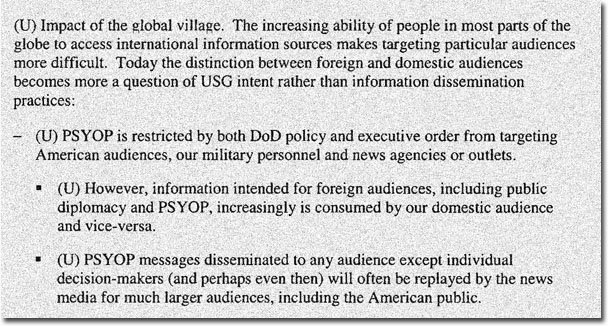
The Information Operations Roadmap is a document commissioned by the Pentagon in 2003 and personally approved by Secretary of Defense Donald Rumsfeld.
Read below adn then click on this link: http://www.gwu.edu/~nsarchiv/NSAEBB/NSAEBB177/index.htm
The document was declassified in January 2006 and describes the United States Military's approach to information warfare, with an emphasis on the Internet
Although "information intended for foreign audiences, including public diplomacy and PSYOP, increasingly is consumed by our domestic audience and vice-versa," the document observes that "the distinction between foreign and domestic audiences becomes more a question of USG [U.S. government] intent rather than information dissemination practices."[1]
Kristin Adair reported:
The Roadmap presents as one of its key assumptions the importance of Psychological Operations (PSYOP), particularly in wartime: "Effectively communicating U.S. Government (USG) capabilities and intentions is an important means of combating the plans of our adversaries.[1]
and:
The document calls on DoD to enhance its capabilities in five key Information Operations (IO) areas: electronic warfare (EW), PSYOP, Operations Security (OPSEC), military deception and computer network operations (CNO).[1]
An article by the BBC states:
The operations described in the document include a surprising range of military activities: public affairs officers who brief journalists, psychological operations troops who try to manipulate the thoughts and beliefs of an enemy, computer network attack specialists who seek to destroy enemy networks.[3]
The document acknowledges the Smith-Mundt Act, adopted in 1948, which explicitly forbids information and psychological operations aimed at the US public, but fails to offer any way of limiting the effect this program has on domestic audiences.[1][3]
The document states the internet can be used as weapon system by opposing forces, with its rapid growth it is becoming harder to defend:
"Strategy should be based on the premise that the Department [of Defense] will 'fight the net' as it would an enemy weapons system ... Networks are growing faster than we can defend them... Attack sophistication is increasing... Number of events is increasing."[3]
One of the stated goals of improving network and electro-magnetic attack capabilities is:
To prevail in an information-centric fight, its increasingly important that our forces dominate the electromagnetic spectrum with attack capabilities"
02 August 2006
Ideas to Ponder
"The more we do to you, the less you seem to believe we are doing it."
-Joseph Mengele
"I know that today denouncers are appearing, almost a pile of them, complaining about someone or another, mostly from envy, since they perhaps want to have someone’s job, or because they do not like someone. People are ostracized, gossiped about, or denounced. People’s comrades, he who denounces someone else reveals his true character. He who openly says: “I accuse” will be listened to, but he must be willing to stand by his accusation. Denouncers are those who carry on their filthy business at night, with anonymous letters with the worst sort of accusations. Mostly, this consists of lies. We must keep our state and our people pure. Anyone has the right to make an accusation, but if his charges are false, if they are lies, the laws of libel apply. If we follow this guideline, I am sure that this law will be a blessing four our people despite all the difficulties."
-Hermann Göring, "Nationalismus und Sozialismus: Rede auf der NSBO. im Berliner Sportpalast am 9. April 1933," Hermann Göring: Reden und Aufsätze (Munich: Zentralverlag der NSDAP, 1941), pp. 36-49.
"What difference does it make to the dead, the orphans, and the homeless, whether the mad destruction is wrought under the name of totalitarianism or the holy name of liberty and democracy?"
-Mahatma Mohandas K. Gandhi
"People are tired of liberty. They have had a surfeit of it. Liberty is no longer a chaste and austere virgin…. Today’s youth are moved by other slogans…Order, Hierarchy, Discipline."
-Benito Mussolini
“Would you rather have butter or guns? Preparedness makes us powerful. Butter merely makes us fat.”
--Hermann Göring
"War is an ugly thing but not the ugliest of things; the decayed and degraded state of moral and patriotic feelings which thinks that nothing is worth war is much worse. A man who has nothing for which he is willing to fight, nothing which is more important than his own personal safety, is a miserable creature and has no chance of being free unless made and kept so by the exertions of better men than himself."
-John Stuart Mill
“Shoot first and ask questions later, and don't worry, no matter what happens, I will protect you.”
-Hermann Goering (1893-1946)
"“The most brilliant propagandist technique will yield no success unless one fundamental principle is borne in mind constantly - it must confine itself to a few points and repeat them over and over”"
-Joseph Goebbels
"The only freedom deserving the name, is that of pursuing our own good in our own way, so long as we do not attempt to deprive others of theirs, or impede their efforts to obtain it. Each is the proper guardian of his own health, whether bodily, or mental and spiritual. Mankind are greater gainers by suffering each other to live as seems good to themselves, than by compelling each to live as seems good to the rest."
-John Stuart Mill
"Truth resides in every human heart, and one has to search for it there, and to be guided by truth as one sees it. But no one has a right to coerce others to act according to his own view of truth."
"Protection, therefore, against the tyranny of the magistrate is not enough; there needs protection against the tyranny of the prevailing opinion and feeling, against the tendency of society to impose, by other means than civil penalties, its own ideas and practices as rules of conduct on those who dissent from them."
-John Stuart Mill
“Think of the press as a great keyboard on which the government can play.”
Joseph Goebbels
""During a war, news should be given out for instruction rather than information."
-Joseph Goebbels
"It is the absolute right of the state to supervise the formation of public opinion."
-Joseph Goebbels
"The size of the lie is a definite factor in causing it to be believed, for the vast masses of a nation are in the depths of their hearts more easily deceived than they are consciously and intentionally bad. The primitive simplicity of their minds renders them a more easy prey to a big lie than a small one, for they themselves often tell little lies, but would be ashamed to tell big lies."
(1889-1945)
"This year will go down in history. For the first time, a civilised nation has full gun registration! Our streets will be safer, our police more efficient, and the world will follow our lead into the future!"
"In relation to the political decontamination of our public life, the government will embark upon a systematic campaign to restore the nation’s moral and material health. The whole educational system, theater, film, literature, the press and broadcasting – all these will be used as a means to this end."
"All propaganda must be so popular and on such an intellectual level, that even the most stupid of those toward whom it is directed will understand it... Through clever and constant application of propaganda, people can be made to see paradise as hell, and also the other way around, to consider the most wretched sort of life as paradise."
"The efficiency of the truly national leader consists primarily in preventing the division of the attention of a people, and always in concentrating it on a single enemy."
-Joseph Mengele
"I know that today denouncers are appearing, almost a pile of them, complaining about someone or another, mostly from envy, since they perhaps want to have someone’s job, or because they do not like someone. People are ostracized, gossiped about, or denounced. People’s comrades, he who denounces someone else reveals his true character. He who openly says: “I accuse” will be listened to, but he must be willing to stand by his accusation. Denouncers are those who carry on their filthy business at night, with anonymous letters with the worst sort of accusations. Mostly, this consists of lies. We must keep our state and our people pure. Anyone has the right to make an accusation, but if his charges are false, if they are lies, the laws of libel apply. If we follow this guideline, I am sure that this law will be a blessing four our people despite all the difficulties."
-Hermann Göring, "Nationalismus und Sozialismus: Rede auf der NSBO. im Berliner Sportpalast am 9. April 1933," Hermann Göring: Reden und Aufsätze (Munich: Zentralverlag der NSDAP, 1941), pp. 36-49.
"What difference does it make to the dead, the orphans, and the homeless, whether the mad destruction is wrought under the name of totalitarianism or the holy name of liberty and democracy?"
-Mahatma Mohandas K. Gandhi
"People are tired of liberty. They have had a surfeit of it. Liberty is no longer a chaste and austere virgin…. Today’s youth are moved by other slogans…Order, Hierarchy, Discipline."
-Benito Mussolini
“Would you rather have butter or guns? Preparedness makes us powerful. Butter merely makes us fat.”
--Hermann Göring
"War is an ugly thing but not the ugliest of things; the decayed and degraded state of moral and patriotic feelings which thinks that nothing is worth war is much worse. A man who has nothing for which he is willing to fight, nothing which is more important than his own personal safety, is a miserable creature and has no chance of being free unless made and kept so by the exertions of better men than himself."
-John Stuart Mill
“Shoot first and ask questions later, and don't worry, no matter what happens, I will protect you.”
-Hermann Goering (1893-1946)
"“The most brilliant propagandist technique will yield no success unless one fundamental principle is borne in mind constantly - it must confine itself to a few points and repeat them over and over”"
-Joseph Goebbels
"The only freedom deserving the name, is that of pursuing our own good in our own way, so long as we do not attempt to deprive others of theirs, or impede their efforts to obtain it. Each is the proper guardian of his own health, whether bodily, or mental and spiritual. Mankind are greater gainers by suffering each other to live as seems good to themselves, than by compelling each to live as seems good to the rest."
-John Stuart Mill
"Truth resides in every human heart, and one has to search for it there, and to be guided by truth as one sees it. But no one has a right to coerce others to act according to his own view of truth."
"Protection, therefore, against the tyranny of the magistrate is not enough; there needs protection against the tyranny of the prevailing opinion and feeling, against the tendency of society to impose, by other means than civil penalties, its own ideas and practices as rules of conduct on those who dissent from them."
-John Stuart Mill
“Think of the press as a great keyboard on which the government can play.”
Joseph Goebbels
""During a war, news should be given out for instruction rather than information."
-Joseph Goebbels
"It is the absolute right of the state to supervise the formation of public opinion."
-Joseph Goebbels
"The size of the lie is a definite factor in causing it to be believed, for the vast masses of a nation are in the depths of their hearts more easily deceived than they are consciously and intentionally bad. The primitive simplicity of their minds renders them a more easy prey to a big lie than a small one, for they themselves often tell little lies, but would be ashamed to tell big lies."
(1889-1945)
"This year will go down in history. For the first time, a civilised nation has full gun registration! Our streets will be safer, our police more efficient, and the world will follow our lead into the future!"
"In relation to the political decontamination of our public life, the government will embark upon a systematic campaign to restore the nation’s moral and material health. The whole educational system, theater, film, literature, the press and broadcasting – all these will be used as a means to this end."
"All propaganda must be so popular and on such an intellectual level, that even the most stupid of those toward whom it is directed will understand it... Through clever and constant application of propaganda, people can be made to see paradise as hell, and also the other way around, to consider the most wretched sort of life as paradise."
"The efficiency of the truly national leader consists primarily in preventing the division of the attention of a people, and always in concentrating it on a single enemy."
Patriotism vs. Nationalism
This was an intresting find I amde on a web search:
"There are many distinctions being blurred in America these days: Democracy and fascism. Church and state. News and propaganda. But perhaps the most far-reaching and easily blurred distinction that affects us all is the distinction between patriotism and nationalism. So that we're all on the same page, let's pretend this is an elementary school and get some definitions out there:
Patriotism
Love for or devotion to one's country
Nationalism
Loyalty and devotion to a nation; especially: a sense of national consciousness exalting one nation above all others and placing primary emphasis on promotion of its culture and interests as opposed to those of other nations or supranational groups
Seems to me like most people would be able to grasp the difference – that being patriotic means loving America, while being nationalistic places America, which can do no wrong, above other nations. The former is good. It's healthy. It promotes pride in one's nation. The latter, however, is not good. It's very unhealthy. It promotes arrogance to the point of hostility.
What everyone is missing is the slow but sure shift from a nation of predominantly patriots to one of predominantly nationalists. We've moved beyond a love of country to a love of this country – and no other. We've shifted from a respect for other nations, other cultures, other ways of being to a marked disrespect for anything not emanating from within the United States. And it's allowing us to be dragged, flags waving, into the next national crisis.
The key difference, to me, between patriotism and nationalism is basis for feeling. Patriots feel how they do because they love America and they hope for its success. Nationalists, on the other hand, feel how they do because they love America, but they fear for its failure. They fear, as Casey so wonderfully put it, progression – progression, to them, is regression – and often wish for a return to a mythical "older time" that only existed for about 15 minutes shortly after World War II.
Patriotism is nuanced, complex; nationalism is not.
I, for instance, am a patriot. I love America. I also cherish and respect other nations, cultures and ideas from around the world, but I'd love to see America do well in the global community. People like Sen. Dick Durbin are patriots, too. He loves this country as much as any Republican claims to, but it pains him to see that his nation isn't more dissimilar from Stalinist Russia or Hitler's Germany. He and I and many others love America, so it especially stings when we find the problems we work so hard to combat cropping up in our own behavior. We would never want to leave at the first sign of trouble; we are more likely to stay and try to fix what troubles us. We love America like parents love their children: We look after them and champion their achievements, but aren't afraid to step in and practice tough love, fixing their mistakes.
Nationalists love America, too, but they love it like young children love their parents. Mommy and Daddy are always right, can do no wrong and are the best parents ever. This "my dad can beat up your dad" mentality causes nationalists to ignore America's bumps and bruises, blaming others for our problems. Nationalism leads people like Scott McClellan to refuse to work with Rep. John Conyers because of how he voted on the war. It causes people like Chris Wallace to defend our actions in Guantanamo Bay, citing other regimes' more outrageous abuses. And it causes people like President Bush and Vice President Cheney to scapegoat Amnesty International, hiding our own malfeasance behind crass jingoism. Suddenly, patriots find themselves being blamed for "defending terrorists" and "supporting our enemies," when all we're trying to do is defend America from itself, fixing its problems.
Patriotism is rational; nationalism is not.
Being a true patriot is a difficult endeavor these days. Applying logic and careful thought to our current affairs has become, in many peoples' eyes, problematic and evidence that we – not they – "hate America." Patriots love America, though they realize that the world is more complex than black and white, good and evil. This is not a true-or-false world in which we live; it's an essay question, one that requires much thought and demands due respect. Being patriotic is much harder than being nationalistic. If your side is always good and the other side is always bad, choosing and defending a course of action is obviously much easier. It's much easier to blame someone else for your problems than to take a hard look at yourself. It's much harder to do the patriotic thing, which is identifying the problem and finding a solution, than to do the nationalistic thing, which involves ignoring the problem entirely or finding someone – a scapegoat – to blame for it."
"There are many distinctions being blurred in America these days: Democracy and fascism. Church and state. News and propaganda. But perhaps the most far-reaching and easily blurred distinction that affects us all is the distinction between patriotism and nationalism. So that we're all on the same page, let's pretend this is an elementary school and get some definitions out there:
Patriotism
Love for or devotion to one's country
Nationalism
Loyalty and devotion to a nation; especially: a sense of national consciousness exalting one nation above all others and placing primary emphasis on promotion of its culture and interests as opposed to those of other nations or supranational groups
Seems to me like most people would be able to grasp the difference – that being patriotic means loving America, while being nationalistic places America, which can do no wrong, above other nations. The former is good. It's healthy. It promotes pride in one's nation. The latter, however, is not good. It's very unhealthy. It promotes arrogance to the point of hostility.
What everyone is missing is the slow but sure shift from a nation of predominantly patriots to one of predominantly nationalists. We've moved beyond a love of country to a love of this country – and no other. We've shifted from a respect for other nations, other cultures, other ways of being to a marked disrespect for anything not emanating from within the United States. And it's allowing us to be dragged, flags waving, into the next national crisis.
The key difference, to me, between patriotism and nationalism is basis for feeling. Patriots feel how they do because they love America and they hope for its success. Nationalists, on the other hand, feel how they do because they love America, but they fear for its failure. They fear, as Casey so wonderfully put it, progression – progression, to them, is regression – and often wish for a return to a mythical "older time" that only existed for about 15 minutes shortly after World War II.
Patriotism is nuanced, complex; nationalism is not.
I, for instance, am a patriot. I love America. I also cherish and respect other nations, cultures and ideas from around the world, but I'd love to see America do well in the global community. People like Sen. Dick Durbin are patriots, too. He loves this country as much as any Republican claims to, but it pains him to see that his nation isn't more dissimilar from Stalinist Russia or Hitler's Germany. He and I and many others love America, so it especially stings when we find the problems we work so hard to combat cropping up in our own behavior. We would never want to leave at the first sign of trouble; we are more likely to stay and try to fix what troubles us. We love America like parents love their children: We look after them and champion their achievements, but aren't afraid to step in and practice tough love, fixing their mistakes.
Nationalists love America, too, but they love it like young children love their parents. Mommy and Daddy are always right, can do no wrong and are the best parents ever. This "my dad can beat up your dad" mentality causes nationalists to ignore America's bumps and bruises, blaming others for our problems. Nationalism leads people like Scott McClellan to refuse to work with Rep. John Conyers because of how he voted on the war. It causes people like Chris Wallace to defend our actions in Guantanamo Bay, citing other regimes' more outrageous abuses. And it causes people like President Bush and Vice President Cheney to scapegoat Amnesty International, hiding our own malfeasance behind crass jingoism. Suddenly, patriots find themselves being blamed for "defending terrorists" and "supporting our enemies," when all we're trying to do is defend America from itself, fixing its problems.
Patriotism is rational; nationalism is not.
Being a true patriot is a difficult endeavor these days. Applying logic and careful thought to our current affairs has become, in many peoples' eyes, problematic and evidence that we – not they – "hate America." Patriots love America, though they realize that the world is more complex than black and white, good and evil. This is not a true-or-false world in which we live; it's an essay question, one that requires much thought and demands due respect. Being patriotic is much harder than being nationalistic. If your side is always good and the other side is always bad, choosing and defending a course of action is obviously much easier. It's much easier to blame someone else for your problems than to take a hard look at yourself. It's much harder to do the patriotic thing, which is identifying the problem and finding a solution, than to do the nationalistic thing, which involves ignoring the problem entirely or finding someone – a scapegoat – to blame for it."
27 July 2006
'Rapid response' targets bird flu
Southeast Asia
Jul 28, 2006
'Rapid response' targets bird flu
By Marwaan Macan-Markar
BANGKOK - With its 900,000-strong army of public health volunteers and its spending of more than US$250 million to help affected poultry farmers, Thailand was held up as a model for combating the spread of the deadly bird flu. But the avian influenza virus has proved it has many tricks under its wings.
This week saw Thailand's impressive record of remaining free of the H5N1 strain of the virus for more than seven months shattered by a virus that continues to remain resilient. Following reports in mid-July of a bird flu outbreak in the poultry population in thenorthern province of Pitchit came confirmation on Tuesday that a 17-year-old boy had died of the disease. It brings the human fatalities to 15 out of 23 reported human cases of bird flu in Thailand since 2004.
Elsewhere in Southeast Asia, this deadly virus is spreading in rural communities, with Indonesia being the worst hit. On July 20, Jakarta reported that a 44-year-old man had died of bird flu, making him the forty-second Indonesian to die from the virus due to close contact with contaminated poultry.
Indonesia now joins Vietnam as the two countries with the most human deaths from bird flu since the current outbreak began in the winter of 2003. But while Vietnam has brought bird flu under control - with no human fatalities reported this year - Indonesia offers a study in contrast. Thirty-one of the country's 42 bird flu deaths occurred since January.
Indonesia has also carved itself a niche for having the highest fatality rate of people reported with H5N1. It has recorded 54 cases of the disease, of which four-fifths have succumbed.
According to the World Health Organization (WHO), 134 people have died of bird flu since early 2004 out of 231 people affected. Azerbaijan has had five deaths, Cambodia six, China two, Egypt six, Iraq two and Turkey four. This is apart from 42 deaths in Vietnam and Indonesia and those in Thailand.
Consequently, in an attempt to prevent a spike in such fatalities - and lay the groundwork to respond to any sign of the virus being passed between humans, which could evolve into a global pandemic, killing millions - efforts are under way in Southeast Asia to strengthen the health responses in rural communities.
The blueprint the WHO and the US-based Center for Disease Control (CDC) have in mind are "rapid response teams" in local communities.
"Each team will be between five to seven people and will include medical and nursing staff with proper equipment," WHO epidemiologist Mark Simmerman told Inter Press Service. "They will be trained to follow new standards that places the focus on areas such as containment efforts to control the virus."
The first three days after a virus is reported is pivotal, he added. "A containment plan, including shutting down schools, will be important to slow the spread of the virus. A quick response is vital."
In Southeast Asia, such rapid response teams could number in the hundreds "or even one or two thousand as the program develops", Simmerman explained at the conclusion of training for public health experts from 13 countries that took place in Bangkok this month.
"This will take time to accomplish, for the aim is to build a link between the local teams, the national response teams and international health teams," said Anthony Mounts, who heads the international epidemiology team at the CDC. "The CDC is trying to improve lab facilities to help diagnose avian influenza locally."
Such upgrading of laboratory facilities will bring to an end to the prevailing pattern in some countries across the region that are affected by bird flu of having to send virus samples for testing abroad, he explained. "Time is a factor here. This will allow the specimens to be collected and transported to national labs for testing within 24 hours."
Aiding this effort is the CDC's plans to make available new technology in the local laboratories real-time PCR (polymerase chain reaction).
"The machine will amplify the genes once a chemical is added that reacts and identifies the avian influenza gene," Mounts said. "It allows you to take specimens from the field and do these tests quickly. You can have accurate answers in a very short time."
The attempt to upgrade the public health responses to avian influenza comes at a time when experts are also drawing attention to the challenges that arise when detecting the H5N1 virus.
"The diagnosis of H5N1 is extremely challenging," microbiologist Kevin Baird wrote this month in The Jakarta Post. "It requires highly skilled scientists equipped with very expensive gear and extremely carefully chosen reagents. Only two laboratories in Indonesia are capable of doing it reliably, and between the two of them they have examined about 400 people since the middle of last year."
At the same time, the past two-and-a-half years have served as a learning curve for Southeast Asia in as much as it lived with the threat of bird flu. The region's readiness to respond to a possible pandemic comes from "what we have learned from our responses to avian influenza", Tawat Suntharajan, director general of Thailand's department of disease control, said while training senior epidemiologists from the region.
(Inter Press Service)
Jul 28, 2006
'Rapid response' targets bird flu
By Marwaan Macan-Markar
BANGKOK - With its 900,000-strong army of public health volunteers and its spending of more than US$250 million to help affected poultry farmers, Thailand was held up as a model for combating the spread of the deadly bird flu. But the avian influenza virus has proved it has many tricks under its wings.
This week saw Thailand's impressive record of remaining free of the H5N1 strain of the virus for more than seven months shattered by a virus that continues to remain resilient. Following reports in mid-July of a bird flu outbreak in the poultry population in thenorthern province of Pitchit came confirmation on Tuesday that a 17-year-old boy had died of the disease. It brings the human fatalities to 15 out of 23 reported human cases of bird flu in Thailand since 2004.
Elsewhere in Southeast Asia, this deadly virus is spreading in rural communities, with Indonesia being the worst hit. On July 20, Jakarta reported that a 44-year-old man had died of bird flu, making him the forty-second Indonesian to die from the virus due to close contact with contaminated poultry.
Indonesia now joins Vietnam as the two countries with the most human deaths from bird flu since the current outbreak began in the winter of 2003. But while Vietnam has brought bird flu under control - with no human fatalities reported this year - Indonesia offers a study in contrast. Thirty-one of the country's 42 bird flu deaths occurred since January.
Indonesia has also carved itself a niche for having the highest fatality rate of people reported with H5N1. It has recorded 54 cases of the disease, of which four-fifths have succumbed.
According to the World Health Organization (WHO), 134 people have died of bird flu since early 2004 out of 231 people affected. Azerbaijan has had five deaths, Cambodia six, China two, Egypt six, Iraq two and Turkey four. This is apart from 42 deaths in Vietnam and Indonesia and those in Thailand.
Consequently, in an attempt to prevent a spike in such fatalities - and lay the groundwork to respond to any sign of the virus being passed between humans, which could evolve into a global pandemic, killing millions - efforts are under way in Southeast Asia to strengthen the health responses in rural communities.
The blueprint the WHO and the US-based Center for Disease Control (CDC) have in mind are "rapid response teams" in local communities.
"Each team will be between five to seven people and will include medical and nursing staff with proper equipment," WHO epidemiologist Mark Simmerman told Inter Press Service. "They will be trained to follow new standards that places the focus on areas such as containment efforts to control the virus."
The first three days after a virus is reported is pivotal, he added. "A containment plan, including shutting down schools, will be important to slow the spread of the virus. A quick response is vital."
In Southeast Asia, such rapid response teams could number in the hundreds "or even one or two thousand as the program develops", Simmerman explained at the conclusion of training for public health experts from 13 countries that took place in Bangkok this month.
"This will take time to accomplish, for the aim is to build a link between the local teams, the national response teams and international health teams," said Anthony Mounts, who heads the international epidemiology team at the CDC. "The CDC is trying to improve lab facilities to help diagnose avian influenza locally."
Such upgrading of laboratory facilities will bring to an end to the prevailing pattern in some countries across the region that are affected by bird flu of having to send virus samples for testing abroad, he explained. "Time is a factor here. This will allow the specimens to be collected and transported to national labs for testing within 24 hours."
Aiding this effort is the CDC's plans to make available new technology in the local laboratories real-time PCR (polymerase chain reaction).
"The machine will amplify the genes once a chemical is added that reacts and identifies the avian influenza gene," Mounts said. "It allows you to take specimens from the field and do these tests quickly. You can have accurate answers in a very short time."
The attempt to upgrade the public health responses to avian influenza comes at a time when experts are also drawing attention to the challenges that arise when detecting the H5N1 virus.
"The diagnosis of H5N1 is extremely challenging," microbiologist Kevin Baird wrote this month in The Jakarta Post. "It requires highly skilled scientists equipped with very expensive gear and extremely carefully chosen reagents. Only two laboratories in Indonesia are capable of doing it reliably, and between the two of them they have examined about 400 people since the middle of last year."
At the same time, the past two-and-a-half years have served as a learning curve for Southeast Asia in as much as it lived with the threat of bird flu. The region's readiness to respond to a possible pandemic comes from "what we have learned from our responses to avian influenza", Tawat Suntharajan, director general of Thailand's department of disease control, said while training senior epidemiologists from the region.
(Inter Press Service)
Suicide Killers
On July 15, MSNBC's "Connected" program discussed the July 7th London attacks.
One of the guests was Pierre Rehov, a French filmmaker who has filmed six documentaries on the intifada by going undercover in the Palestinian areas. Pierre's upcoming film, "Suicide Killers," is based on interviews that he conducted with the families of suicide bombers and would-be bombers in an attempt to find out why they do it. Pierre agreed to a request for a Q&A interview here about his work on the new film.
Q - What inspired you to produce "Suicide Killers," your seventh film?
A - I started working with victims of suicide attacks to make a film on PTSD (Post Traumatic Stress Disorder) when I became fascinated with the personalities of those who had committed those crimes, as they were described again and again by their victims. Especially the fact that suicide bombers are all smiling one second before they blow themselves up.
Q - Why is this film especially important?
A - People don't understand the devastating culture behind this unbelievable phenomenon. My film is not politically correct because it addresses the real problem, showing the real face of Islam. It points the finger against a culture of hatred in which the uneducated are brainwashed to a level where their only solution in life becomes to kill themselves and kill others in the name of a God whose word, as transmitted by other men, has become their only certitude.
Q - What insights did you gain from making this film? What do you know that other experts do not know?
A - I came to the conclusion that we are facing a neurosis at the level of an entire civilization. Most neuroses have in common a dramatic event, generally linked to an unacceptable sexual behavior. In this case, we are talking of kids living all their lives in pure frustration, with no opportunity to experience sex, love, tenderness or even understanding from the opposite sex. The separation between men and women in Islam is absolute. So is contempt toward women, who are totally dominated by men. This leads to a situation of pure anxiety, in which normal behavior is not possible. It is no coincidence that suicide killers are mostly young men dominated subconsciously by an overwhelming libido that they not only cannot satisfy but are afraid of, as if it is the work of the devil. Since Islam describes heaven as a place where everything on Earth will finally be allowed, and promises 72 virgins to those frustrated kids, killing others and killing themselves to reach this redemption becomes their only solution.
Q - What was it like to interview would-be suicide bombers, their families and survivors of suicide bombings?
A - It was a fascinating and a terrifying experience. You are dealing with seemingly normal people with very nice manners who have their own logic, which to a certain extent can make sense since they are so convinced that what they say is true. It is like dealing with pure craziness, like interviewing people in an asylum, since what they say, is for them, the absolute truth. I hear a mother saying "Thank God, my son is dead." Her son had became a shaheed, a martyr, which for her was a greater source of pride than if he had became an engineer, a doctor or a winner of the Nobel Prize. This system of values works completely backwards since their interpretation of Islam worships death much more than life. You are facing people whose only dream, only achievement goal is to fulfill what they believe to be their destiny, namely to be a Shaheed or the family of a shaheed. They don't see the innocent being killed, they only see the impure that they have to destroy.
Q - You say suicide bombers experience a moment of absolute power, beyond punishment. Is death the ultimate power?
A - Not death as an end, but death as a door opener to the after life. They are seeking the reward that God has promised them. They work for God, the ultimate authority, above all human laws. They therefore experience this single delusional second of absolute power, where nothing bad can ever happen to them, since they become God's sword.
Q - Is there a suicide bomber personality profile? Describe the psychopathology.
A - Generally kids between 15 and 25 bearing a lot of complexes, generally inferiority complexes. They must have been fed with religion. They usually have a lack of developed personality. Usually they are impressionable idealists. In the western world they would easily have become drug addicts, but not criminals. Interestingly, they are not criminals since they don't see good and evil the same way that we do. If they had been raised in an Occidental culture, they would have hated violence. But they constantly battle against their own death anxiety. The only solution to this deep-seated pathology is to be willing to die and be rewarded in the afterlife in Paradise.
Q - Are suicide bombers principally motivated by religious conviction?
A - Yes, it is their only conviction. They don't act to gain a territory or to find freedom or even dignity. They only follow Allah, the supreme judge, and what He tells them to do.
Q - Do all Muslims interpret jihad and martyrdom in the same way?
A - All Muslim believers believe that, ultimately, Islam will prevail on earth.They believe this is the only true religion and there is no room, in their mind, for interpretation. The main difference between moderate Muslims and extremists is that moderate Muslims don't think they will see the absolute victory of Islam during their lifetime, therefore they respect other beliefs. The extremists believe that the fulfillment of the Prophecy of Islam and ruling the entire world as described in the Koran, is for today. Each victory of Bin Laden convinces 20 million moderate Muslims to become extremists.
Q - Describe the culture that manufactures suicide bombers.
A - Oppression, lack of freedom, brain washing, organized poverty, placing God in charge of daily life, total separation between men and women, forbidding sex, giving women no power whatsoever, and placing men in charge of family honor, which is mainly connected to their women's behavior.
Q - What socio-economic forces support the perpetuation of suicide bombings?
A - Muslim charity is usually a cover for supporting terrorist organizations. But one has also to look at countries like Pakistan, Saudi Arabia and Iran, which are also supporting the same organizations through different networks. The ironic thing in the case of Palestinian suicide bombers is that most of the money comes through financial support from the Occidental world, donated to a culture that utterly hates and rejects the West (mainly symbolized by Israel).
Q - Is there a financial support network for the families of the suicide bombers? If so, who is paying them and how does that affect the decision?
A - There used to be a financial incentive in the days of Saddam Hussein ($25,000 per family) and Yasser Arafat (smaller amounts), but these days are gone. It is a mistake to believe that these families would sacrifice their children for money. Although, the children themselves who are very attached to their families, might find in this financial support another reason to become suicide bombers. It is like buying a life insurance policy and then committing suicide.
Q - Why are so many suicide bombers young men?
A - As discussed above, libido is paramount. Also ego, because this is a sure way to become a hero. The shaheeds are the cowboys or the firemen of Islam. Shaheed is a positively reinforced value in this culture. And what kid has never dreamed of becoming a cowboy or a fireman?
Q - What role does the U.N. play in the terrorist equation?
A - The U.N. is in the hands of Arab countries and third world or ex-communist countries. Their hands are tied. The U.N. has condemned Israel more than any other country in the world, including the regime of Castro, Idi Amin or Kaddahfi. By behaving this way, the U.N. leaves a door open by not openly condemning terrorist organizations. In addition, through UNRWA, the U.N. is directly tied to terror organizations such as Hamas, representing 65 percent of their apparatus in the so-called Palestinian refugee camps. As a support to Arab countries, the U.N. has maintained Palestinians in camps with the hope to "return" into Israel for more than 50 years, therefore making it impossible to settle those populations, which still live in deplorable conditions. Four hundred million dollars are spent every year, mainly financed by U.S. taxes, to support 23,000 employees of UNRWA, many of whom belong to terrorist organizations (see Congressman Eric Cantor on this subject, and in my film "Hostages of Hatred").
Q - You say that a suicide bomber is a 'stupid bomb and a smart bomb' simultaneously. Explain what you mean.
A - Unlike an electronic device, a suicide killer has until the last second the capacity to change his mind. In reality, he is nothing but a platform representing interests which are not his, but he doesn't know it.
Q - How can we put an end to the madness of suicide bombings and terrorism in general?
A - Stop being politically correct and stop believing that this culture is a victim of ours. Radical Islamism today is nothing but a new form of Naziism. Nobody was trying to justify or excuse Hitler in the 1930s. We had to defeat him in order to make peace one day with the German people.
Q - Are these men traveling outside their native areas in large numbers? Based on your research, would you predict that we are beginning to see a new wave of suicide bombers outside the Middle East?
A - Every successful terror attack is considered a victory by the radical Islamists. Everywhere Islam expands there is regional conflict. Right now, there are thousands of candidates for martyrdom lining up in training camps in Bosnia, Afghanistan and Pakistan. Inside Europe, hundreds of illegal mosques are preparing the next step of brain washing to lost young men who cannot find a satisfying identity in the Occidental world. Israel is much more prepared for this than the rest of the world will ever be. Yes, there will be more suicide killings in Europe and the U.S. Sadly, this is only the beginning.
One of the guests was Pierre Rehov, a French filmmaker who has filmed six documentaries on the intifada by going undercover in the Palestinian areas. Pierre's upcoming film, "Suicide Killers," is based on interviews that he conducted with the families of suicide bombers and would-be bombers in an attempt to find out why they do it. Pierre agreed to a request for a Q&A interview here about his work on the new film.
Q - What inspired you to produce "Suicide Killers," your seventh film?
A - I started working with victims of suicide attacks to make a film on PTSD (Post Traumatic Stress Disorder) when I became fascinated with the personalities of those who had committed those crimes, as they were described again and again by their victims. Especially the fact that suicide bombers are all smiling one second before they blow themselves up.
Q - Why is this film especially important?
A - People don't understand the devastating culture behind this unbelievable phenomenon. My film is not politically correct because it addresses the real problem, showing the real face of Islam. It points the finger against a culture of hatred in which the uneducated are brainwashed to a level where their only solution in life becomes to kill themselves and kill others in the name of a God whose word, as transmitted by other men, has become their only certitude.
Q - What insights did you gain from making this film? What do you know that other experts do not know?
A - I came to the conclusion that we are facing a neurosis at the level of an entire civilization. Most neuroses have in common a dramatic event, generally linked to an unacceptable sexual behavior. In this case, we are talking of kids living all their lives in pure frustration, with no opportunity to experience sex, love, tenderness or even understanding from the opposite sex. The separation between men and women in Islam is absolute. So is contempt toward women, who are totally dominated by men. This leads to a situation of pure anxiety, in which normal behavior is not possible. It is no coincidence that suicide killers are mostly young men dominated subconsciously by an overwhelming libido that they not only cannot satisfy but are afraid of, as if it is the work of the devil. Since Islam describes heaven as a place where everything on Earth will finally be allowed, and promises 72 virgins to those frustrated kids, killing others and killing themselves to reach this redemption becomes their only solution.
Q - What was it like to interview would-be suicide bombers, their families and survivors of suicide bombings?
A - It was a fascinating and a terrifying experience. You are dealing with seemingly normal people with very nice manners who have their own logic, which to a certain extent can make sense since they are so convinced that what they say is true. It is like dealing with pure craziness, like interviewing people in an asylum, since what they say, is for them, the absolute truth. I hear a mother saying "Thank God, my son is dead." Her son had became a shaheed, a martyr, which for her was a greater source of pride than if he had became an engineer, a doctor or a winner of the Nobel Prize. This system of values works completely backwards since their interpretation of Islam worships death much more than life. You are facing people whose only dream, only achievement goal is to fulfill what they believe to be their destiny, namely to be a Shaheed or the family of a shaheed. They don't see the innocent being killed, they only see the impure that they have to destroy.
Q - You say suicide bombers experience a moment of absolute power, beyond punishment. Is death the ultimate power?
A - Not death as an end, but death as a door opener to the after life. They are seeking the reward that God has promised them. They work for God, the ultimate authority, above all human laws. They therefore experience this single delusional second of absolute power, where nothing bad can ever happen to them, since they become God's sword.
Q - Is there a suicide bomber personality profile? Describe the psychopathology.
A - Generally kids between 15 and 25 bearing a lot of complexes, generally inferiority complexes. They must have been fed with religion. They usually have a lack of developed personality. Usually they are impressionable idealists. In the western world they would easily have become drug addicts, but not criminals. Interestingly, they are not criminals since they don't see good and evil the same way that we do. If they had been raised in an Occidental culture, they would have hated violence. But they constantly battle against their own death anxiety. The only solution to this deep-seated pathology is to be willing to die and be rewarded in the afterlife in Paradise.
Q - Are suicide bombers principally motivated by religious conviction?
A - Yes, it is their only conviction. They don't act to gain a territory or to find freedom or even dignity. They only follow Allah, the supreme judge, and what He tells them to do.
Q - Do all Muslims interpret jihad and martyrdom in the same way?
A - All Muslim believers believe that, ultimately, Islam will prevail on earth.They believe this is the only true religion and there is no room, in their mind, for interpretation. The main difference between moderate Muslims and extremists is that moderate Muslims don't think they will see the absolute victory of Islam during their lifetime, therefore they respect other beliefs. The extremists believe that the fulfillment of the Prophecy of Islam and ruling the entire world as described in the Koran, is for today. Each victory of Bin Laden convinces 20 million moderate Muslims to become extremists.
Q - Describe the culture that manufactures suicide bombers.
A - Oppression, lack of freedom, brain washing, organized poverty, placing God in charge of daily life, total separation between men and women, forbidding sex, giving women no power whatsoever, and placing men in charge of family honor, which is mainly connected to their women's behavior.
Q - What socio-economic forces support the perpetuation of suicide bombings?
A - Muslim charity is usually a cover for supporting terrorist organizations. But one has also to look at countries like Pakistan, Saudi Arabia and Iran, which are also supporting the same organizations through different networks. The ironic thing in the case of Palestinian suicide bombers is that most of the money comes through financial support from the Occidental world, donated to a culture that utterly hates and rejects the West (mainly symbolized by Israel).
Q - Is there a financial support network for the families of the suicide bombers? If so, who is paying them and how does that affect the decision?
A - There used to be a financial incentive in the days of Saddam Hussein ($25,000 per family) and Yasser Arafat (smaller amounts), but these days are gone. It is a mistake to believe that these families would sacrifice their children for money. Although, the children themselves who are very attached to their families, might find in this financial support another reason to become suicide bombers. It is like buying a life insurance policy and then committing suicide.
Q - Why are so many suicide bombers young men?
A - As discussed above, libido is paramount. Also ego, because this is a sure way to become a hero. The shaheeds are the cowboys or the firemen of Islam. Shaheed is a positively reinforced value in this culture. And what kid has never dreamed of becoming a cowboy or a fireman?
Q - What role does the U.N. play in the terrorist equation?
A - The U.N. is in the hands of Arab countries and third world or ex-communist countries. Their hands are tied. The U.N. has condemned Israel more than any other country in the world, including the regime of Castro, Idi Amin or Kaddahfi. By behaving this way, the U.N. leaves a door open by not openly condemning terrorist organizations. In addition, through UNRWA, the U.N. is directly tied to terror organizations such as Hamas, representing 65 percent of their apparatus in the so-called Palestinian refugee camps. As a support to Arab countries, the U.N. has maintained Palestinians in camps with the hope to "return" into Israel for more than 50 years, therefore making it impossible to settle those populations, which still live in deplorable conditions. Four hundred million dollars are spent every year, mainly financed by U.S. taxes, to support 23,000 employees of UNRWA, many of whom belong to terrorist organizations (see Congressman Eric Cantor on this subject, and in my film "Hostages of Hatred").
Q - You say that a suicide bomber is a 'stupid bomb and a smart bomb' simultaneously. Explain what you mean.
A - Unlike an electronic device, a suicide killer has until the last second the capacity to change his mind. In reality, he is nothing but a platform representing interests which are not his, but he doesn't know it.
Q - How can we put an end to the madness of suicide bombings and terrorism in general?
A - Stop being politically correct and stop believing that this culture is a victim of ours. Radical Islamism today is nothing but a new form of Naziism. Nobody was trying to justify or excuse Hitler in the 1930s. We had to defeat him in order to make peace one day with the German people.
Q - Are these men traveling outside their native areas in large numbers? Based on your research, would you predict that we are beginning to see a new wave of suicide bombers outside the Middle East?
A - Every successful terror attack is considered a victory by the radical Islamists. Everywhere Islam expands there is regional conflict. Right now, there are thousands of candidates for martyrdom lining up in training camps in Bosnia, Afghanistan and Pakistan. Inside Europe, hundreds of illegal mosques are preparing the next step of brain washing to lost young men who cannot find a satisfying identity in the Occidental world. Israel is much more prepared for this than the rest of the world will ever be. Yes, there will be more suicide killings in Europe and the U.S. Sadly, this is only the beginning.
25 July 2006
Viet Nam Thoughts
Below is an email I recently recieved from a friend of mine:
Hi Bernie:
My trip to SE Asia was great. I stayed in Ho Chi Minh City the entire 10 days. The talk on the street is that VN will join the WTO this year. Also, few locals believe the New Government will institute democratic reforms. Instead, it is business as usual. There are 3 million party members controlling 85 million people. The party members enjoy great privilege and wealth at the expense of the people. Hanoi is giving lip service to humanitarian reforms and religious freedoms to gain favor with the US for our support of their WTO membership. Strategically, the US will lend support to VN as a countervailing force to China in the Region. I suppose it makes since to do this, but I am discouraged by the US’ continued support of countries that deny human rights and freedom. The old adage, garbage in—garbage out, comes to mind. The US trade with China and other totalitarian countries says much about our morals. For example, while we preach freedom of religion, freedom of speech, freedom to assembly, and human rights, we simultaneously support regimes that deny the very foundations of our freedoms. In so doing, we empower these counties to suppress their people. What does this say about us?
Frank
Hi Bernie:
My trip to SE Asia was great. I stayed in Ho Chi Minh City the entire 10 days. The talk on the street is that VN will join the WTO this year. Also, few locals believe the New Government will institute democratic reforms. Instead, it is business as usual. There are 3 million party members controlling 85 million people. The party members enjoy great privilege and wealth at the expense of the people. Hanoi is giving lip service to humanitarian reforms and religious freedoms to gain favor with the US for our support of their WTO membership. Strategically, the US will lend support to VN as a countervailing force to China in the Region. I suppose it makes since to do this, but I am discouraged by the US’ continued support of countries that deny human rights and freedom. The old adage, garbage in—garbage out, comes to mind. The US trade with China and other totalitarian countries says much about our morals. For example, while we preach freedom of religion, freedom of speech, freedom to assembly, and human rights, we simultaneously support regimes that deny the very foundations of our freedoms. In so doing, we empower these counties to suppress their people. What does this say about us?
Frank
War Thoughts
"Never, never, never believe any war will be smooth and easy, or that anyone who embarks on the strange voyage can measure the tides and hurricanes he will encounter. The statesman who yields to war fever must realize that once the signal is given, he is no longer the master of policy but the slave of unforeseeable and uncontrollable events."
-Sir Winston Churchill (1874 - 1965)
"Politics is war without bloodshed while war is politics with bloodshed."
-Mao Tse-Tung (1893 - 1976)
"The way to win an atomic war is to make certain it never starts."
Omar Bradley (1893 - 1981), Speech to Boston Chamber of Commerce, 1948
"What difference does it make to the dead, the orphans and the homeless, whether the mad destruction is wrought under the name of totalitarianism or the holy name of liberty or democracy?"
-Mahatma Gandhi (1869 - 1948), "Non-Violence in Peace and War"
"War is an ugly thing, but not the ugliest of things. The decayed and degraded state of moral and patriotic feeling which thinks that nothing is worth war is much worse. The person who has nothing for which he is willing to fight, nothing which is more important than his own personal safety, is a miserable creature and has no chance of being free unless made and kept so by the exertions of better men than himself."
-John Stuart Mill (1806 - 1873)
"It is well that war is so terrible, or we should grow too fond of it."
-Robert E. Lee (1807 - 1870)
""Every gun that is made, every warship launched, every rocket fired signifies, in the final sense, a theft from those who hunger and are not fed, those who are cold and are not clothed. This world in arms is not spending money alone. It is spending the sweat of its laborers, the genius of its scientists, the hopes of its children . . . Under the cloud of threatening war, it is humanity hanging from a cross of iron."
-Dwight D Eisenhower, from "The Chance for Peace" address delivered before the American Society of Newspaper Editors, April 16, 1953
""Why of course the people don't want war. Why should some poor slob on a farm want to risk his life in a war when the best he can get out of it is to come back to his farm in one piece? Naturally the common people don't want war: neither in Russia, nor in England, nor for that matter in Germany. That is understood. But, after all, it is the leaders of the country who determine the policy and it is always a simple matter to drag the people along, whether it is a democracy, or a fascist dictatorship, or a parliament, or a communist dictatorship. Voice or no voice, the people can always be brought to the bidding of the leaders. That is easy. All you have to do is tell them they are being attacked, and denounce the peacemakers for lack of patriotism and exposing the country to danger. It works the same in any country."
-Hermann Goering
-Sir Winston Churchill (1874 - 1965)
"Politics is war without bloodshed while war is politics with bloodshed."
-Mao Tse-Tung (1893 - 1976)
"The way to win an atomic war is to make certain it never starts."
Omar Bradley (1893 - 1981), Speech to Boston Chamber of Commerce, 1948
"What difference does it make to the dead, the orphans and the homeless, whether the mad destruction is wrought under the name of totalitarianism or the holy name of liberty or democracy?"
-Mahatma Gandhi (1869 - 1948), "Non-Violence in Peace and War"
"War is an ugly thing, but not the ugliest of things. The decayed and degraded state of moral and patriotic feeling which thinks that nothing is worth war is much worse. The person who has nothing for which he is willing to fight, nothing which is more important than his own personal safety, is a miserable creature and has no chance of being free unless made and kept so by the exertions of better men than himself."
-John Stuart Mill (1806 - 1873)
"It is well that war is so terrible, or we should grow too fond of it."
-Robert E. Lee (1807 - 1870)
""Every gun that is made, every warship launched, every rocket fired signifies, in the final sense, a theft from those who hunger and are not fed, those who are cold and are not clothed. This world in arms is not spending money alone. It is spending the sweat of its laborers, the genius of its scientists, the hopes of its children . . . Under the cloud of threatening war, it is humanity hanging from a cross of iron."
-Dwight D Eisenhower, from "The Chance for Peace" address delivered before the American Society of Newspaper Editors, April 16, 1953
""Why of course the people don't want war. Why should some poor slob on a farm want to risk his life in a war when the best he can get out of it is to come back to his farm in one piece? Naturally the common people don't want war: neither in Russia, nor in England, nor for that matter in Germany. That is understood. But, after all, it is the leaders of the country who determine the policy and it is always a simple matter to drag the people along, whether it is a democracy, or a fascist dictatorship, or a parliament, or a communist dictatorship. Voice or no voice, the people can always be brought to the bidding of the leaders. That is easy. All you have to do is tell them they are being attacked, and denounce the peacemakers for lack of patriotism and exposing the country to danger. It works the same in any country."
-Hermann Goering
All Cell phones are equal
It was a bright cold day in April, and the clocks were striking thirteen.
-George Orwell, "1984", first sentence
Today's cell phone system argues for retaining network neutrality
Friday July 21, 2006 (08:00 PM GMT)
By: James Glass
For now, Internet service providers are prohibited from discriminating against connections to particular sites on the Internet: they are required to treat traffic to Google exactly the same as traffic to Yahoo! or MSN. This principle of equality is called "network neutrality." However, large telecommunication companies are lobbying congress to scrap the network neutrality rules that have been in place since the birth of the Internet. We don't have to look far to see why this is a bad idea.
Net neutrality proponents foretell a grim future for the Internet if net neutrality is scrapped: one where technology stagnates because of high entry barriers and one where a small oligarchy controls what consumers can and cannot experience. Those who want to eliminate neutrality dismiss this as alarmist, and claim that net neutrality would remove the incentive for broadband providers to build the next generation of Internet infrastructure, which all agree is sorely needed in the US.
With such wildly divergent ideas about the effects of a simple policy, wouldn't it be nice if history provided some guidance from which to evaluate these claims?
It turns out that we have a privately owned and controlled network all around us, one that closely mirrors the technical functionality of the Internet, but where there has never been a requirement for net neutrality: the US cellular phone network.
Almost all cell phones sold in the developed world have the ability to send and receive SMS (short message service) text messages. SMS is gaining popularity in the US, but only as a way to send quick messages to friends. So why aren't there a wealth of amazing and interactive services available for mobile devices? Why is there no MySpace, Craigslist, Amazon, Flikr, or eBay accessible through this network? Why are cell phone payment systems and email systems nearly nonexistent? Why haven't charities raised money or awareness of their causes through this system?
It's simple. Because the cell phone carriers control what services are allowed to use their networks. There is no net neutrality on the cell phone network.
Imagine you want to create a user-moderated news service like digg.com that operates on SMS. On the neutral Internet, you rent a Web server ($7-$100 per month to start), register your name, and start programming. Total time required: less then two hours in most cases. But getting a service on the non-neutral US cell phone network would be a little different:
The first step would be to contact a company known as an aggregator. This company manages your relationships with the cell phone carriers -- and that's carriers, plural, because making an agreement with just one carrier ensures that your service will fail because it cannot effectively spread via word of mouth. The first requirement from an aggregator is a service charge, which starts at $1,000 per month. Then, you must buy a shortcode (which kind of serves as your Web site name) for an additional $500-$1,000 per month. But you're not done.
The next step is satisfying the requirements of the cell phone companies. Many of these steps, such as requiring affirmative opt-in before a subscription can start, are not burdensome, and serve to protect the carriers' customers. Others, however, border on ludicrous. Requirements vary by carrier, but some prohibit operators from offering games or sweepstakes, or require that subscription periods can only be monthly: not daily, weekly, or yearly. Others require that content, such as ringtones, be locked so users can't forward them from their phones to their friends' phones.
Other requirements are outright offensive: as of this writing, Cingular, Sprint/Nextel, T-Mobile and Verizon all prohibit charities from raising money though their Premium SMS services. Too bad for the United Way, Greenpeace, and the Red Cross.
Some carriers also have "decency" restrictions that are so silly and restrictive that they make the production code that governed movies between 1934 and 1967 seem quaint. Verizon is the worst offender in this case: It prohibits dating services, images that are suggestive (the same images would be acceptable if aired on prime-time network TV), and any use of "crude" words, including such shockers as "fornicate" and "genital."
After you make your application compliant to the carriers' requirements, you wait weeks or months for the carriers to approve it, and jump through more hoops if they reject your application, which they can do for any or no reason.
In practical terms, you'd never get approval for your brand new peer-mediated news service. Even if you were able to set up filters to block images and bad words, you'd still be sunk: Verizon prohibits "un-moderated chatting, flirting and/or peer-to-peer communication services."
Even if you could slip your service past the censors, you would already have been set back eight weeks and many thousands of dollars -- and this is just the beginning. Next, the carrier will charge you a fee (a few cents, typically) for every message you send to your users, and charge your users to receive your messages -- and charge them to send you messages. Just imagine where craigslist.org would be if it had to pay a few cents every time someone browsed an ad, and you had to pay as well. It's no wonder SMS services are overpriced and haven't grown beyond a niche market for ringtones and horoscopes.
This sad state of affairs is what lies in wait if we let commercial interests take control of the Internet. Expect the same type of behavior from AT&T, Comcast, and the rest of the oligarchs. It doesn't take much imagination to imagine Verizon treating their Internet property just like their cell phone network -- short-sightedly milking it for all it's worth, at great expense to the public, and to the future.
James Glass (not his real name) is the owner of a company currently trying to navigate the minefield of running a third-party service on the cell phone networks. He is writing the article pseudonymously because the cell phone companies have the power and freedom to crush his company by blocking it from their networks.
"All animals are equal but some animals are more equal than others."
George Orwell, "Animal Farm"
-George Orwell, "1984", first sentence
Today's cell phone system argues for retaining network neutrality
Friday July 21, 2006 (08:00 PM GMT)
By: James Glass
For now, Internet service providers are prohibited from discriminating against connections to particular sites on the Internet: they are required to treat traffic to Google exactly the same as traffic to Yahoo! or MSN. This principle of equality is called "network neutrality." However, large telecommunication companies are lobbying congress to scrap the network neutrality rules that have been in place since the birth of the Internet. We don't have to look far to see why this is a bad idea.
Net neutrality proponents foretell a grim future for the Internet if net neutrality is scrapped: one where technology stagnates because of high entry barriers and one where a small oligarchy controls what consumers can and cannot experience. Those who want to eliminate neutrality dismiss this as alarmist, and claim that net neutrality would remove the incentive for broadband providers to build the next generation of Internet infrastructure, which all agree is sorely needed in the US.
With such wildly divergent ideas about the effects of a simple policy, wouldn't it be nice if history provided some guidance from which to evaluate these claims?
It turns out that we have a privately owned and controlled network all around us, one that closely mirrors the technical functionality of the Internet, but where there has never been a requirement for net neutrality: the US cellular phone network.
Almost all cell phones sold in the developed world have the ability to send and receive SMS (short message service) text messages. SMS is gaining popularity in the US, but only as a way to send quick messages to friends. So why aren't there a wealth of amazing and interactive services available for mobile devices? Why is there no MySpace, Craigslist, Amazon, Flikr, or eBay accessible through this network? Why are cell phone payment systems and email systems nearly nonexistent? Why haven't charities raised money or awareness of their causes through this system?
It's simple. Because the cell phone carriers control what services are allowed to use their networks. There is no net neutrality on the cell phone network.
Imagine you want to create a user-moderated news service like digg.com that operates on SMS. On the neutral Internet, you rent a Web server ($7-$100 per month to start), register your name, and start programming. Total time required: less then two hours in most cases. But getting a service on the non-neutral US cell phone network would be a little different:
The first step would be to contact a company known as an aggregator. This company manages your relationships with the cell phone carriers -- and that's carriers, plural, because making an agreement with just one carrier ensures that your service will fail because it cannot effectively spread via word of mouth. The first requirement from an aggregator is a service charge, which starts at $1,000 per month. Then, you must buy a shortcode (which kind of serves as your Web site name) for an additional $500-$1,000 per month. But you're not done.
The next step is satisfying the requirements of the cell phone companies. Many of these steps, such as requiring affirmative opt-in before a subscription can start, are not burdensome, and serve to protect the carriers' customers. Others, however, border on ludicrous. Requirements vary by carrier, but some prohibit operators from offering games or sweepstakes, or require that subscription periods can only be monthly: not daily, weekly, or yearly. Others require that content, such as ringtones, be locked so users can't forward them from their phones to their friends' phones.
Other requirements are outright offensive: as of this writing, Cingular, Sprint/Nextel, T-Mobile and Verizon all prohibit charities from raising money though their Premium SMS services. Too bad for the United Way, Greenpeace, and the Red Cross.
Some carriers also have "decency" restrictions that are so silly and restrictive that they make the production code that governed movies between 1934 and 1967 seem quaint. Verizon is the worst offender in this case: It prohibits dating services, images that are suggestive (the same images would be acceptable if aired on prime-time network TV), and any use of "crude" words, including such shockers as "fornicate" and "genital."
After you make your application compliant to the carriers' requirements, you wait weeks or months for the carriers to approve it, and jump through more hoops if they reject your application, which they can do for any or no reason.
In practical terms, you'd never get approval for your brand new peer-mediated news service. Even if you were able to set up filters to block images and bad words, you'd still be sunk: Verizon prohibits "un-moderated chatting, flirting and/or peer-to-peer communication services."
Even if you could slip your service past the censors, you would already have been set back eight weeks and many thousands of dollars -- and this is just the beginning. Next, the carrier will charge you a fee (a few cents, typically) for every message you send to your users, and charge your users to receive your messages -- and charge them to send you messages. Just imagine where craigslist.org would be if it had to pay a few cents every time someone browsed an ad, and you had to pay as well. It's no wonder SMS services are overpriced and haven't grown beyond a niche market for ringtones and horoscopes.
This sad state of affairs is what lies in wait if we let commercial interests take control of the Internet. Expect the same type of behavior from AT&T, Comcast, and the rest of the oligarchs. It doesn't take much imagination to imagine Verizon treating their Internet property just like their cell phone network -- short-sightedly milking it for all it's worth, at great expense to the public, and to the future.
James Glass (not his real name) is the owner of a company currently trying to navigate the minefield of running a third-party service on the cell phone networks. He is writing the article pseudonymously because the cell phone companies have the power and freedom to crush his company by blocking it from their networks.
"All animals are equal but some animals are more equal than others."
George Orwell, "Animal Farm"
17 July 2006
In full: Bush and Blair's unguarded chat
In full: Bush and Blair's unguarded chat
The Middle East crisis has caused a major headache for world leaders
A full transcript of the off-the-cuff conversation between US President George W Bush and UK Prime Minister Tony Blair during a break at the G8 conference in Russia.
The president was caught on tape using an expletive as he described the actions of Hezbollah in attacking Israel.
The two men start by discussing an exchange of gifts:
Updated: 9:43 a.m. ET July 17, 2006
Not realizing his remarks were being picked up by a microphone, President Bush bluntly expressed his frustration with Hezbollah, and his preference for diet Coke during the G-8 summit in St. Petersburg. Read a transcript of his comments:
Bush to Putin: I gotta leave by 2:15. They want me out of town so they can free up your security forces.
No, just going to make it up. I'm not going to talk too long like the rest of them. Some of these guys talk too long.
Gotta go home. Got something to do tonight. How about you? Where are you going home? This is your neighborhood doesn't take you long to get home.
You eight hours? Me too. Russia’s a big country and you’re a big country. Takes him eight hours to fly home. Not Coke, diet Coke. Russia’s big and so is China.
Yo, Blair. What are you doing? Are you leaving?
Blair: No, not yet. On this trade thing…
Bush: Yeah, I told that to (inaudible). If you want me to. I just want some movement. Yesterday I didn't see much movement. The desire to move.
Blair: It may be that it’s impossible.
Bush: I'll be glad to say. Who's introducing me?
Blair: Angela
Bush: Well tell her to call on it. Well, tell her to put me on the spot.
Thanks for the sweater; it was awfully thoughtful of you. I know you picked it out yourself.
Blair: Oh yes absolutely - in fact I knitted it!!!
(laughter)
Bush: What about Kofi Annan - he seems alright. I don't like his ceasefire plan. His attitude is basically ceasefire and everything sorts out.... But I think...
Blair: Yeah the only thing I think is really difficult is that we can't stop this without getting international presence agreed. I think what you guys have talked about which is the criticism of the [inaudible word). I am perfectly happy to try and see what the lie of the land is, but you need that done quickly because otherwise it will spiral.
Bush: Yeah I think Condi's [US Secretary of State Condoleezza Rice) gonna go soon.
Blair: Well that's all that matters but if you... You see at least it gets it going.
Bush: I agree it's a process...I told her your offer too.
Blair: Well it's only if she needs the ground prepared as it were. If she goes out she HAS to succeed whereas I can just go and...
Bush: You see the irony is what they need to is get Syria to get Hezbollah to stop doing this shit and it's all over...
Blair: Dunno... Syria....
Bush: Why?
Blair: Because I think this is all part of the same thing...
Bush: (with mouth full of bread) Yeah
Blair: Look - what does he think? He thinks if Lebanon turns out fine. If you get a solution in Israel and Palestine. Iraq goes in the right way
Bush: Yeah - he's [indistinct]
Blair: Yeah.... He's had it. That's what all this is about - it's the same with Iran
Bush: I felt like telling Kofi to call, to get on the phone to Assad and make something happen.
Blair: Yeah
BUSH: [indistinct] blaming Israel and [indistinct] blaming the Lebanese government....
The Middle East crisis has caused a major headache for world leaders
A full transcript of the off-the-cuff conversation between US President George W Bush and UK Prime Minister Tony Blair during a break at the G8 conference in Russia.
The president was caught on tape using an expletive as he described the actions of Hezbollah in attacking Israel.
The two men start by discussing an exchange of gifts:
Updated: 9:43 a.m. ET July 17, 2006
Not realizing his remarks were being picked up by a microphone, President Bush bluntly expressed his frustration with Hezbollah, and his preference for diet Coke during the G-8 summit in St. Petersburg. Read a transcript of his comments:
Bush to Putin: I gotta leave by 2:15. They want me out of town so they can free up your security forces.
No, just going to make it up. I'm not going to talk too long like the rest of them. Some of these guys talk too long.
Gotta go home. Got something to do tonight. How about you? Where are you going home? This is your neighborhood doesn't take you long to get home.
You eight hours? Me too. Russia’s a big country and you’re a big country. Takes him eight hours to fly home. Not Coke, diet Coke. Russia’s big and so is China.
Yo, Blair. What are you doing? Are you leaving?
Blair: No, not yet. On this trade thing…
Bush: Yeah, I told that to (inaudible). If you want me to. I just want some movement. Yesterday I didn't see much movement. The desire to move.
Blair: It may be that it’s impossible.
Bush: I'll be glad to say. Who's introducing me?
Blair: Angela
Bush: Well tell her to call on it. Well, tell her to put me on the spot.
Thanks for the sweater; it was awfully thoughtful of you. I know you picked it out yourself.
Blair: Oh yes absolutely - in fact I knitted it!!!
(laughter)
Bush: What about Kofi Annan - he seems alright. I don't like his ceasefire plan. His attitude is basically ceasefire and everything sorts out.... But I think...
Blair: Yeah the only thing I think is really difficult is that we can't stop this without getting international presence agreed. I think what you guys have talked about which is the criticism of the [inaudible word). I am perfectly happy to try and see what the lie of the land is, but you need that done quickly because otherwise it will spiral.
Bush: Yeah I think Condi's [US Secretary of State Condoleezza Rice) gonna go soon.
Blair: Well that's all that matters but if you... You see at least it gets it going.
Bush: I agree it's a process...I told her your offer too.
Blair: Well it's only if she needs the ground prepared as it were. If she goes out she HAS to succeed whereas I can just go and...
Bush: You see the irony is what they need to is get Syria to get Hezbollah to stop doing this shit and it's all over...
Blair: Dunno... Syria....
Bush: Why?
Blair: Because I think this is all part of the same thing...
Bush: (with mouth full of bread) Yeah
Blair: Look - what does he think? He thinks if Lebanon turns out fine. If you get a solution in Israel and Palestine. Iraq goes in the right way
Bush: Yeah - he's [indistinct]
Blair: Yeah.... He's had it. That's what all this is about - it's the same with Iran
Bush: I felt like telling Kofi to call, to get on the phone to Assad and make something happen.
Blair: Yeah
BUSH: [indistinct] blaming Israel and [indistinct] blaming the Lebanese government....
The Angry Arab
This guy does not seem to like ANYBODY or any government.... He provides an intereting perspective. I can't say I agree with him but it is informative none the less:
http://angryarab.blogspot.com/
and some other interesting links:
http://beirut2bayside.blogspot.com/
http://www.bloggingbeirut.com/
http://angryarab.blogspot.com/
and some other interesting links:
http://beirut2bayside.blogspot.com/
http://www.bloggingbeirut.com/
Hezbollah and the art of the possible
Hezbollah and the art of the possible
By Sami Moubayed
DAMASCUS - The decision by Hassan Nasrallah, the secretary general of Hezbollah, to bomb the northern Israeli town of Haifa was received with mixed emotions in Lebanon and the Arab world. Those who wanted to see pain inflicted on Israel organized massive parades in his favor in Damascus, Amman, Baghdad and Cairo.
Others, however, claimed that Nasrallah was leading the Arabs to where Egyptian president Gamal Abdul Nasser had led them in 1967 - to unforgivable defeat. Because of Nasser's adventurism, the Arabs lost the Golan Heights, the Sinai Peninsula, Jerusalem and the West Bank. Like Nasser, they claim, Nasrallah is a true patriot, but both leaders were greatly misinformed about the might of the enemy, and the power of their own armies.
They also underestimated Israel's standing and friends in the international community, which since 1967 have exceeded those of the Arabs - at least in quantity. Many in the Arab world, including the regimes of Jordan, Egypt and Saudi Arabia, see Nasrallah as the new Nasser who will lead his people to certain defeat. Saudi Arabia even issued an official statement warning against "irresponsible adventurism adopted by certain elements within the state" in Lebanon.
The Saudis did not, however, mention Hezbollah by name. It would be only natural for the Saudis, who are historically at odds with Iran, and tactical allies of Saad al-Hariri, the current leader of Lebanon's Sunni community and a member of parliament, to oppose the adventurism of Nasrallah. Too much Saudi money and investment, from the days of former Lebanese prime minister Rafik al-Hariri, is at stake in Lebanon.
The Saudis are the traditional backers of the Sunni community that is led by the Hariri family, which wants a Westernized, economy-oriented country and not a hotbed for revolutionary warfare. They cannot afford to losing their influence in Lebanon and have it replaced by that of Iran - which is exactly what happens whenever Hezbollah gets the upper hand in Lebanese politics.
For his part, in an inflammatory speech, Nasrallah addressed the Saudis directly (but also without mentioning them by name), saying, "We have been adventurers for all our life and brought nothing but honor and freedom for our country."
Sunday's rocket attacks on Haifa hit a train station on Shenem Beach and caused havoc among the port city's 270,000 residents. Nine Israelis were killed and another 23 were wounded. It was the first time Haifa had been attacked since it was taken from the Arabs in the Arab-Israeli War of 1948.
In addition to raising the moral of Nasrallah's supporters (and fears of his critics from what responses the attack would generate), the attack on Haifa proved that the Hezbollah leader was not kidding when he said that he could strike deep into the Israeli interior.
Not only did Nasrallah bomb Haifa, but he also landed missiles on the city of Acre in the western Galilee, 152 kilometers from Jerusalem. Israeli Prime Minister Ehud Olmert said there would be "far-reaching consequences" for the attack, warning all citizens in Tel Aviv to be on high alert for more Hezbollah rockets.
On Friday, Nasrallah had caused more divisions in the Arab world. Just when it seemed he was being defeated, he came out on Hezbollah's Al-Manar TV and announced that an Israeli warship off the coast of Beirut had been hit by Hezbollah rockets. Four Israeli sailors were reported missing after the attack. According to Al-Jazeera reports, the Israelis then tried to land paratroopers in Sidon, but their attempt was foiled by Hezbollah.
In a weekend speech, Nasrallah again defiantly addressed the Israelis, saying, "You wanted an open war and we are ready for an open war." He added, "Soon you will find how stupid your new government is and how it is incapable of reading the situation. It has no experience. You said in your opinion polls that you believe me more than anyone else. Believe me now - you attacked every house in Lebanon and you will pay for that."
He then said: "Our homes will not be the only ones to be destroyed. Our children will not be the only ones to die." Then Nasrallah landed rockets inside Israel, on the city of Tiberias - another attack unprecedented since 1948.
Israel responded to Hezbollah's attacks with even mightier force. For days now it has been bombing the southern suburbs of Beirut, where Hezbollah and the Shi'ite population are densely located. In all, more than 500,000 people live in the district, known as al-Dahiya.
Residents have left their homes and are sleeping in the streets. Education Minister Khalid Qabbani has ordered that all public schools remain open to serve as shelters to the displaced.
During the civil war (1975-90) the residents of al-Dahiya used to flee to other parts of Beirut whenever their neighborhoods were unsafe to live in, and vice-versa when Beirut was in flames. Today, both Beirut and al-Dahiya are unsafe. The offices of Hezbollah in the suburbs of the Lebanese capital were bombed, as was its radio station Al-Nour and television station Al-Manar. The party's nine-floor headquarters was destroyed, as was the political office in Haret Hreik (a leading Shi'ite neighborhood).
The country, Beirut included, currently lives in complete blackouts. At the time of writing, more than 100 Lebanese have been killed and another 300 have been wounded.
No end in sight
The crisis in Lebanon is far from coming to an end. Olmert has put forward his country's terms for a ceasefire, which includes the disarming of Hezbollah and the return of the two Israeli soldiers captured inside Lebanon last Wednesday. Hezbollah has turned down both requests, insisting on a prisoner exchange with Israel.
But for the sake of argument, let's say that Israel agrees to Hezbollah's terms and exchanges prisoners with Nasrallah. It has done it in the past, with Nasrallah himself in 2004 and with Ahmad Jibril, the secretary general of the Popular Front for the Liberation of Palestine-General Command (PFLP-GC), in November 1985.
The "Jibril Deal" was amazing, when the PFLP-GC traded six Israeli soldiers held by the Palestinians for 4,765 Palestinians held in Israeli jails in Lebanon. Some criticize Israel for giving up hundreds of Palestinians ("terrorists" in the eyes of the Israeli public) for the sake of a few - or one, Israeli soldier.
Israeli leaders, however, were never embarrassed by such action since it reflected high ethics and was considered true patriotism to pay a price no matter how high for the release or remains of a captured Israel soldier. It is also viewed as a great sacrifice to give comfort to the families of Israeli troops.
One example, however, should immediately come to the minds of the Israelis who are refusing to listen to Hezbollah's requests. It is the case of Israeli Air Force officer Ron Arad, who parachuted into Lebanon when his aircraft was damaged while on a mission to attack Palestinian bases in October 1986.
Arad was captured by the Shi'ite militia Amal, whose members broke off to create Hezbollah. Among the members of Amal at the time was the young Nasrallah. Arad's captors asked for a price to release him. The Israeli government, led at the time by Shimon Perez, refused to give in to pressure and said no, thinking that it could release him by force. It failed, and Arad disappeared.
The moral of the story is that military force does not always achieve the results sought by Israel. Israel certainly does not want the one 19-year-old held in Gaza to disappear, nor does it want Hezbollah to kill the two soldiers it has captive in Lebanon.
Jerusalem is currently asking for the release of the two prisoners and the disarming of Hezbollah. While releasing the prisoners is possible, if Israel offers Hezbollah something in return, getting Nasrallah to disarm is out of the question.
Israel should remember the words of German chancellor Otto von Bismarck: "Politics is the art of the possible, the attainable ..." And Israel forcing Hezbollah to disarm is impossible. Also, continuing this war to force Hezbollah to disarm is impossible for Israel.
Napoleon Bonaparte once said, "I have tasted command. I like it. And I will never give it up." Nasrallah has been in command of the largest armed sect in Lebanon since 1992. He is a highly popular leader who has a wide power base that spreads throughout the Arab and Muslim worlds. He is wholeheartedly backed by Syria and Iran, and the Lebanese Shi'ites (40% of the country's 3.7 million) are overwhelmingly with him.
Disarming Hezbollah, and writing them off the political scene in Lebanon, would be like asking the Shi'ites of Iraq, who now have real power since the downfall of Saddam Hussein, to give it up.
The Shi'ites of Lebanon have the exact same dilemma. They, too, had been the underclass in Lebanon, maltreated by Sunnis and Christians for more than 100 years. They had their day in sun under the leadership of Imam Musa al-Sadr in the 1970s, and Nasrallah from 1990s onward.
They believe that holding on to their arms is a must to protect them from further Israeli atrocities in south Lebanon, or in the case of sectarian violence inside Lebanon, from their opponents in the Lebanese political scene. Or from anybody who tries to disarm them by force, and restore them to the status of inferiors.
For all of these reasons, the Israelis will have to amend their proposal for a ceasefire in Lebanon if they want an end to hostilities. To gain the release of their arrested soldiers, they must talk to Hezbollah. And they must pay the price - Hezbollah's price - to avoid repeating the fate of Ron Arad.
Further, disarming Hezbollah should not be raised by Israel at this time as no one in Lebanon has the power to do it. Not even the Hariri bloc, which is backed by France, can get the Shi'ite guerrillas to lay down their arms.
The only solution would be for Israel to relinquish the Sheba Farms and release the remaining Lebanese prisoners in Israeli jails. In effect, it means doing what Nasrallah wants.
Or, it can continue in this bone-breaking war, to see which party falters first.
And as long as this happens, Hezbollah can play the Israeli card. Nasrallah can say, "We cannot lay down the arms of Hezbollah because Israel is still a threat to Lebanon."
Sami Moubayed is a Syrian political analyst.
(Copyright 2006 Asia Times Online Ltd. All rights reserved. Please contact us about sales, syndication and republishing .)
By Sami Moubayed
DAMASCUS - The decision by Hassan Nasrallah, the secretary general of Hezbollah, to bomb the northern Israeli town of Haifa was received with mixed emotions in Lebanon and the Arab world. Those who wanted to see pain inflicted on Israel organized massive parades in his favor in Damascus, Amman, Baghdad and Cairo.
Others, however, claimed that Nasrallah was leading the Arabs to where Egyptian president Gamal Abdul Nasser had led them in 1967 - to unforgivable defeat. Because of Nasser's adventurism, the Arabs lost the Golan Heights, the Sinai Peninsula, Jerusalem and the West Bank. Like Nasser, they claim, Nasrallah is a true patriot, but both leaders were greatly misinformed about the might of the enemy, and the power of their own armies.
They also underestimated Israel's standing and friends in the international community, which since 1967 have exceeded those of the Arabs - at least in quantity. Many in the Arab world, including the regimes of Jordan, Egypt and Saudi Arabia, see Nasrallah as the new Nasser who will lead his people to certain defeat. Saudi Arabia even issued an official statement warning against "irresponsible adventurism adopted by certain elements within the state" in Lebanon.
The Saudis did not, however, mention Hezbollah by name. It would be only natural for the Saudis, who are historically at odds with Iran, and tactical allies of Saad al-Hariri, the current leader of Lebanon's Sunni community and a member of parliament, to oppose the adventurism of Nasrallah. Too much Saudi money and investment, from the days of former Lebanese prime minister Rafik al-Hariri, is at stake in Lebanon.
The Saudis are the traditional backers of the Sunni community that is led by the Hariri family, which wants a Westernized, economy-oriented country and not a hotbed for revolutionary warfare. They cannot afford to losing their influence in Lebanon and have it replaced by that of Iran - which is exactly what happens whenever Hezbollah gets the upper hand in Lebanese politics.
For his part, in an inflammatory speech, Nasrallah addressed the Saudis directly (but also without mentioning them by name), saying, "We have been adventurers for all our life and brought nothing but honor and freedom for our country."
Sunday's rocket attacks on Haifa hit a train station on Shenem Beach and caused havoc among the port city's 270,000 residents. Nine Israelis were killed and another 23 were wounded. It was the first time Haifa had been attacked since it was taken from the Arabs in the Arab-Israeli War of 1948.
In addition to raising the moral of Nasrallah's supporters (and fears of his critics from what responses the attack would generate), the attack on Haifa proved that the Hezbollah leader was not kidding when he said that he could strike deep into the Israeli interior.
Not only did Nasrallah bomb Haifa, but he also landed missiles on the city of Acre in the western Galilee, 152 kilometers from Jerusalem. Israeli Prime Minister Ehud Olmert said there would be "far-reaching consequences" for the attack, warning all citizens in Tel Aviv to be on high alert for more Hezbollah rockets.
On Friday, Nasrallah had caused more divisions in the Arab world. Just when it seemed he was being defeated, he came out on Hezbollah's Al-Manar TV and announced that an Israeli warship off the coast of Beirut had been hit by Hezbollah rockets. Four Israeli sailors were reported missing after the attack. According to Al-Jazeera reports, the Israelis then tried to land paratroopers in Sidon, but their attempt was foiled by Hezbollah.
In a weekend speech, Nasrallah again defiantly addressed the Israelis, saying, "You wanted an open war and we are ready for an open war." He added, "Soon you will find how stupid your new government is and how it is incapable of reading the situation. It has no experience. You said in your opinion polls that you believe me more than anyone else. Believe me now - you attacked every house in Lebanon and you will pay for that."
He then said: "Our homes will not be the only ones to be destroyed. Our children will not be the only ones to die." Then Nasrallah landed rockets inside Israel, on the city of Tiberias - another attack unprecedented since 1948.
Israel responded to Hezbollah's attacks with even mightier force. For days now it has been bombing the southern suburbs of Beirut, where Hezbollah and the Shi'ite population are densely located. In all, more than 500,000 people live in the district, known as al-Dahiya.
Residents have left their homes and are sleeping in the streets. Education Minister Khalid Qabbani has ordered that all public schools remain open to serve as shelters to the displaced.
During the civil war (1975-90) the residents of al-Dahiya used to flee to other parts of Beirut whenever their neighborhoods were unsafe to live in, and vice-versa when Beirut was in flames. Today, both Beirut and al-Dahiya are unsafe. The offices of Hezbollah in the suburbs of the Lebanese capital were bombed, as was its radio station Al-Nour and television station Al-Manar. The party's nine-floor headquarters was destroyed, as was the political office in Haret Hreik (a leading Shi'ite neighborhood).
The country, Beirut included, currently lives in complete blackouts. At the time of writing, more than 100 Lebanese have been killed and another 300 have been wounded.
No end in sight
The crisis in Lebanon is far from coming to an end. Olmert has put forward his country's terms for a ceasefire, which includes the disarming of Hezbollah and the return of the two Israeli soldiers captured inside Lebanon last Wednesday. Hezbollah has turned down both requests, insisting on a prisoner exchange with Israel.
But for the sake of argument, let's say that Israel agrees to Hezbollah's terms and exchanges prisoners with Nasrallah. It has done it in the past, with Nasrallah himself in 2004 and with Ahmad Jibril, the secretary general of the Popular Front for the Liberation of Palestine-General Command (PFLP-GC), in November 1985.
The "Jibril Deal" was amazing, when the PFLP-GC traded six Israeli soldiers held by the Palestinians for 4,765 Palestinians held in Israeli jails in Lebanon. Some criticize Israel for giving up hundreds of Palestinians ("terrorists" in the eyes of the Israeli public) for the sake of a few - or one, Israeli soldier.
Israeli leaders, however, were never embarrassed by such action since it reflected high ethics and was considered true patriotism to pay a price no matter how high for the release or remains of a captured Israel soldier. It is also viewed as a great sacrifice to give comfort to the families of Israeli troops.
One example, however, should immediately come to the minds of the Israelis who are refusing to listen to Hezbollah's requests. It is the case of Israeli Air Force officer Ron Arad, who parachuted into Lebanon when his aircraft was damaged while on a mission to attack Palestinian bases in October 1986.
Arad was captured by the Shi'ite militia Amal, whose members broke off to create Hezbollah. Among the members of Amal at the time was the young Nasrallah. Arad's captors asked for a price to release him. The Israeli government, led at the time by Shimon Perez, refused to give in to pressure and said no, thinking that it could release him by force. It failed, and Arad disappeared.
The moral of the story is that military force does not always achieve the results sought by Israel. Israel certainly does not want the one 19-year-old held in Gaza to disappear, nor does it want Hezbollah to kill the two soldiers it has captive in Lebanon.
Jerusalem is currently asking for the release of the two prisoners and the disarming of Hezbollah. While releasing the prisoners is possible, if Israel offers Hezbollah something in return, getting Nasrallah to disarm is out of the question.
Israel should remember the words of German chancellor Otto von Bismarck: "Politics is the art of the possible, the attainable ..." And Israel forcing Hezbollah to disarm is impossible. Also, continuing this war to force Hezbollah to disarm is impossible for Israel.
Napoleon Bonaparte once said, "I have tasted command. I like it. And I will never give it up." Nasrallah has been in command of the largest armed sect in Lebanon since 1992. He is a highly popular leader who has a wide power base that spreads throughout the Arab and Muslim worlds. He is wholeheartedly backed by Syria and Iran, and the Lebanese Shi'ites (40% of the country's 3.7 million) are overwhelmingly with him.
Disarming Hezbollah, and writing them off the political scene in Lebanon, would be like asking the Shi'ites of Iraq, who now have real power since the downfall of Saddam Hussein, to give it up.
The Shi'ites of Lebanon have the exact same dilemma. They, too, had been the underclass in Lebanon, maltreated by Sunnis and Christians for more than 100 years. They had their day in sun under the leadership of Imam Musa al-Sadr in the 1970s, and Nasrallah from 1990s onward.
They believe that holding on to their arms is a must to protect them from further Israeli atrocities in south Lebanon, or in the case of sectarian violence inside Lebanon, from their opponents in the Lebanese political scene. Or from anybody who tries to disarm them by force, and restore them to the status of inferiors.
For all of these reasons, the Israelis will have to amend their proposal for a ceasefire in Lebanon if they want an end to hostilities. To gain the release of their arrested soldiers, they must talk to Hezbollah. And they must pay the price - Hezbollah's price - to avoid repeating the fate of Ron Arad.
Further, disarming Hezbollah should not be raised by Israel at this time as no one in Lebanon has the power to do it. Not even the Hariri bloc, which is backed by France, can get the Shi'ite guerrillas to lay down their arms.
The only solution would be for Israel to relinquish the Sheba Farms and release the remaining Lebanese prisoners in Israeli jails. In effect, it means doing what Nasrallah wants.
Or, it can continue in this bone-breaking war, to see which party falters first.
And as long as this happens, Hezbollah can play the Israeli card. Nasrallah can say, "We cannot lay down the arms of Hezbollah because Israel is still a threat to Lebanon."
Sami Moubayed is a Syrian political analyst.
(Copyright 2006 Asia Times Online Ltd. All rights reserved. Please contact us about sales, syndication and republishing .)
12 July 2006
No one HEAR gets out alive

Way back in the early 80's Danny Sugarman wrote a book called "No one here gets out alive", a biography of Jim Morrison
"Well, Okay then, Jim, say we got this rock group started, and say you could sing - which you can't - what are we gonna call it?"
"The Doors. There the known. And there's the unknown. And whae seperates the two is the door, and that's what I want to be. Ahh wanna be th' dooooorrrrr..."
One of the things that struck me back then was how Jim Morrison used crowd psychology in his stage shows. He read Huxley, Nietzsche and Norman O. Brown.
"In one interview when talking about how Morrison used long pregnant pauses to excite the crowd:
"But what would you do if they went berserk and rushed the stage," someone once asked him, "not out of adoration, but like they where going to kill you?" Jim Remembered Norman O. Brown and his own theory about the sexual neuroses of crowds. He seemed confident. "I always knowexactly when to do it," he said. "That excites people. You know what happens? They get frightened, and fear is very exciting. People like to get scared. It's exactly like the moment before you have an orgasm. Everybody wants that. It's a peeking experience."
Now, it seems that John Dean, of Nixon White House fame, has just written a book "Conservative Without Conscience." In the book, he claims that there is a 50 year old study that the Republican conservative movement has followed on, for lack of a better description, groupthink.
John Dean, White House legal counsel to President Nixon and the best-selling author of "Worse Than Watergate," has now authored "Conservatives Without Conscience" - a sincere, well-considered look at how conservative politics in the U.S. is veering dangerously close to authoritarianism.
John Dean, White House legal counsel to President Nixon, also served as chief minority counsel for the House Judiciary Committee and as an associate deputy attorney general in the U.S. Department of Justice. He writes a widely read bi-weekly column for FindLaw. This is his seventh book. Below is an excerpt of Dean's interview on MSNBC
DEAN: Goldwater Republicanism is really R.I.P. It's been put to rest by most of the people who are now active in moving the movement further to the right than it's ever been. I think that Senator [Goldwater], before he departed, was very distressed with Conservatism. In fact, it was our conversations back in 1994 that started this book. That's really where I began. We wanted to find answers to the question, "Why were Republicans acting as they were?" -- Why Conservatives had taken over the party and were being followed as easily as they were in taking the party where [Goldwater] didn't want it to go.
OLBERMANN: What did you find? -- In less than the 200 pages that the book goes into.
DEAN: I ran into a massive study that has really been going on 50 years now by academics. They've never really shared this with the general public. It's a remarkable analysis of the authoritarian personality. Both those who are inclined to follow leaders and those who jump in front and want to be the leaders. It was not the opinion of social scientists. It was information they drew by questioning large numbers of people -- hundreds of thousands of people -- in anonymous testing where [the subjects] conceded their innermost feelings and reactions to things. And it came out that most of these people were pre-qualified to be conservatives and this, did indeed, fit with the authoritarian personality.
OLBERMANN: Did the studies indicate that this really has anything to do with the political point of view? Would it be easier to impose authoritarianism over the right than it would the left? Is it theoretically possible that it could have gone in either direction and it's just a question of people who like to follow other people?
DEAN: They have found, really, maybe a small, 1%, of the left who will follow authoritarianism. Probably the far left. As far as widespread testing, it's just overwhelmingly conservative orientation.
OLBERMANN: There is an extraordinary amount of academic work that you quote in the book. A lot of it is very unsettling. It deals with psychological principles that are frightening and may have faced other nations at other times. In German and Italy in the 30's, come into mind in particular. But, how does it apply now? To what degree should it scare us and to what degree is it something that might be forestalled?
DEAN: To me, it was something of an epiphany to run into this information. First, I'd never read about it before. I sort of worked my way into it until I found it. It's not generally known out there, what's going on. I think, from the best we can tell, these people -- the followers -- a few of them will change their ways when the realize that they are doing -- not even aware of what they are doing. The leaders, those inclined to dominate, they're not going to change for a second. They're going to be what they are. So, by and large, the reason I write about this is, I think we need to understand it. We need to realize that when you take a certain step of vote a certain way, heading in a certain direction, where this can end up. So, it's sort of a cautionary note. It's a warning as to where this can go. Other countries have gone there.
"I'm a spy in the house of love.
I know the dreams, that you're dreamin' of.
I know the words that you long to hear.
I know your deepest, secret fear.
I know your deepest, secret fear.
I know your deepest, secret fear. I'm a spy, I can see you
What you do.
And I know."
OLBERMANN: And the idea of leaders and followers going down this path or perhaps taking a country down this path requires -- this whole edifice requires and enemy. Communism, al Qaeda, Democrats, me... whoever for the two-minutes hate. I overuse the Orwellian analogies to nauseating proportions. But it really was, in reading what you wrote about, especially what the academics talked about. There was that two-minutes hate. There has to be an opponent, an enemy, to coalesce around or the whole thing falls apart. Is that the gist of it?
DEAN: It is one of the things, believe it or not, that still holds conservatism together. There is many factions in conservatism and their dislike or hatred of those they betray as liberal, who will basically be anybody who disagrees with them, is one of the cohesive factors. There are a few others but that's certainly one of the basics. There's no question that, particularly the followers, they're very aggressive in their effort to pursue and help their authority figure out or authority beliefs out. They will do what ever needs to be done in many regards. They will blindly follow. They stay loyal too long and this is the frightening part of it.
OLBERMANN: Let me read something from the book. Let me read this one quote then I have a question about it. "Many people believe that neoconservatives and many Republicans appreciate that they are more likely to maintain influence and control of the presidency if the nation remains under ever-increasing threats of terrorism, so they have no hesitation in pursuing policies that can provoke the potential terrorists throughout the world." That's ominous, not just in the sense that authoritarians involved in conservatism and now Republicanism would politicize counter-terror here which we've already argued that point on many occasions. Are you actually saying that they would set up -- encourage terrorism from other countries to set them up as a boogey man to have, again, that group to hate here -- more importantly, afraid of?
DEAN: What I'm saying is that there has been fear mongering, the likes of which we have not seen in a long time in this country. It happened early in the cold war. We got accustomed to it. We learned to live with it. We learned to understand what it was about and get it in proportion. We haven't done that yet with terrorism. And this administration is really capitalizing on it and using it for its' political advantage. No question, the academic testing show -- the empirical evidence shows -- when people are frightened, they tend to go to these authority figures. They tend to become more conservative. So, it's paid off for them politically to do this.
OLBERMANN: This all seems to require, not merely, venality or immorality but a kind of amorality where morals don't enter into it at all. "We're right. So anything we do to preserve our process, our power -- even if it by itself is wrong -- it's right in the greater sense." It's that wonderful rationalization that everybody uses in small doses throughout their lives. But, is this idea, this sort of psychological sort of review of the whole thing, does it apply to Dick Cheney? Does it apply to George Bush? Does it apply to Bill Frist? Who are the names on these authoritarian figures?
DEAN: You just named three that I discuss at some length in the book. I focused in the book, not on the Bush Administration and Cheney and The President because they had really been there done that, but what I wanted to understand is what they have done is made it legitimate to have authoritarianism. It was already operating on Capitol Hill after the '94 control by the Republicans in Congress. It recreated the mood. It restructured Congress itself in a very authoritarian style, in the House in particular. The Senate hasn't gone there yet but it's going there because more House members are moving over. This atmosphere is what Bush and Cheney walked into. They are authoritarian personalities. Cheney much more so than Bush. They have made it legitimate and they have taken way past where anybody's ever taken it in the United States.
OLBERMANN: Our society's best defense against that is what? Do we have to hope, as you suggested, the people that follow, wise up and break away from this sort of lockstep salute to, "of course, they're right, of course there are WMDs, of course there are terrorists, of course there is al Qaeda, of course everything is the way the president says it." Or do we rely on the hope that these are fanatics and fanatics always screw up because they would rather believe in their own cause than double-check their own math.
DEAN: The lead researcher in this field told me, he said, "I look at the numbers of the United States and I see about 23% of the population who are pure right-wing authoritarian followers." They're not going to change. They're going to march over the cliff. The best thing to deal with them -- and they're growing, and they have a tremendous influence on Republican politics -- The best defense is understanding them, to realize what they are doing, how they're doing it and how they operate. Then it can be kept in perspective and they can be seen for what they are.
All this reminded me of the stuff that Danny Sugarman wrote about Jim Morrison's theory on crowd control. Morrison read quite a bit of Friedrich Nietzsche and the idea of "Uberman" I always found this stuff fascinating and was probably the impetus for me reading Machiavelli and Nietzsche.
"Insanity in individuals is something rare - but in groups, parties, nations and epochs, it is the rule."
-Friedrich Nietzsche
To predict the behavior of ordinary people in advance, you only have to assume that they will always try to escape a disagreeable situation with the smallest possible expenditure of intelligence.
-Friedrich Nietzsche
of course, there is also the warning from him:
"He who fights with monsters might take care lest he thereby become a monster. And if you gaze for long into an abyss, the abyss gazes also into you."
-Friedrich Nietzsche, Beyond Good and Evil, Aphorism 146
or, put another way:
"Five to one, baby
One in five
No one here gets out alive, now
You get yours, baby
I'll get mine
Gonna make it, baby
If we try
The old get old
And the young get stronger
May take a week
And it may take longer
They got the guns
But we got the numbers
Gonna win, yeah
We're takin' over
Come on!"
Subscribe to:
Posts (Atom)