Breaking the silence
The overwrought response to John Mearsheimer and Stephen Walt's brave paper only confirms its thesis.
By Juan Cole
April 18, 2006 | John Mearsheimer of the University of Chicago and Stephen Walt of Harvard University's Kennedy School of Government have put their hands into a hornet's nest with their paper in the London Review of Books, titled "The Israel Lobby and U.S. Foreign Policy." (http://www.lrb.co.uk/v28/n06/mear01_.html)
As political scientists who routinely analyze U.S. foreign policy, they have gained a reputation for lucid and principled argument, but outside the halls of academia are not exactly household names. In daring to simply describe the well-known operations of the Israel lobby, however, they have made themselves targets of a massive smear campaign. Ironically, this reaction is just what their paper predicted.
Fair and gentlemanly to a fault, and widely respected in their discipline, the two professors are impossible to imagine as fire-breathing racial bigots, devious purveyors of blatant falsehoods or wild-eyed conspiracy theorists prone to ignore obvious evidence, but these are the sort of epithets being hurled at them by their critics.
In "The Israel Lobby," Mearsheimer and Walt argue that U.S. policy toward the Middle East has been dangerously skewed by a powerful pro-Israel lobby, which inhibits free discussion of the issues and has made the pro-Israeli position a political sacred cow. Congress, they point out, virtually never criticizes Israel: It is an untouchable subject. And this taboo has had enormous consequences, which are themselves off limits for discussion. Because America's blank-check support for Israel arouses enormous Arab and Muslim rage, Israel is a strategic liability, not an asset.....
Nor, Mearsheimer and Walt argue, is there any moral reason for America to act against its own interests by supporting Israel come what may. Citing distinguished Israeli historians and journalists, they demythologize Israel's history, demonstrating that the root of the Palestinian-Israeli conflict is the historical fact that "the creation of Israel entailed a moral crime against the Palestinian people" -- a crime that Israel's founders explicitly acknowledged, and that has never been rectified. They discuss Israel's illegal, almost 40-year-old occupation and colonization of Palestinian land, and its flawed democracy, which explicitly discriminates against Arabs.
In an April 9 Op-Ed in the Pittsburgh Post-Gazette titled "Of Course There Is an Israel Lobby," ambassador Edward Peck wrote, "Knowing the fiercely negative reactions to accurate, detailed reporting of controversies surrounding Israel, the media fail to cover Israel's violations of every principle for which the United States -- and Israel -- loudly proclaim they stand. There is only rare, skimpy coverage of the ongoing Israeli mass punishments, house demolitions, illegal settlements, assassinations, settler brutality, curfews and beatings. On the other hand, the blind Palestinian rage generated by decades of receiving humiliating, savage suppression in their homeland is reported in lurid, bloody detail."....
Anyone who has spent any time in the Arab or Muslim world knows that the Israeli-Palestinian conflict, and America's support for Israel's unjust treatment of the Palestinians, are the main sources of anger at America and have been for decades. In a recent Zogby poll, one question that was asked of Arab publics was whether their dislike of the United States was because of its values or its policies. Here are the percentages that said it was because of U.S. policies in the region: Jordan, 76; Morocco, 79; Lebanon, 80; Saudi Arabia, 86; United Arab Emirates, 75; Egypt, 90. Another question was why people thought the U.S. invaded and occupied Iraq. Here are the percentages for those who believed it was to "protect Israel": Jordan, 64; Morocco, 82; Lebanon, 82; Saudi Arabia, 44; Egypt, 92. That is, not only are Americans disliked for their invasion of an Arab country, but the Arab public generally attributes the assault to a desire to protect Israel. All those instances when the Americans vetoed U.N. Security Council censures of Israel for its predations against Palestinians or neighbors, all those tens of billions of dollars in aid the U.S. gave Israel, all the times it winked at atrocities such as the 1982 invasion of Lebanon and indiscriminate shelling of Beirut have added up over time.
Arabs and Muslims like Americans and democracy just fine in principle. What they don't like is U.S. foreign policy. Their main grievance before 2003 was of U.S. complicity in the dispossession of the Palestinians. Now they have another major objection, the U.S. occupation of Iraq -- and they clearly see the two as related. I am not arguing that the Arab public is correct, only that critics are blind if they cannot see that it is knee-jerk U.S. support for the worst Israeli policies that has soured Arabs and Muslims on the United States. To avoid accepting this conclusion, we would have to believe that they have consistently lied to pollsters for decades, and we would have to take it upon ourselves to represent the Arabs and Muslims, since they cannot represent themselves.
None of this is hard to understand. The United States is not generally hated by, say, Thais, or Paraguayans, or Cameroonians. This is because we have not done anything to them. We have, however, abetted an epochal wrong against the Palestinian people, with whom Arabs and Muslims feel a similar kinship to that felt by mid-19th century Americans with the Texans trapped at the Alamo. For obvious reasons, an open discussion of the causes and consequences of their anger against us is vital for our national security.
When Ben Franklin exited the Constitutional Convention, he was asked what kind of government the United States would have. "A republic, if you can keep it," he is said to have replied. If we cannot even discuss the shape of U.S. foreign policy toward the Middle East without a lynch mob forming, we won't be able to keep it.
The original article is located here:
http://www.lrb.co.uk/v28/n06/mear01_.html
You might also find the following review useful as it provides some balance:
Is the "Israel lobby" distorting America's Mideast policies?
Two leading academics have tried to break the taboo against criticizing Israel's powerful U.S. lobby. It's a worthy aim, but their clumsy argument may backfire.
By Michelle Goldberg
..."There is virtually no evidence that oil was an important cause of the Iraq war," Mearsheimer says. "It is an intuitively plausible argument, but when you look for evidence that the oil companies were pushing for war, or that Paul Wolfowitz was thinking in terms of oil as a geopolitical weapon, you cannot find it. Instead, you find lots of evidence that the neoconservatives and the leaders of the Lobby were pushing hard for war against Iraq."
In fact, though, such evidence does exist -- it has been compiled by Paul Roberts, author of "The End of Oil," by analysts like James Paul of the Global Policy Forum, and by Kevin Phillips in "American Theocracy." Phillips quotes James Akins, former U.S. ambassador to Saudi Arabia, saying, "what they [the Bush administration] have in mind is denationalization, and then parceling Iraqi oil out to American oil companies. The American oil companies are going to be the main beneficiaries of this war." In his memoir "The Right Man," David Frum, the former Bush speechwriter and neocon par excellence, wrote that Bush's campaign to bring freedom to the Middle East would also "bring new prosperity to us all, by securing the world's largest pool of oil."
"One could go on and on in this way, listing logical errors and over-generalizations. And that's unfortunate, because it clouds what is valuable in "The Israel Lobby." Walt and Mearsheimer are correct, after all, in arguing that discussion about Israel is hugely circumscribed in mainstream American media and politics. Citing the liberal, pro-Israel journalist Eric Alterman, they write that the public debate among Middle East pundits "is dominated by people who cannot imagine criticizing Israel. [Alterman] lists 61 columnists and commentators who can be counted upon to support Israel reflexively and without qualification. Conversely, Alterman found just five pundits who consistently criticize Israeli behavior or endorse pro-Arab positions. Newspapers occasionally publish guest op-eds challenging Israeli policy, but the balance of opinion clearly favors the other side." A person who got all their information from the American media would have little idea about the ways Jewish settlers continue to appropriate land in the West Bank, harassing local Palestinian farmers and uprooting their crops. Indeed, one can find far more critical coverage of the Israeli occupation in liberal Israeli newspapers like Haaretz than in any American daily."
http://salon.com/news/feature/2006/04/18/lobby/index1.html
18 April 2006


17 April 2006
Impostor: How George W. Bush Bankrupted America and Betrayed the Reagan Legacy
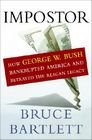
"Impostor: How George W. Bush Bankrupted America and Betrayed the Reagan Legacy"
by Bartlett, Bruce
BOOK REVIEW:
George W. Bush came to the presidency in 2000 claiming to be the heir of Ronald Reagan. But while he did cut taxes, in most other respects he has governed in a way utterly unlike his revered predecessor, expanding the size and scope of government, letting immigration go unchecked, and allowing the federal budget to mushroom out of control.
Despite their strong misgivings, most conservatives remained silent during Bush's first term. But a series of missteps and scandals, culminating in the ill-conceived nomination of Harriet Miers to the Supreme Court, has brought this hidden rift within the conservative movement crashing to the surface.
Now, in what is sure to be the political book of the season, Bruce Bartlett lays bare the incompetence and profligacy of Bush's economic policies. A highly respected Washington economist--and true-believing Reaganite--Bartlett started out as a supporter of Bush and helped him craft his tax cuts. But he was dismayed by the way they were executed. Reagan combined his tax cuts with fiscal restraint, but Bush has done the opposite. Bartlett thus reluctantly concluded that Bush is not a Reaganite at all, but an unprincipled opportunist who will do whatever he or his advisers think is expedient to buy votes.
In this sober, thorough, and utterly devastating book, Bartlett attacks the Bush Administration's economic performance root and branch, from the "stovepiping" of its policy process to the coercive tactics used to ram its policies through Congress, to the effects of the policies themselves. He is especially hard on Bush's enormous new Medicare entitlement...and predicts that within a few years, Bush's tax cuts and unrestricted spending willproduce an economic crisis that will require a major tax increase, probably in the form of a European-style VAT.
Bartlett has surprisingly kind words for Bill Clinton, whose record on the budget was far better than Bush's. Whatever else one may think of him, Bartlett argues, Clinton cut spending, abolished a federal entitlement program, and left a budget surplus. By contrast, Bush has increased spending, created a massive entitlement program, and produced the biggest deficits in American history.
In fact, Bartlett concludes, Bush is less like Reagan than like Nixon: an arch-conservative Republican, bitterly hated by liberals, who vainly tried to woo moderates by enacting big parts of the liberal program. It didn't work then, and it won't work now--and may have similar harmful effects for the GOP."
I am quite sure that this book will eventually be burned so you better grab it.
oh, and you may want to read the authors comments:
http://www.cato.org/research/articles/cpr28n1-050101.html
Ten Most Harmful Books of the 19th and 20th Centuries
Ten Most Harmful Books of the 19th and 20th Centuries
Posted May 31, 2005
HUMAN EVENTS asked a panel of 15 conservative scholars and public policy leaders to help us compile a list of the Ten Most Harmful Books of the 19th and 20th Centuries. Each panelist nominated a number of titles and then voted on a ballot including all books nominated. A title received a score of 10 points for being listed No. 1 by one of our panelists, 9 points for being listed No. 2, etc. Appropriately, The Communist Manifesto, by Karl Marx and Friedrich Engels, earned the highest aggregate score and the No. 1 listing.
1. The Communist Manifesto by Karl Marx and Freidrich Engels
2. Mein Kampf by Adolf Hitler
3. Quotations from Chairman Mao by Mao Zedong
4. The Kinsey Report by Alfred Kinsey
5. Democracy and Education by John Dewey
6. Das Kapital by Karl Marx
7. The Feminine Mystique by Betty Friedan
8. The Course of Positive Philosophy by Auguste Comte
9. Beyond Good and Evil by Freidrich Nietzsche
10. General Theory of Employment, Interest and Money by John Maynard Keynes
Honorable Mention
The Population Bomb by Paul Ehrlich
What Is To Be Done by V.I. Lenin
Authoritarian Personality by Theodor Adorno
On Liberty by John Stuart Mill
Beyond Freedom and Dignity by B.F. Skinner
Reflections on Violence by Georges Sorel
The Promise of American Life by Herbert Croly
The Origin of Species by Charles Darwin
Madness and Civilization by Michel Foucault
Soviet Communism: A New Civilization by Sidney and Beatrice Webb
Coming of Age in Samoa by Margaret Mead
Unsafe at Any Speed by Ralph Nader
Second Sex by Simone de Beauvoir
Prison Notebooks by Antonio Gramsci
Silent Spring by Rachel Carson
Wretched of the Earth by Frantz Fanon
Introduction to Psychoanalysis by Sigmund Freud
The Greening of America by Charles Reich
The Limits to Growth by Club of Rome
Descent of Man by Charles Darwin
Just think, you could subscribe to this website and get a free book:
The Professors: The 101 Most Dangerous Academics in America
By: David Horowitz
Bestselling author David Horowitz reveals a shocking and perverse culture of academics who are poisoning the minds of today's college students. The Professors is a wake-up call to all those who assume that a college education is sans hatred of America and the American military and support for America's terrorist enemies.
This is the guy offering money to students who report their professors as being subversive!
Wonder when we're going to hear about the book burnings starting?
FAHRENHEIT 451: The temperature at which paper catches fire and burns.
"How inconvenient! Always before it had been like snuffing a candle. The police went first and adhesive-taped the victim's mouth and bandaged him off into their glittering beetle cars, so when you arrived you found an empty house. You weren't hurting anyone, you were hurting only things! And since things really couldn't be hurt, since things felt nothing, and things don't scream or whimper, as this woman might begin to scream and cry out, there was nothing to tease your conscience later. You were simply cleaning up. Janitorial work, essentially. Everything to its proper place. Quick with the kerosene! Who's got a match!"
Do you think my son is going to be offered money to burn "The Origin of Species" by Charles Darwin? Who are THESE people and what in god's name are they smoking?
Posted May 31, 2005
HUMAN EVENTS asked a panel of 15 conservative scholars and public policy leaders to help us compile a list of the Ten Most Harmful Books of the 19th and 20th Centuries. Each panelist nominated a number of titles and then voted on a ballot including all books nominated. A title received a score of 10 points for being listed No. 1 by one of our panelists, 9 points for being listed No. 2, etc. Appropriately, The Communist Manifesto, by Karl Marx and Friedrich Engels, earned the highest aggregate score and the No. 1 listing.
1. The Communist Manifesto by Karl Marx and Freidrich Engels
2. Mein Kampf by Adolf Hitler
3. Quotations from Chairman Mao by Mao Zedong
4. The Kinsey Report by Alfred Kinsey
5. Democracy and Education by John Dewey
6. Das Kapital by Karl Marx
7. The Feminine Mystique by Betty Friedan
8. The Course of Positive Philosophy by Auguste Comte
9. Beyond Good and Evil by Freidrich Nietzsche
10. General Theory of Employment, Interest and Money by John Maynard Keynes
Honorable Mention
The Population Bomb by Paul Ehrlich
What Is To Be Done by V.I. Lenin
Authoritarian Personality by Theodor Adorno
On Liberty by John Stuart Mill
Beyond Freedom and Dignity by B.F. Skinner
Reflections on Violence by Georges Sorel
The Promise of American Life by Herbert Croly
The Origin of Species by Charles Darwin
Madness and Civilization by Michel Foucault
Soviet Communism: A New Civilization by Sidney and Beatrice Webb
Coming of Age in Samoa by Margaret Mead
Unsafe at Any Speed by Ralph Nader
Second Sex by Simone de Beauvoir
Prison Notebooks by Antonio Gramsci
Silent Spring by Rachel Carson
Wretched of the Earth by Frantz Fanon
Introduction to Psychoanalysis by Sigmund Freud
The Greening of America by Charles Reich
The Limits to Growth by Club of Rome
Descent of Man by Charles Darwin
Just think, you could subscribe to this website and get a free book:
The Professors: The 101 Most Dangerous Academics in America
By: David Horowitz
Bestselling author David Horowitz reveals a shocking and perverse culture of academics who are poisoning the minds of today's college students. The Professors is a wake-up call to all those who assume that a college education is sans hatred of America and the American military and support for America's terrorist enemies.
This is the guy offering money to students who report their professors as being subversive!
Wonder when we're going to hear about the book burnings starting?
FAHRENHEIT 451: The temperature at which paper catches fire and burns.
"How inconvenient! Always before it had been like snuffing a candle. The police went first and adhesive-taped the victim's mouth and bandaged him off into their glittering beetle cars, so when you arrived you found an empty house. You weren't hurting anyone, you were hurting only things! And since things really couldn't be hurt, since things felt nothing, and things don't scream or whimper, as this woman might begin to scream and cry out, there was nothing to tease your conscience later. You were simply cleaning up. Janitorial work, essentially. Everything to its proper place. Quick with the kerosene! Who's got a match!"
Do you think my son is going to be offered money to burn "The Origin of Species" by Charles Darwin? Who are THESE people and what in god's name are they smoking?
16 April 2006
THE LESSON OF TAL AFAR
THE LESSON OF TAL AFAR
Is it too late for the Administration to correct its course in Iraq?
by GEORGE PACKER
Issue of 2006-04-10
Posted 2006-04-0
This is just an excerpt of an excellent article. I would seggest reading it in it's original at the link above.
THE “I” WORD
Colonel H. R. McMaster, the commander o the 3rd Armored Cavalry Regiment, is forty-three years old, a small man, thick in th middle, with black eyebrows that are the onl signs of hair on a pale, shaved head. Hi features are deeply furrowed across the bro and along the nose, as if his head had bee shaped from modelling clay; but when he grin mischief creases his face, and it’s easy t imagine him as an undaunted ten-year-old marching around and giving orders in his ow private war. The first time I saw him, he had football in his hands and was throwing har spirals to a few other soldiers next to hi plywood headquarters, on a muddy airfield few miles south of Tal Afar
McMaster and the 3rd A.C.R. had been stationed in Tal Afar for nine months. When they arrived, in the spring of 2005, the city was largely in the hands of hard-core Iraqi and foreign jihadis, who, together with members of the local Sunni population, had destabilized the city with a campaign of intimidation, including beheadings aimed largely at Tal Afar’s Shiite minority. By October, after months of often fierce fighting and painstaking negotiations with local leaders, McMaster’s regiment, working alongside Iraqi Army battalions, had established bases around the city and greatly reduced the violence. When I met McMaster, his unit was about to return home; the men were to be replaced by a brigade of the 1st Armored Division that had no experience in Tal Afar, and no one knew if the city would remain secure. (Within weeks, there were reports that sectarian killings were on the rise.)
The lessons that McMaster and his soldiers applied in Tal Afar were learned during the first two years of an increasingly unpopular war. “When we came to Iraq, we didn’t understand the complexity—what it meant for a society to live under a brutal dictatorship, with ethnic and sectarian divisions,” he said, in his hoarse, energetic voice. “When we first got here, we made a lot of mistakes. We were like a blind man, trying to do the right thing but breaking a lot of things.” Later, he said, “You gotta come in with your ears open. You can’t come in and start talking. You have to really listen to people.”
McMaster is a West Point graduate who earned a Silver Star for battlefield prowess during the 1991 Gulf War: his armored cavalry troop stumbled across an Iraqi mechanized brigade in the middle of a sandstorm and destroyed it. That war was a textbook case of what the military calls “kinetic operations,” or major combat in relatively uncomplicated circumstances; the field of battle was almost easier, some Gulf War veterans say, than the live-fire exercises at the National Training Center, in Fort Irwin, California. After the war, McMaster earned a doctorate in history from the University of North Carolina. His dissertation, based on research in newly declassified archives, was published in 1997, with the title “Dereliction of Duty: Lyndon Johnson, Robert McNamara, the Joint Chiefs of Staff, and the Lies That Led to Vietnam.” The book assembled a damning case against senior military leaders for failing to speak their minds when, in the early years of the war, they disagreed with Pentagon policies. The Joint Chiefs of Staff, knowing that Johnson and McNamara wanted uncritical support rather than honest advice, and eager to protect their careers, went along with official lies and a split-the-difference strategy of gradual escalation that none of them thought could work. “Dereliction of Duty” won McMaster wide praise, and its candor inspired an ardent following among post-Vietnam officers.
Is it too late for the Administration to correct its course in Iraq?
by GEORGE PACKER
Issue of 2006-04-10
Posted 2006-04-0
This is just an excerpt of an excellent article. I would seggest reading it in it's original at the link above.
THE “I” WORD
Colonel H. R. McMaster, the commander o the 3rd Armored Cavalry Regiment, is forty-three years old, a small man, thick in th middle, with black eyebrows that are the onl signs of hair on a pale, shaved head. Hi features are deeply furrowed across the bro and along the nose, as if his head had bee shaped from modelling clay; but when he grin mischief creases his face, and it’s easy t imagine him as an undaunted ten-year-old marching around and giving orders in his ow private war. The first time I saw him, he had football in his hands and was throwing har spirals to a few other soldiers next to hi plywood headquarters, on a muddy airfield few miles south of Tal Afar
McMaster and the 3rd A.C.R. had been stationed in Tal Afar for nine months. When they arrived, in the spring of 2005, the city was largely in the hands of hard-core Iraqi and foreign jihadis, who, together with members of the local Sunni population, had destabilized the city with a campaign of intimidation, including beheadings aimed largely at Tal Afar’s Shiite minority. By October, after months of often fierce fighting and painstaking negotiations with local leaders, McMaster’s regiment, working alongside Iraqi Army battalions, had established bases around the city and greatly reduced the violence. When I met McMaster, his unit was about to return home; the men were to be replaced by a brigade of the 1st Armored Division that had no experience in Tal Afar, and no one knew if the city would remain secure. (Within weeks, there were reports that sectarian killings were on the rise.)
The lessons that McMaster and his soldiers applied in Tal Afar were learned during the first two years of an increasingly unpopular war. “When we came to Iraq, we didn’t understand the complexity—what it meant for a society to live under a brutal dictatorship, with ethnic and sectarian divisions,” he said, in his hoarse, energetic voice. “When we first got here, we made a lot of mistakes. We were like a blind man, trying to do the right thing but breaking a lot of things.” Later, he said, “You gotta come in with your ears open. You can’t come in and start talking. You have to really listen to people.”
McMaster is a West Point graduate who earned a Silver Star for battlefield prowess during the 1991 Gulf War: his armored cavalry troop stumbled across an Iraqi mechanized brigade in the middle of a sandstorm and destroyed it. That war was a textbook case of what the military calls “kinetic operations,” or major combat in relatively uncomplicated circumstances; the field of battle was almost easier, some Gulf War veterans say, than the live-fire exercises at the National Training Center, in Fort Irwin, California. After the war, McMaster earned a doctorate in history from the University of North Carolina. His dissertation, based on research in newly declassified archives, was published in 1997, with the title “Dereliction of Duty: Lyndon Johnson, Robert McNamara, the Joint Chiefs of Staff, and the Lies That Led to Vietnam.” The book assembled a damning case against senior military leaders for failing to speak their minds when, in the early years of the war, they disagreed with Pentagon policies. The Joint Chiefs of Staff, knowing that Johnson and McNamara wanted uncritical support rather than honest advice, and eager to protect their careers, went along with official lies and a split-the-difference strategy of gradual escalation that none of them thought could work. “Dereliction of Duty” won McMaster wide praise, and its candor inspired an ardent following among post-Vietnam officers.
PREDICTION MARKET:wanna know the odds
So you've wanted to knOW the probablity of something happening in the world? Bet on by people who might know?
Well, then check out the link above. The prediction accuracy over the liftime of betting is 85.07%
How about this on:
"Bird flu spreads and becomes a serious threat to poultry operations; Federal gov't orders cull of poultry in designated areas." posted 14 April.
Well, then check out the link above. The prediction accuracy over the liftime of betting is 85.07%
How about this on:
"Bird flu spreads and becomes a serious threat to poultry operations; Federal gov't orders cull of poultry in designated areas." posted 14 April.
Documents Show Link Between AT&T and Agency in Eavesdropping Case
April 13, 2006
Documents Show Link Between AT&T and Agency in Eavesdropping Case
By JOHN MARKOFF and SCOTT SHANE
SAN FRANCISCO, April 12 — Mark Klein was a veteran AT&T technician in 2002 when he began to see what he thought were suspicious connections between that telecommunications giant and the National Security Agency. But he kept quiet about it until news broke late last year that President Bush had approved an N.S.A. program to eavesdrop without court warrants on Americans suspected of ties to Al Qaeda.
Now Mr. Klein and a few company documents he saved have emerged as key elements in a class-action lawsuit filed against AT&T on Jan. 31 by a civil liberties group, the Electronic Frontier Foundation. The suit accuses the company of helping the security agency invade its customers' privacy. Mr. Klein's account and the documents provide new details about how the agency works with the private sector in intercepting communications for intelligence purposes.
The documents, some of which Mr. Klein had earlier provided to reporters, describe a mysterious room at the AT&T Internet and telephone hub in San Francisco where he worked. The documents, which were examined by four independent telecommunications and computer security experts at the request of The New York Times, describe equipment capable of monitoring a large quantity of e-mail messages, Internet phone calls, and other Internet traffic.
The equipment, which Mr. Klein said was installed by AT&T in 2003, was able to select messages that could be identified by keywords, Internet or e-mail addresses or country of origin and divert copies to another location for further analysis. The security agency began eavesdropping without warrants on international phone calls and e-mail messages of people inside the United States suspected of terrorist links soon after the Sept. 11 attacks.
After disclosing the program last December, The New York Times also reported that the agency had gathered data from phone and e-mail traffic with the cooperation of several major telecommunications companies. The technical experts all said that the documents showed that AT&T had an agreement with the federal government to systematically gather information flowing on the Internet through the company's network.
The gathering of such information, known as data mining, involves the use of sophisticated computer programs to detect patterns or glean useful intelligence from masses of information. "This took expert planning and hundreds of millions of dollars to build," said Brian Reid, director of engineering at the Internet Systems Consortium in Redwood City, Calif. "This is the correct way to do high volume Internet snooping."
Another expert, who had designed large federal and commercial data networks, said that the documents were consistent with administration assertions that the N.S.A. monitored only foreign communications and communications between foreign and United States locations, partly because of the location of the monitoring sites. The network designer was granted anonymity because he believed that commenting on the operation could affect his ability to work as a consultant.
The documents referred to a second location, in Atlanta, and suggested similar rooms might exist at other AT&T switching sites. Mr. Klein said other AT&T technicians had told him of such installations in San Jose, Calif.; Los Angeles; San Diego; and Seattle.
The Internet hubs there carry a significant amount of international traffic. The network designer and other experts said it would be a simple technical matter to reprogram the equipment to intercept purely domestic Internet traffic. The Department of Justice initially asked the Electronic Frontier Foundation not to file Mr. Klein's documents in court, but a review determined that they were not classified and the government dropped its objection. The foundation filed the documents under seal because of concern about releasing proprietary information.
On Monday, AT&T filed a motion with a federal judge in San Francisco asking the court to order the foundation to return the documents because they were proprietary. The documents showed that the room in San Francisco, which Mr. Klein says was off-limits to most employees but serviced by a company technician working with the security agency, contained computerized equipment that could sift through immense volumes of traffic as it passed through the cables of AT&T's WorldNet Internet service.
According to the documents, e-mail messages and other data carried by 16 other commercial Internet providers reached AT&T customers through the San Francisco hub. One piece of filtering equipment described in the documents was manufactured by Narus, based in Mountain View, Calif. The equipment could be programmed to identify and intercept voice or data conversations between e-mail, telephone or Internet addresses, said Steve Bannerman, the company's vice president for marketing.
Buyers included companies trying to comply with the Communications Assistance for Law Enforcement Act of 1994, which requires that communications systems have a wiretapping capability built in. Typically, law enforcement interceptions are done on a case by case basis and require warrants.
Mr. Bannerman said he could not comment further because Narus had not announced any sales to the federal government. William P. Crowell, a former deputy director of the N.S.A, is on the Narus board. In an interview, Mr. Klein said he did not have a security clearance but had witnessed interactions between colleagues who did have clearances and the highly secretive N.S.A. "It was strange and sort of suspicious," he said. Mr. Klein said he learned of an agency connection to the mysterious room in 2002 when a company manager told him to expect a visit from an N.S.A. official who wanted to speak with another senior company technician about "a special job." That technician later installed the equipment in the room, he said.
Based on his observations and technical knowledge, Mr. Klein concluded that the equipment permitted "vacuum-cleaner surveillance" of Internet traffic. Mr. Klein, 60, who retired in 2004 after 23 years with AT&T and lives near Oakland, Calif., said he decided to make his observations known because he believed the government's monitoring was violating Americans' civil liberties.
An AT&T spokesman at the company's corporate headquarters in San Antonio declined to comment on Mr. Klein's statements. "AT&T does follow all laws with respect to assistance offered to government agencies," said Walt Sharp, the AT&T spokesman. "However, we are not in a position to comment on matters of national security." Asked to comment, Don Weber, a spokesman for the N.S.A., said, "It would be irresponsible of us to discuss actual or alleged operational issues as it would give those wishing to do harm to the United States the ability to adjust and potentially inflict harm."
John Markoff reported from San Francisco for this article, and Scott Shane from Washington.
Documents Show Link Between AT&T and Agency in Eavesdropping Case
By JOHN MARKOFF and SCOTT SHANE
SAN FRANCISCO, April 12 — Mark Klein was a veteran AT&T technician in 2002 when he began to see what he thought were suspicious connections between that telecommunications giant and the National Security Agency. But he kept quiet about it until news broke late last year that President Bush had approved an N.S.A. program to eavesdrop without court warrants on Americans suspected of ties to Al Qaeda.
Now Mr. Klein and a few company documents he saved have emerged as key elements in a class-action lawsuit filed against AT&T on Jan. 31 by a civil liberties group, the Electronic Frontier Foundation. The suit accuses the company of helping the security agency invade its customers' privacy. Mr. Klein's account and the documents provide new details about how the agency works with the private sector in intercepting communications for intelligence purposes.
The documents, some of which Mr. Klein had earlier provided to reporters, describe a mysterious room at the AT&T Internet and telephone hub in San Francisco where he worked. The documents, which were examined by four independent telecommunications and computer security experts at the request of The New York Times, describe equipment capable of monitoring a large quantity of e-mail messages, Internet phone calls, and other Internet traffic.
The equipment, which Mr. Klein said was installed by AT&T in 2003, was able to select messages that could be identified by keywords, Internet or e-mail addresses or country of origin and divert copies to another location for further analysis. The security agency began eavesdropping without warrants on international phone calls and e-mail messages of people inside the United States suspected of terrorist links soon after the Sept. 11 attacks.
After disclosing the program last December, The New York Times also reported that the agency had gathered data from phone and e-mail traffic with the cooperation of several major telecommunications companies. The technical experts all said that the documents showed that AT&T had an agreement with the federal government to systematically gather information flowing on the Internet through the company's network.
The gathering of such information, known as data mining, involves the use of sophisticated computer programs to detect patterns or glean useful intelligence from masses of information. "This took expert planning and hundreds of millions of dollars to build," said Brian Reid, director of engineering at the Internet Systems Consortium in Redwood City, Calif. "This is the correct way to do high volume Internet snooping."
Another expert, who had designed large federal and commercial data networks, said that the documents were consistent with administration assertions that the N.S.A. monitored only foreign communications and communications between foreign and United States locations, partly because of the location of the monitoring sites. The network designer was granted anonymity because he believed that commenting on the operation could affect his ability to work as a consultant.
The documents referred to a second location, in Atlanta, and suggested similar rooms might exist at other AT&T switching sites. Mr. Klein said other AT&T technicians had told him of such installations in San Jose, Calif.; Los Angeles; San Diego; and Seattle.
The Internet hubs there carry a significant amount of international traffic. The network designer and other experts said it would be a simple technical matter to reprogram the equipment to intercept purely domestic Internet traffic. The Department of Justice initially asked the Electronic Frontier Foundation not to file Mr. Klein's documents in court, but a review determined that they were not classified and the government dropped its objection. The foundation filed the documents under seal because of concern about releasing proprietary information.
On Monday, AT&T filed a motion with a federal judge in San Francisco asking the court to order the foundation to return the documents because they were proprietary. The documents showed that the room in San Francisco, which Mr. Klein says was off-limits to most employees but serviced by a company technician working with the security agency, contained computerized equipment that could sift through immense volumes of traffic as it passed through the cables of AT&T's WorldNet Internet service.
According to the documents, e-mail messages and other data carried by 16 other commercial Internet providers reached AT&T customers through the San Francisco hub. One piece of filtering equipment described in the documents was manufactured by Narus, based in Mountain View, Calif. The equipment could be programmed to identify and intercept voice or data conversations between e-mail, telephone or Internet addresses, said Steve Bannerman, the company's vice president for marketing.
Buyers included companies trying to comply with the Communications Assistance for Law Enforcement Act of 1994, which requires that communications systems have a wiretapping capability built in. Typically, law enforcement interceptions are done on a case by case basis and require warrants.
Mr. Bannerman said he could not comment further because Narus had not announced any sales to the federal government. William P. Crowell, a former deputy director of the N.S.A, is on the Narus board. In an interview, Mr. Klein said he did not have a security clearance but had witnessed interactions between colleagues who did have clearances and the highly secretive N.S.A. "It was strange and sort of suspicious," he said. Mr. Klein said he learned of an agency connection to the mysterious room in 2002 when a company manager told him to expect a visit from an N.S.A. official who wanted to speak with another senior company technician about "a special job." That technician later installed the equipment in the room, he said.
Based on his observations and technical knowledge, Mr. Klein concluded that the equipment permitted "vacuum-cleaner surveillance" of Internet traffic. Mr. Klein, 60, who retired in 2004 after 23 years with AT&T and lives near Oakland, Calif., said he decided to make his observations known because he believed the government's monitoring was violating Americans' civil liberties.
An AT&T spokesman at the company's corporate headquarters in San Antonio declined to comment on Mr. Klein's statements. "AT&T does follow all laws with respect to assistance offered to government agencies," said Walt Sharp, the AT&T spokesman. "However, we are not in a position to comment on matters of national security." Asked to comment, Don Weber, a spokesman for the N.S.A., said, "It would be irresponsible of us to discuss actual or alleged operational issues as it would give those wishing to do harm to the United States the ability to adjust and potentially inflict harm."
John Markoff reported from San Francisco for this article, and Scott Shane from Washington.
THE IRAN PLANS
THE IRAN PLANS
Would President Bush go to war to stop Tehran from getting the bomb?
by SEYMOUR M. HERSH
Issue of 2006-04-17
Posted 2006-04-08
The Bush Administration, while publicl advocating diplomacy in order to stop Iran fro pursuing a nuclear weapon, has increase clandestine activities inside Iran and intensifie planning for a possible major air attack. Curren and former American military and intelligenc officials said that Air Force planning groups ar drawing up lists of targets, and teams o American combat troops have been ordere into Iran, under cover, to collect targeting dat and to establish contact with anti-governmen ethnic-minority groups. The officials say tha President Bush is determined to deny th Iranian regime the opportunity to begin a pilo program, planned for this spring, to enric uranium
American and European intelligence agencies, and the International Atomic Energy Agency (I.A.E.A.), agree that Iran is intent on developing the capability to produce nuclear weapons. But there are widely differing estimates of how long that will take, and whether diplomacy, sanctions, or military action is the best way to prevent it. Iran insists that its research is for peaceful use only, in keeping with the Nuclear Non-Proliferation Treaty, and that it will not be delayed or deterred.
There is a growing conviction among members of the United States military, and in the international community, that President Bush’s ultimate goal in the nuclear confrontation with Iran is regime change. Iran’s President, Mahmoud Ahmadinejad, has challenged the reality of the Holocaust and said that Israel must be “wiped off the map.” Bush and others in the White House view him as a potential Adolf Hitler, a former senior intelligence official said. “That’s the name they’re using. They say, ‘Will Iran get a strategic weapon and threaten another world war?’ ”
A government consultant with close ties to the civilian leadership in the Pentagon said that Bush was “absolutely convinced that Iran is going to get the bomb” if it is not stopped. He said that the President believes that he must do “what no Democrat or Republican, if elected in the future, would have the courage to do,” and “that saving Iran is going to be his legacy.”
One former defense official, who still deals with sensitive issues for the Bush Administration, told me that the military planning was premised on a belief that “a sustained bombing campaign in Iran will humiliate the religious leadership and lead the public to rise up and overthrow the government.” He added, “I was shocked when I heard it, and asked myself, ‘What are they smoking?’ ”
The rationale for regime change was articulated in early March by Patrick Clawson, an Iran expert who is the deputy director for research at the Washington Institute for Near East Policy and who has been a supporter of President Bush. “So long as Iran has an Islamic republic, it will have a nuclear-weapons program, at least clandestinely,” Clawson told the Senate Foreign Relations Committee on March 2nd. “The key issue, therefore, is: How long will the present Iranian regime last?”
When I spoke to Clawson, he emphasized that “this Administration is putting a lot of effort into diplomacy.” However, he added, Iran had no choice other than to accede to America’s demands or face a military attack. Clawson said that he fears that Ahmadinejad “sees the West as wimps and thinks we will eventually cave in. We have to be ready to deal with Iran if the crisis escalates.” Clawson said that he would prefer to rely on sabotage and other clandestine activities, such as “industrial accidents.” But, he said, it would be prudent to prepare for a wider war, “given the way the Iranians are acting. This is not like planning to invade Quebec.”
One military planner told me that White House criticisms of Iran and the high tempo of planning and clandestine activities amount to a campaign of “coercion” aimed at Iran. “You have to be ready to go, and we’ll see how they respond,” the officer said. “You have to really show a threat in order to get Ahmadinejad to back down.” He added, “People think Bush has been focussed on Saddam Hussein since 9/11,” but, “in my view, if you had to name one nation that was his focus all the way along, it was Iran.” (In response to detailed requests for comment, the White House said that it would not comment on military planning but added, “As the President has indicated, we are pursuing a diplomatic solution”; the Defense Department also said that Iran was being dealt with through “diplomatic channels” but wouldn’t elaborate on that; the C.I.A. said that there were “inaccuracies” in this account but would not specify them.)
“This is much more than a nuclear issue,” one high-ranking diplomat told me in Vienna. “That’s just a rallying point, and there is still time to fix it. But the Administration believes it cannot be fixed unless they control the hearts and minds of Iran. The real issue is who is going to control the Middle East and its oil in the next ten years.”
A senior Pentagon adviser on the war on terror expressed a similar view. “This White House believes that the only way to solve the problem is to change the power structure in Iran, and that means war,” he said. The danger, he said, was that “it also reinforces the belief inside Iran that the only way to defend the country is to have a nuclear capability.” A military conflict that destabilized the region could also increase the risk of terror: “Hezbollah comes into play,” the adviser said, referring to the terror group that is considered one of the world’s most successful, and which is now a Lebanese political party with strong ties to Iran. “And here comes Al Qaeda.”
In recent weeks, the President has quietly initiated a series of talks on plans for Iran with a few key senators and members of Congress, including at least one Democrat. A senior member of the House Appropriations Committee, who did not take part in the meetings but has discussed their content with his colleagues, told me that there had been “no formal briefings,” because “they’re reluctant to brief the minority. They’re doing the Senate, somewhat selectively.”
The House member said that no one in the meetings “is really objecting” to the talk of war. “The people they’re briefing are the same ones who led the charge on Iraq. At most, questions are raised: How are you going to hit all the sites at once? How are you going to get deep enough?” (Iran is building facilities underground.) “There’s no pressure from Congress” not to take military action, the House member added. “The only political pressure is from the guys who want to do it.” Speaking of President Bush, the House member said, “The most worrisome thing is that this guy has a messianic vision.”
Some operations, apparently aimed in part at intimidating Iran, are already under way. American Naval tactical aircraft, operating from carriers in the Arabian Sea, have been flying simulated nuclear-weapons delivery missions—rapid ascending maneuvers known as “over the shoulder” bombing—since last summer, the former official said, within range of Iranian coastal radars.
Last month, in a paper given at a conference on Middle East security in Berlin, Colonel Sam Gardiner, a military analyst who taught at the National War College before retiring from the Air Force, in 1987, provided an estimate of what would be needed to destroy Iran’s nuclear program. Working from satellite photographs of the known facilities, Gardiner estimated that at least four hundred targets would have to be hit. He added:
I don’t think a U.S. military planner would want to stop there. Iran probably has two chemical-production plants. We would hit those. We would want to hit the medium-range ballistic missiles that have just recently been moved closer to Iraq. There are fourteen airfields with sheltered aircraft. . . . We’d want to get rid of that threat. We would want to hit the assets that could be used to threaten Gulf shipping. That means targeting the cruise-missile sites and the Iranian diesel submarines. . . . Some of the facilities may be too difficult to target even with penetrating weapons. The U.S. will have to use Special Operations units.
One of the military’s initial option plans, as presented to the White House by the Pentagon this winter, calls for the use of a bunker-buster tactical nuclear weapon, such as the B61-11, against underground nuclear sites. One target is Iran’s main centrifuge plant, at Natanz, nearly two hundred miles south of Tehran. Natanz, which is no longer under I.A.E.A. safeguards, reportedly has underground floor space to hold fifty thousand centrifuges, and laboratories and workspaces buried approximately seventy-five feet beneath the surface. That number of centrifuges could provide enough enriched uranium for about twenty nuclear warheads a year. (Iran has acknowledged that it initially kept the existence of its enrichment program hidden from I.A.E.A. inspectors, but claims that none of its current activity is barred by the Non-Proliferation Treaty.) The elimination of Natanz would be a major setback for Iran’s nuclear ambitions, but the conventional weapons in the American arsenal could not insure the destruction of facilities under seventy-five feet of earth and rock, especially if they are reinforced with concrete.
There is a Cold War precedent for targeting deep underground bunkers with nuclear weapons. In the early nineteen-eighties, the American intelligence community watched as the Soviet government began digging a huge underground complex outside Moscow. Analysts concluded that the underground facility was designed for “continuity of government”—for the political and military leadership to survive a nuclear war. (There are similar facilities, in Virginia and Pennsylvania, for the American leadership.) The Soviet facility still exists, and much of what the U.S. knows about it remains classified. “The ‘tell’ ”—the giveaway—“was the ventilator shafts, some of which were disguised,” the former senior intelligence official told me. At the time, he said, it was determined that “only nukes” could destroy the bunker. He added that some American intelligence analysts believe that the Russians helped the Iranians design their underground facility. “We see a similarity of design,” specifically in the ventilator shafts, he said.
A former high-level Defense Department official told me that, in his view, even limited bombing would allow the U.S. to “go in there and do enough damage to slow down the nuclear infrastructure—it’s feasible.” The former defense official said, “The Iranians don’t have friends, and we can tell them that, if necessary, we’ll keep knocking back their infrastructure. The United States should act like we’re ready to go.” He added, “We don’t have to knock down all of their air defenses. Our stealth bombers and standoff missiles really work, and we can blow fixed things up. We can do things on the ground, too, but it’s difficult and very dangerous—put bad stuff in ventilator shafts and put them to sleep.”
But those who are familiar with the Soviet bunker, according to the former senior intelligence official, “say ‘No way.’ You’ve got to know what’s underneath—to know which ventilator feeds people, or diesel generators, or which are false. And there’s a lot that we don’t know.” The lack of reliable intelligence leaves military planners, given the goal of totally destroying the sites, little choice but to consider the use of tactical nuclear weapons. “Every other option, in the view of the nuclear weaponeers, would leave a gap,” the former senior intelligence official said. “ ‘Decisive’ is the key word of the Air Force’s planning. It’s a tough decision. But we made it in Japan.”
He went on, “Nuclear planners go through extensive training and learn the technical details of damage and fallout—we’re talking about mushroom clouds, radiation, mass casualties, and contamination over years. This is not an underground nuclear test, where all you see is the earth raised a little bit. These politicians don’t have a clue, and whenever anybody tries to get it out”—remove the nuclear option—“they’re shouted down.”
The attention given to the nuclear option has created serious misgivings inside the offices of the Joint Chiefs of Staff, he added, and some officers have talked about resigning. Late this winter, the Joint Chiefs of Staff sought to remove the nuclear option from the evolving war plans for Iran—without success, the former intelligence official said. “The White House said, ‘Why are you challenging this? The option came from you.’ ”
The Pentagon adviser on the war on terror confirmed that some in the Administration were looking seriously at this option, which he linked to a resurgence of interest in tactical nuclear weapons among Pentagon civilians and in policy circles. He called it “a juggernaut that has to be stopped.” He also confirmed that some senior officers and officials were considering resigning over the issue. “There are very strong sentiments within the military against brandishing nuclear weapons against other countries,” the adviser told me. “This goes to high levels.” The matter may soon reach a decisive point, he said, because the Joint Chiefs had agreed to give President Bush a formal recommendation stating that they are strongly opposed to considering the nuclear option for Iran. “The internal debate on this has hardened in recent weeks,” the adviser said. “And, if senior Pentagon officers express their opposition to the use of offensive nuclear weapons, then it will never happen.”
The adviser added, however, that the idea of using tactical nuclear weapons in such situations has gained support from the Defense Science Board, an advisory panel whose members are selected by Secretary of Defense Donald Rumsfeld. “They’re telling the Pentagon that we can build the B61 with more blast and less radiation,” he said.
The chairman of the Defense Science Board is William Schneider, Jr., an Under-Secretary of State in the Reagan Administration. In January, 2001, as President Bush prepared to take office, Schneider served on an ad-hoc panel on nuclear forces sponsored by the National Institute for Public Policy, a conservative think tank. The panel’s report recommended treating tactical nuclear weapons as an essential part of the U.S. arsenal and noted their suitability “for those occasions when the certain and prompt destruction of high priority targets is essential and beyond the promise of conventional weapons.” Several signers of the report are now prominent members of the Bush Administration, including Stephen Hadley, the national-security adviser; Stephen Cambone, the Under-Secretary of Defense for Intelligence; and Robert Joseph, the Under-Secretary of State for Arms Control and International Security.
The Pentagon adviser questioned the value of air strikes. “The Iranians have distributed their nuclear activity very well, and we have no clue where some of the key stuff is. It could even be out of the country,” he said. He warned, as did many others, that bombing Iran could provoke “a chain reaction” of attacks on American facilities and citizens throughout the world: “What will 1.2 billion Muslims think the day we attack Iran?”
With or without the nuclear option, the list o targets may inevitably expand. One recentl retired high-level Bush Administration official who is also an expert on war planning, told m that he would have vigorously argued agains an air attack on Iran, because “Iran is a muc tougher target” than Iraq. But, he added, “I you’re going to do any bombing to stop th nukes, you might as well improve your li across the board. Maybe hit some trainin camps, and clear up a lot of other problems.
The Pentagon adviser said that, in the event of an attack, the Air Force intended to strike many hundreds of targets in Iran but that “ninety-nine per cent of them have nothing to do with proliferation. There are people who believe it’s the way to operate”—that the Administration can achieve its policy goals in Iran with a bombing campaign, an idea that has been supported by neoconservatives.
If the order were to be given for an attack, the American combat troops now operating in Iran would be in position to mark the critical targets with laser beams, to insure bombing accuracy and to minimize civilian casualties. As of early winter, I was told by the government consultant with close ties to civilians in the Pentagon, the units were also working with minority groups in Iran, including the Azeris, in the north, the Baluchis, in the southeast, and the Kurds, in the northeast. The troops “are studying the terrain, and giving away walking-around money to ethnic tribes, and recruiting scouts from local tribes and shepherds,” the consultant said. One goal is to get “eyes on the ground”—quoting a line from “Othello,” he said, “Give me the ocular proof.” The broader aim, the consultant said, is to “encourage ethnic tensions” and undermine the regime.
The new mission for the combat troops is a product of Defense Secretary Rumsfeld’s long-standing interest in expanding the role of the military in covert operations, which was made official policy in the Pentagon’s Quadrennial Defense Review, published in February. Such activities, if conducted by C.I.A. operatives, would need a Presidential Finding and would have to be reported to key members of Congress.
“ ‘Force protection’ is the new buzzword,” the former senior intelligence official told me. He was referring to the Pentagon’s position that clandestine activities that can be broadly classified as preparing the battlefield or protecting troops are military, not intelligence, operations, and are therefore not subject to congressional oversight. “The guys in the Joint Chiefs of Staff say there are a lot of uncertainties in Iran,” he said. “We need to have more than what we had in Iraq. Now we have the green light to do everything we want.”
The President’s deep distrust of Ahmadineja has strengthened his determination to confron Iran. This view has been reinforced b allegations that Ahmadinejad, who joined special-forces brigade of the Revolutionar Guards in 1986, may have been involved i terrorist activities in the late eighties. (There ar gaps in Ahmadinejad’s official biography i this period.) Ahmadinejad has reportedly bee connected to Imad Mughniyeh, a terrorist wh has been implicated in the deadly bombings o the U.S. Embassy and the U.S. Marine barrack in Beirut, in 1983. Mughniyeh was then th security chief of Hezbollah; he remains on th F.B.I.’s list of most-wanted terrorists
Robert Baer, who was a C.I.A. officer in the Middle East and elsewhere for two decades, told me that Ahmadinejad and his Revolutionary Guard colleagues in the Iranian government “are capable of making a bomb, hiding it, and launching it at Israel. They’re apocalyptic Shiites. If you’re sitting in Tel Aviv and you believe they’ve got nukes and missiles—you’ve got to take them out. These guys are nuts, and there’s no reason to back off.”
Under Ahmadinejad, the Revolutionary Guards have expanded their power base throughout the Iranian bureaucracy; by the end of January, they had replaced thousands of civil servants with their own members. One former senior United Nations official, who has extensive experience with Iran, depicted the turnover as “a white coup,” with ominous implications for the West. “Professionals in the Foreign Ministry are out; others are waiting to be kicked out,” he said. “We may be too late. These guys now believe that they are stronger than ever since the revolution.” He said that, particularly in consideration of China’s emergence as a superpower, Iran’s attitude was “To hell with the West. You can do as much as you like.”
Iran’s supreme religious leader, Ayatollah Khamenei, is considered by many experts to be in a stronger position than Ahmadinejad. “Ahmadinejad is not in control,” one European diplomat told me. “Power is diffuse in Iran. The Revolutionary Guards are among the key backers of the nuclear program, but, ultimately, I don’t think they are in charge of it. The Supreme Leader has the casting vote on the nuclear program, and the Guards will not take action without his approval.”
The Pentagon adviser on the war on terror said that “allowing Iran to have the bomb is not on the table. We cannot have nukes being sent downstream to a terror network. It’s just too dangerous.” He added, “The whole internal debate is on which way to go”—in terms of stopping the Iranian program. It is possible, the adviser said, that Iran will unilaterally renounce its nuclear plans—and forestall the American action. “God may smile on us, but I don’t think so. The bottom line is that Iran cannot become a nuclear-weapons state. The problem is that the Iranians realize that only by becoming a nuclear state can they defend themselves against the U.S. Something bad is going to happen.”
While almost no one disputes Iran’s nuclea ambitions, there is intense debate over ho soon it could get the bomb, and what to d about that. Robert Gallucci, a forme government expert on nonproliferation who i now the dean of the School of Foreign Servic at Georgetown, told me, “Based on what know, Iran could be eight to ten years away from developing a deliverable nuclear weapon Gallucci added, “If they had a covert nuclea program and we could prove it, and we coul not stop it by negotiation, diplomacy, or th threat of sanctions, I’d be in favor of taking i out. But if you do it”—bomb Iran—“withou being able to show there’s a secret program you’re in trouble.
Meir Dagan, the head of Mossad, Israel’s intelligence agency, told the Knesset last December that “Iran is one to two years away, at the latest, from having enriched uranium. From that point, the completion of their nuclear weapon is simply a technical matter.” In a conversation with me, a senior Israeli intelligence official talked about what he said was Iran’s duplicity: “There are two parallel nuclear programs” inside Iran—the program declared to the I.A.E.A. and a separate operation, run by the military and the Revolutionary Guards. Israeli officials have repeatedly made this argument, but Israel has not produced public evidence to support it. Richard Armitage, the Deputy Secretary of State in Bush’s first term, told me, “I think Iran has a secret nuclear-weapons program—I believe it, but I don’t know it.”
In recent months, the Pakistani government has given the U.S. new access to A. Q. Khan, the so-called father of the Pakistani atomic bomb. Khan, who is now living under house arrest in Islamabad, is accused of setting up a black market in nuclear materials; he made at least one clandestine visit to Tehran in the late nineteen-eighties. In the most recent interrogations, Khan has provided information on Iran’s weapons design and its time line for building a bomb. “The picture is of ‘unquestionable danger,’ ” the former senior intelligence official said. (The Pentagon adviser also confirmed that Khan has been “singing like a canary.”) The concern, the former senior official said, is that “Khan has credibility problems. He is suggestible, and he’s telling the neoconservatives what they want to hear”—or what might be useful to Pakistan’s President, Pervez Musharraf, who is under pressure to assist Washington in the war on terror.
“I think Khan’s leading us on,” the former intelligence official said. “I don’t know anybody who says, ‘Here’s the smoking gun.’ But lights are beginning to blink. He’s feeding us information on the time line, and targeting information is coming in from our own sources— sensors and the covert teams. The C.I.A., which was so burned by Iraqi W.M.D., is going to the Pentagon and the Vice-President’s office saying, ‘It’s all new stuff.’ People in the Administration are saying, ‘We’ve got enough.’ ”
The Administration’s case against Iran is compromised by its history of promoting false intelligence on Iraq’s weapons of mass destruction. In a recent essay on the Foreign Policy Web site, entitled “Fool Me Twice,” Joseph Cirincione, the director for nonproliferation at the Carnegie Endowment for International Peace, wrote, “The unfolding administration strategy appears to be an effort to repeat its successful campaign for the Iraq war.” He noted several parallels:
The vice president of the United States gives a major speech focused on the threat from an oil-rich nation in the Middle East. The U.S. Secretary of State tells Congress that the same nation is our most serious global challenge. The Secretary of Defense calls that nation the leading supporter of global terrorism.
Cirincione called some of the Administration’s claims about Iran “questionable” or lacking in evidence. When I spoke to him, he asked, “What do we know? What is the threat? The question is: How urgent is all this?” The answer, he said, “is in the intelligence community and the I.A.E.A.” (In August, the Washington Post reported that the most recent comprehensive National Intelligence Estimate predicted that Iran was a decade away from being a nuclear power.)
Last year, the Bush Administration briefed I.A.E.A. officials on what it said was new and alarming information about Iran’s weapons program which had been retrieved from an Iranian’s laptop. The new data included more than a thousand pages of technical drawings of weapons systems. The Washington Post reported that there were also designs for a small facility that could be used in the uranium-enrichment process. Leaks about the laptop became the focal point of stories in the Times and elsewhere. The stories were generally careful to note that the materials could have been fabricated, but also quoted senior American officials as saying that they appeared to be legitimate. The headline in the Times’ account read, “RELYING ON COMPUTER, U.S. SEEKS TO PROVE IRAN’S NUCLEAR AIMS.”
I was told in interviews with American and European intelligence officials, however, that the laptop was more suspect and less revelatory than it had been depicted. The Iranian who owned the laptop had initially been recruited by German and American intelligence operatives, working together. The Americans eventually lost interest in him. The Germans kept on, but the Iranian was seized by the Iranian counter-intelligence force. It is not known where he is today. Some family members managed to leave Iran with his laptop and handed it over at a U.S. embassy, apparently in Europe. It was a classic “walk-in.”
A European intelligence official said, “There was some hesitation on our side” about what the materials really proved, “and we are still not convinced.” The drawings were not meticulous, as newspaper accounts suggested, “but had the character of sketches,” the European official said. “It was not a slam-dunk smoking gun.”
The threat of American military action ha created dismay at the headquarters of th I.A.E.A., in Vienna. The agency’s official believe that Iran wants to be able to make nuclear weapon, but “nobody has presented a inch of evidence of a parallel nuclear-weapon program in Iran,” the high-ranking diploma told me. The I.A.E.A.’s best estimate is that th Iranians are five years away from building nuclear bomb. “But, if the United States doe anything militarily, they will make th development of a bomb a matter of Irania national pride,” the diplomat said. “The whol issue is America’s risk assessment of Iran’ future intentions, and they don’t trust th regime. Iran is a menace to American policy.
In Vienna, I was told of an exceedingly testy meeting earlier this year between Mohamed ElBaradei, the I.A.E.A.’s director-general, who won the Nobel Peace Prize last year, and Robert Joseph, the Under-Secretary of State for Arms Control. Joseph’s message was blunt, one diplomat recalled: “We cannot have a single centrifuge spinning in Iran. Iran is a direct threat to the national security of the United States and our allies, and we will not tolerate it. We want you to give us an understanding that you will not say anything publicly that will undermine us. ”
Joseph’s heavy-handedness was unnecessary, the diplomat said, since the I.A.E.A. already had been inclined to take a hard stand against Iran. “All of the inspectors are angry at being misled by the Iranians, and some think the Iranian leadership are nutcases—one hundred per cent totally certified nuts,” the diplomat said. He added that ElBaradei’s overriding concern is that the Iranian leaders “want confrontation, just like the neocons on the other side”—in Washington. “At the end of the day, it will work only if the United States agrees to talk to the Iranians.”
The central question—whether Iran will be able to proceed with its plans to enrich uranium—is now before the United Nations, with the Russians and the Chinese reluctant to impose sanctions on Tehran. A discouraged former I.A.E.A. official told me in late March that, at this point, “there’s nothing the Iranians could do that would result in a positive outcome. American diplomacy does not allow for it. Even if they announce a stoppage of enrichment, nobody will believe them. It’s a dead end.”
Another diplomat in Vienna asked me, “Why would the West take the risk of going to war against that kind of target without giving it to the I.A.E.A. to verify? We’re low-cost, and we can create a program that will force Iran to put its cards on the table.” A Western Ambassador in Vienna expressed similar distress at the White House’s dismissal of the I.A.E.A. He said, “If you don’t believe that the I.A.E.A. can establish an inspection system—if you don’t trust them—you can only bomb.”
There is little sympathy for the I.A.E.A. in th Bush Administration or among its Europea allies. “We’re quite frustrated with the director-general,” the European diplomat told me. “Hi basic approach has been to describe this as dispute between two sides with equal weight It’s not. We’re the good guys! ElBaradei ha been pushing the idea of letting Iran have small nuclear-enrichment program, which i ludicrous. It’s not his job to push ideas that pos a serious proliferation risk.
The Europeans are rattled, however, by their growing perception that President Bush and Vice-President Dick Cheney believe a bombing campaign will be needed, and that their real goal is regime change. “Everyone is on the same page about the Iranian bomb, but the United States wants regime change,” a European diplomatic adviser told me. He added, “The Europeans have a role to play as long as they don’t have to choose between going along with the Russians and the Chinese or going along with Washington on something they don’t want. Their policy is to keep the Americans engaged in something the Europeans can live with. It may be untenable.”
“The Brits think this is a very bad idea,” Flynt Leverett, a former National Security Council staff member who is now a senior fellow at the Brookings Institution’s Saban Center, told me, “but they’re really worried we’re going to do it.” The European diplomatic adviser acknowledged that the British Foreign Office was aware of war planning in Washington but that, “short of a smoking gun, it’s going to be very difficult to line up the Europeans on Iran.” He said that the British “are jumpy about the Americans going full bore on the Iranians, with no compromise.”
The European diplomat said that he was skeptical that Iran, given its record, had admitted to everything it was doing, but “to the best of our knowledge the Iranian capability is not at the point where they could successfully run centrifuges” to enrich uranium in quantity. One reason for pursuing diplomacy was, he said, Iran’s essential pragmatism. “The regime acts in its best interests,” he said. Iran’s leaders “take a hard-line approach on the nuclear issue and they want to call the American bluff,” believing that “the tougher they are the more likely the West will fold.” But, he said, “From what we’ve seen with Iran, they will appear superconfident until the moment they back off.”
The diplomat went on, “You never reward bad behavior, and this is not the time to offer concessions. We need to find ways to impose sufficient costs to bring the regime to its senses. It’s going to be a close call, but I think if there is unity in opposition and the price imposed”—in sanctions—“is sufficient, they may back down. It’s too early to give up on the U.N. route.” He added, “If the diplomatic process doesn’t work, there is no military ‘solution.’ There may be a military option, but the impact could be catastrophic.”
Tony Blair, the British Prime Minister, was George Bush’s most dependable ally in the year leading up to the 2003 invasion of Iraq. But he and his party have been racked by a series of financial scandals, and his popularity is at a low point. Jack Straw, the Foreign Secretary, said last year that military action against Iran was “inconceivable.” Blair has been more circumspect, saying publicly that one should never take options off the table.
Other European officials expressed similar skepticism about the value of an American bombing campaign. “The Iranian economy is in bad shape, and Ahmadinejad is in bad shape politically,” the European intelligence official told me. “He will benefit politically from American bombing. You can do it, but the results will be worse.” An American attack, he said, would alienate ordinary Iranians, including those who might be sympathetic to the U.S. “Iran is no longer living in the Stone Age, and the young people there have access to U.S. movies and books, and they love it,” he said. “If there was a charm offensive with Iran, the mullahs would be in trouble in the long run.”
Another European official told me that he was aware that many in Washington wanted action. “It’s always the same guys,” he said, with a resigned shrug. “There is a belief that diplomacy is doomed to fail. The timetable is short.”
A key ally with an important voice in the debate is Israel, whose leadership has warned for years that it viewed any attempt by Iran to begin enriching uranium as a point of no return. I was told by several officials that the White House’s interest in preventing an Israeli attack on a Muslim country, which would provoke a backlash across the region, was a factor in its decision to begin the current operational planning. In a speech in Cleveland on March 20th, President Bush depicted Ahmadinejad’s hostility toward Israel as a “serious threat. It’s a threat to world peace.” He added, “I made it clear, I’ll make it clear again, that we will use military might to protect our ally Israel.”
Any American bombing attack, Richar Armitage told me, would have to consider th following questions: “What will happen in th other Islamic countries? What ability does Ira have to reach us and touch us globally—that is terrorism? Will Syria and Lebanon up th pressure on Israel? What does the attack do t our already diminished international standing And what does this mean for Russia, China and the U.N. Security Council?
Iran, which now produces nearly four million barrels of oil a day, would not have to cut off production to disrupt the world’s oil markets. It could blockade or mine the Strait of Hormuz, the thirty-four-mile-wide passage through which Middle Eastern oil reaches the Indian Ocean. Nonetheless, the recently retired defense official dismissed the strategic consequences of such actions. He told me that the U.S. Navy could keep shipping open by conducting salvage missions and putting mine- sweepers to work. “It’s impossible to block passage,” he said. The government consultant with ties to the Pentagon also said he believed that the oil problem could be managed, pointing out that the U.S. has enough in its strategic reserves to keep America running for sixty days. However, those in the oil business I spoke to were less optimistic; one industry expert estimated that the price per barrel would immediately spike, to anywhere from ninety to a hundred dollars per barrel, and could go higher, depending on the duration and scope of the conflict.
Michel Samaha, a veteran Lebanese Christian politician and former cabinet minister in Beirut, told me that the Iranian retaliation might be focussed on exposed oil and gas fields in Saudi Arabia, Qatar, Kuwait, and the United Arab Emirates. “They would be at risk,” he said, “and this could begin the real jihad of Iran versus the West. You will have a messy world.”
Iran could also initiate a wave of terror attacks in Iraq and elsewhere, with the help of Hezbollah. On April 2nd, the Washington Post reported that the planning to counter such attacks “is consuming a lot of time” at U.S. intelligence agencies. “The best terror network in the world has remained neutral in the terror war for the past several years,” the Pentagon adviser on the war on terror said of Hezbollah. “This will mobilize them and put us up against the group that drove Israel out of southern Lebanon. If we move against Iran, Hezbollah will not sit on the sidelines. Unless the Israelis take them out, they will mobilize against us.” (When I asked the government consultant about that possibility, he said that, if Hezbollah fired rockets into northern Israel, “Israel and the new Lebanese government will finish them off.”)
The adviser went on, “If we go, the southern half of Iraq will light up like a candle.” The American, British, and other coalition forces in Iraq would be at greater risk of attack from Iranian troops or from Shiite militias operating on instructions from Iran. (Iran, which is predominantly Shiite, has close ties to the leading Shiite parties in Iraq.) A retired four-star general told me that, despite the eight thousand British troops in the region, “the Iranians could take Basra with ten mullahs and one sound truck.”
“If you attack,” the high-ranking diplomat told me in Vienna, “Ahmadinejad will be the new Saddam Hussein of the Arab world, but with more credibility and more power. You must bite the bullet and sit down with the Iranians.”
The diplomat went on, “There are people in Washington who would be unhappy if we found a solution. They are still banking on isolation and regime change. This is wishful thinking.” He added, “The window of opportunity is now.”
Would President Bush go to war to stop Tehran from getting the bomb?
by SEYMOUR M. HERSH
Issue of 2006-04-17
Posted 2006-04-08
The Bush Administration, while publicl advocating diplomacy in order to stop Iran fro pursuing a nuclear weapon, has increase clandestine activities inside Iran and intensifie planning for a possible major air attack. Curren and former American military and intelligenc officials said that Air Force planning groups ar drawing up lists of targets, and teams o American combat troops have been ordere into Iran, under cover, to collect targeting dat and to establish contact with anti-governmen ethnic-minority groups. The officials say tha President Bush is determined to deny th Iranian regime the opportunity to begin a pilo program, planned for this spring, to enric uranium
American and European intelligence agencies, and the International Atomic Energy Agency (I.A.E.A.), agree that Iran is intent on developing the capability to produce nuclear weapons. But there are widely differing estimates of how long that will take, and whether diplomacy, sanctions, or military action is the best way to prevent it. Iran insists that its research is for peaceful use only, in keeping with the Nuclear Non-Proliferation Treaty, and that it will not be delayed or deterred.
There is a growing conviction among members of the United States military, and in the international community, that President Bush’s ultimate goal in the nuclear confrontation with Iran is regime change. Iran’s President, Mahmoud Ahmadinejad, has challenged the reality of the Holocaust and said that Israel must be “wiped off the map.” Bush and others in the White House view him as a potential Adolf Hitler, a former senior intelligence official said. “That’s the name they’re using. They say, ‘Will Iran get a strategic weapon and threaten another world war?’ ”
A government consultant with close ties to the civilian leadership in the Pentagon said that Bush was “absolutely convinced that Iran is going to get the bomb” if it is not stopped. He said that the President believes that he must do “what no Democrat or Republican, if elected in the future, would have the courage to do,” and “that saving Iran is going to be his legacy.”
One former defense official, who still deals with sensitive issues for the Bush Administration, told me that the military planning was premised on a belief that “a sustained bombing campaign in Iran will humiliate the religious leadership and lead the public to rise up and overthrow the government.” He added, “I was shocked when I heard it, and asked myself, ‘What are they smoking?’ ”
The rationale for regime change was articulated in early March by Patrick Clawson, an Iran expert who is the deputy director for research at the Washington Institute for Near East Policy and who has been a supporter of President Bush. “So long as Iran has an Islamic republic, it will have a nuclear-weapons program, at least clandestinely,” Clawson told the Senate Foreign Relations Committee on March 2nd. “The key issue, therefore, is: How long will the present Iranian regime last?”
When I spoke to Clawson, he emphasized that “this Administration is putting a lot of effort into diplomacy.” However, he added, Iran had no choice other than to accede to America’s demands or face a military attack. Clawson said that he fears that Ahmadinejad “sees the West as wimps and thinks we will eventually cave in. We have to be ready to deal with Iran if the crisis escalates.” Clawson said that he would prefer to rely on sabotage and other clandestine activities, such as “industrial accidents.” But, he said, it would be prudent to prepare for a wider war, “given the way the Iranians are acting. This is not like planning to invade Quebec.”
One military planner told me that White House criticisms of Iran and the high tempo of planning and clandestine activities amount to a campaign of “coercion” aimed at Iran. “You have to be ready to go, and we’ll see how they respond,” the officer said. “You have to really show a threat in order to get Ahmadinejad to back down.” He added, “People think Bush has been focussed on Saddam Hussein since 9/11,” but, “in my view, if you had to name one nation that was his focus all the way along, it was Iran.” (In response to detailed requests for comment, the White House said that it would not comment on military planning but added, “As the President has indicated, we are pursuing a diplomatic solution”; the Defense Department also said that Iran was being dealt with through “diplomatic channels” but wouldn’t elaborate on that; the C.I.A. said that there were “inaccuracies” in this account but would not specify them.)
“This is much more than a nuclear issue,” one high-ranking diplomat told me in Vienna. “That’s just a rallying point, and there is still time to fix it. But the Administration believes it cannot be fixed unless they control the hearts and minds of Iran. The real issue is who is going to control the Middle East and its oil in the next ten years.”
A senior Pentagon adviser on the war on terror expressed a similar view. “This White House believes that the only way to solve the problem is to change the power structure in Iran, and that means war,” he said. The danger, he said, was that “it also reinforces the belief inside Iran that the only way to defend the country is to have a nuclear capability.” A military conflict that destabilized the region could also increase the risk of terror: “Hezbollah comes into play,” the adviser said, referring to the terror group that is considered one of the world’s most successful, and which is now a Lebanese political party with strong ties to Iran. “And here comes Al Qaeda.”
In recent weeks, the President has quietly initiated a series of talks on plans for Iran with a few key senators and members of Congress, including at least one Democrat. A senior member of the House Appropriations Committee, who did not take part in the meetings but has discussed their content with his colleagues, told me that there had been “no formal briefings,” because “they’re reluctant to brief the minority. They’re doing the Senate, somewhat selectively.”
The House member said that no one in the meetings “is really objecting” to the talk of war. “The people they’re briefing are the same ones who led the charge on Iraq. At most, questions are raised: How are you going to hit all the sites at once? How are you going to get deep enough?” (Iran is building facilities underground.) “There’s no pressure from Congress” not to take military action, the House member added. “The only political pressure is from the guys who want to do it.” Speaking of President Bush, the House member said, “The most worrisome thing is that this guy has a messianic vision.”
Some operations, apparently aimed in part at intimidating Iran, are already under way. American Naval tactical aircraft, operating from carriers in the Arabian Sea, have been flying simulated nuclear-weapons delivery missions—rapid ascending maneuvers known as “over the shoulder” bombing—since last summer, the former official said, within range of Iranian coastal radars.
Last month, in a paper given at a conference on Middle East security in Berlin, Colonel Sam Gardiner, a military analyst who taught at the National War College before retiring from the Air Force, in 1987, provided an estimate of what would be needed to destroy Iran’s nuclear program. Working from satellite photographs of the known facilities, Gardiner estimated that at least four hundred targets would have to be hit. He added:
I don’t think a U.S. military planner would want to stop there. Iran probably has two chemical-production plants. We would hit those. We would want to hit the medium-range ballistic missiles that have just recently been moved closer to Iraq. There are fourteen airfields with sheltered aircraft. . . . We’d want to get rid of that threat. We would want to hit the assets that could be used to threaten Gulf shipping. That means targeting the cruise-missile sites and the Iranian diesel submarines. . . . Some of the facilities may be too difficult to target even with penetrating weapons. The U.S. will have to use Special Operations units.
One of the military’s initial option plans, as presented to the White House by the Pentagon this winter, calls for the use of a bunker-buster tactical nuclear weapon, such as the B61-11, against underground nuclear sites. One target is Iran’s main centrifuge plant, at Natanz, nearly two hundred miles south of Tehran. Natanz, which is no longer under I.A.E.A. safeguards, reportedly has underground floor space to hold fifty thousand centrifuges, and laboratories and workspaces buried approximately seventy-five feet beneath the surface. That number of centrifuges could provide enough enriched uranium for about twenty nuclear warheads a year. (Iran has acknowledged that it initially kept the existence of its enrichment program hidden from I.A.E.A. inspectors, but claims that none of its current activity is barred by the Non-Proliferation Treaty.) The elimination of Natanz would be a major setback for Iran’s nuclear ambitions, but the conventional weapons in the American arsenal could not insure the destruction of facilities under seventy-five feet of earth and rock, especially if they are reinforced with concrete.
There is a Cold War precedent for targeting deep underground bunkers with nuclear weapons. In the early nineteen-eighties, the American intelligence community watched as the Soviet government began digging a huge underground complex outside Moscow. Analysts concluded that the underground facility was designed for “continuity of government”—for the political and military leadership to survive a nuclear war. (There are similar facilities, in Virginia and Pennsylvania, for the American leadership.) The Soviet facility still exists, and much of what the U.S. knows about it remains classified. “The ‘tell’ ”—the giveaway—“was the ventilator shafts, some of which were disguised,” the former senior intelligence official told me. At the time, he said, it was determined that “only nukes” could destroy the bunker. He added that some American intelligence analysts believe that the Russians helped the Iranians design their underground facility. “We see a similarity of design,” specifically in the ventilator shafts, he said.
A former high-level Defense Department official told me that, in his view, even limited bombing would allow the U.S. to “go in there and do enough damage to slow down the nuclear infrastructure—it’s feasible.” The former defense official said, “The Iranians don’t have friends, and we can tell them that, if necessary, we’ll keep knocking back their infrastructure. The United States should act like we’re ready to go.” He added, “We don’t have to knock down all of their air defenses. Our stealth bombers and standoff missiles really work, and we can blow fixed things up. We can do things on the ground, too, but it’s difficult and very dangerous—put bad stuff in ventilator shafts and put them to sleep.”
But those who are familiar with the Soviet bunker, according to the former senior intelligence official, “say ‘No way.’ You’ve got to know what’s underneath—to know which ventilator feeds people, or diesel generators, or which are false. And there’s a lot that we don’t know.” The lack of reliable intelligence leaves military planners, given the goal of totally destroying the sites, little choice but to consider the use of tactical nuclear weapons. “Every other option, in the view of the nuclear weaponeers, would leave a gap,” the former senior intelligence official said. “ ‘Decisive’ is the key word of the Air Force’s planning. It’s a tough decision. But we made it in Japan.”
He went on, “Nuclear planners go through extensive training and learn the technical details of damage and fallout—we’re talking about mushroom clouds, radiation, mass casualties, and contamination over years. This is not an underground nuclear test, where all you see is the earth raised a little bit. These politicians don’t have a clue, and whenever anybody tries to get it out”—remove the nuclear option—“they’re shouted down.”
The attention given to the nuclear option has created serious misgivings inside the offices of the Joint Chiefs of Staff, he added, and some officers have talked about resigning. Late this winter, the Joint Chiefs of Staff sought to remove the nuclear option from the evolving war plans for Iran—without success, the former intelligence official said. “The White House said, ‘Why are you challenging this? The option came from you.’ ”
The Pentagon adviser on the war on terror confirmed that some in the Administration were looking seriously at this option, which he linked to a resurgence of interest in tactical nuclear weapons among Pentagon civilians and in policy circles. He called it “a juggernaut that has to be stopped.” He also confirmed that some senior officers and officials were considering resigning over the issue. “There are very strong sentiments within the military against brandishing nuclear weapons against other countries,” the adviser told me. “This goes to high levels.” The matter may soon reach a decisive point, he said, because the Joint Chiefs had agreed to give President Bush a formal recommendation stating that they are strongly opposed to considering the nuclear option for Iran. “The internal debate on this has hardened in recent weeks,” the adviser said. “And, if senior Pentagon officers express their opposition to the use of offensive nuclear weapons, then it will never happen.”
The adviser added, however, that the idea of using tactical nuclear weapons in such situations has gained support from the Defense Science Board, an advisory panel whose members are selected by Secretary of Defense Donald Rumsfeld. “They’re telling the Pentagon that we can build the B61 with more blast and less radiation,” he said.
The chairman of the Defense Science Board is William Schneider, Jr., an Under-Secretary of State in the Reagan Administration. In January, 2001, as President Bush prepared to take office, Schneider served on an ad-hoc panel on nuclear forces sponsored by the National Institute for Public Policy, a conservative think tank. The panel’s report recommended treating tactical nuclear weapons as an essential part of the U.S. arsenal and noted their suitability “for those occasions when the certain and prompt destruction of high priority targets is essential and beyond the promise of conventional weapons.” Several signers of the report are now prominent members of the Bush Administration, including Stephen Hadley, the national-security adviser; Stephen Cambone, the Under-Secretary of Defense for Intelligence; and Robert Joseph, the Under-Secretary of State for Arms Control and International Security.
The Pentagon adviser questioned the value of air strikes. “The Iranians have distributed their nuclear activity very well, and we have no clue where some of the key stuff is. It could even be out of the country,” he said. He warned, as did many others, that bombing Iran could provoke “a chain reaction” of attacks on American facilities and citizens throughout the world: “What will 1.2 billion Muslims think the day we attack Iran?”
With or without the nuclear option, the list o targets may inevitably expand. One recentl retired high-level Bush Administration official who is also an expert on war planning, told m that he would have vigorously argued agains an air attack on Iran, because “Iran is a muc tougher target” than Iraq. But, he added, “I you’re going to do any bombing to stop th nukes, you might as well improve your li across the board. Maybe hit some trainin camps, and clear up a lot of other problems.
The Pentagon adviser said that, in the event of an attack, the Air Force intended to strike many hundreds of targets in Iran but that “ninety-nine per cent of them have nothing to do with proliferation. There are people who believe it’s the way to operate”—that the Administration can achieve its policy goals in Iran with a bombing campaign, an idea that has been supported by neoconservatives.
If the order were to be given for an attack, the American combat troops now operating in Iran would be in position to mark the critical targets with laser beams, to insure bombing accuracy and to minimize civilian casualties. As of early winter, I was told by the government consultant with close ties to civilians in the Pentagon, the units were also working with minority groups in Iran, including the Azeris, in the north, the Baluchis, in the southeast, and the Kurds, in the northeast. The troops “are studying the terrain, and giving away walking-around money to ethnic tribes, and recruiting scouts from local tribes and shepherds,” the consultant said. One goal is to get “eyes on the ground”—quoting a line from “Othello,” he said, “Give me the ocular proof.” The broader aim, the consultant said, is to “encourage ethnic tensions” and undermine the regime.
The new mission for the combat troops is a product of Defense Secretary Rumsfeld’s long-standing interest in expanding the role of the military in covert operations, which was made official policy in the Pentagon’s Quadrennial Defense Review, published in February. Such activities, if conducted by C.I.A. operatives, would need a Presidential Finding and would have to be reported to key members of Congress.
“ ‘Force protection’ is the new buzzword,” the former senior intelligence official told me. He was referring to the Pentagon’s position that clandestine activities that can be broadly classified as preparing the battlefield or protecting troops are military, not intelligence, operations, and are therefore not subject to congressional oversight. “The guys in the Joint Chiefs of Staff say there are a lot of uncertainties in Iran,” he said. “We need to have more than what we had in Iraq. Now we have the green light to do everything we want.”
The President’s deep distrust of Ahmadineja has strengthened his determination to confron Iran. This view has been reinforced b allegations that Ahmadinejad, who joined special-forces brigade of the Revolutionar Guards in 1986, may have been involved i terrorist activities in the late eighties. (There ar gaps in Ahmadinejad’s official biography i this period.) Ahmadinejad has reportedly bee connected to Imad Mughniyeh, a terrorist wh has been implicated in the deadly bombings o the U.S. Embassy and the U.S. Marine barrack in Beirut, in 1983. Mughniyeh was then th security chief of Hezbollah; he remains on th F.B.I.’s list of most-wanted terrorists
Robert Baer, who was a C.I.A. officer in the Middle East and elsewhere for two decades, told me that Ahmadinejad and his Revolutionary Guard colleagues in the Iranian government “are capable of making a bomb, hiding it, and launching it at Israel. They’re apocalyptic Shiites. If you’re sitting in Tel Aviv and you believe they’ve got nukes and missiles—you’ve got to take them out. These guys are nuts, and there’s no reason to back off.”
Under Ahmadinejad, the Revolutionary Guards have expanded their power base throughout the Iranian bureaucracy; by the end of January, they had replaced thousands of civil servants with their own members. One former senior United Nations official, who has extensive experience with Iran, depicted the turnover as “a white coup,” with ominous implications for the West. “Professionals in the Foreign Ministry are out; others are waiting to be kicked out,” he said. “We may be too late. These guys now believe that they are stronger than ever since the revolution.” He said that, particularly in consideration of China’s emergence as a superpower, Iran’s attitude was “To hell with the West. You can do as much as you like.”
Iran’s supreme religious leader, Ayatollah Khamenei, is considered by many experts to be in a stronger position than Ahmadinejad. “Ahmadinejad is not in control,” one European diplomat told me. “Power is diffuse in Iran. The Revolutionary Guards are among the key backers of the nuclear program, but, ultimately, I don’t think they are in charge of it. The Supreme Leader has the casting vote on the nuclear program, and the Guards will not take action without his approval.”
The Pentagon adviser on the war on terror said that “allowing Iran to have the bomb is not on the table. We cannot have nukes being sent downstream to a terror network. It’s just too dangerous.” He added, “The whole internal debate is on which way to go”—in terms of stopping the Iranian program. It is possible, the adviser said, that Iran will unilaterally renounce its nuclear plans—and forestall the American action. “God may smile on us, but I don’t think so. The bottom line is that Iran cannot become a nuclear-weapons state. The problem is that the Iranians realize that only by becoming a nuclear state can they defend themselves against the U.S. Something bad is going to happen.”
While almost no one disputes Iran’s nuclea ambitions, there is intense debate over ho soon it could get the bomb, and what to d about that. Robert Gallucci, a forme government expert on nonproliferation who i now the dean of the School of Foreign Servic at Georgetown, told me, “Based on what know, Iran could be eight to ten years away from developing a deliverable nuclear weapon Gallucci added, “If they had a covert nuclea program and we could prove it, and we coul not stop it by negotiation, diplomacy, or th threat of sanctions, I’d be in favor of taking i out. But if you do it”—bomb Iran—“withou being able to show there’s a secret program you’re in trouble.
Meir Dagan, the head of Mossad, Israel’s intelligence agency, told the Knesset last December that “Iran is one to two years away, at the latest, from having enriched uranium. From that point, the completion of their nuclear weapon is simply a technical matter.” In a conversation with me, a senior Israeli intelligence official talked about what he said was Iran’s duplicity: “There are two parallel nuclear programs” inside Iran—the program declared to the I.A.E.A. and a separate operation, run by the military and the Revolutionary Guards. Israeli officials have repeatedly made this argument, but Israel has not produced public evidence to support it. Richard Armitage, the Deputy Secretary of State in Bush’s first term, told me, “I think Iran has a secret nuclear-weapons program—I believe it, but I don’t know it.”
In recent months, the Pakistani government has given the U.S. new access to A. Q. Khan, the so-called father of the Pakistani atomic bomb. Khan, who is now living under house arrest in Islamabad, is accused of setting up a black market in nuclear materials; he made at least one clandestine visit to Tehran in the late nineteen-eighties. In the most recent interrogations, Khan has provided information on Iran’s weapons design and its time line for building a bomb. “The picture is of ‘unquestionable danger,’ ” the former senior intelligence official said. (The Pentagon adviser also confirmed that Khan has been “singing like a canary.”) The concern, the former senior official said, is that “Khan has credibility problems. He is suggestible, and he’s telling the neoconservatives what they want to hear”—or what might be useful to Pakistan’s President, Pervez Musharraf, who is under pressure to assist Washington in the war on terror.
“I think Khan’s leading us on,” the former intelligence official said. “I don’t know anybody who says, ‘Here’s the smoking gun.’ But lights are beginning to blink. He’s feeding us information on the time line, and targeting information is coming in from our own sources— sensors and the covert teams. The C.I.A., which was so burned by Iraqi W.M.D., is going to the Pentagon and the Vice-President’s office saying, ‘It’s all new stuff.’ People in the Administration are saying, ‘We’ve got enough.’ ”
The Administration’s case against Iran is compromised by its history of promoting false intelligence on Iraq’s weapons of mass destruction. In a recent essay on the Foreign Policy Web site, entitled “Fool Me Twice,” Joseph Cirincione, the director for nonproliferation at the Carnegie Endowment for International Peace, wrote, “The unfolding administration strategy appears to be an effort to repeat its successful campaign for the Iraq war.” He noted several parallels:
The vice president of the United States gives a major speech focused on the threat from an oil-rich nation in the Middle East. The U.S. Secretary of State tells Congress that the same nation is our most serious global challenge. The Secretary of Defense calls that nation the leading supporter of global terrorism.
Cirincione called some of the Administration’s claims about Iran “questionable” or lacking in evidence. When I spoke to him, he asked, “What do we know? What is the threat? The question is: How urgent is all this?” The answer, he said, “is in the intelligence community and the I.A.E.A.” (In August, the Washington Post reported that the most recent comprehensive National Intelligence Estimate predicted that Iran was a decade away from being a nuclear power.)
Last year, the Bush Administration briefed I.A.E.A. officials on what it said was new and alarming information about Iran’s weapons program which had been retrieved from an Iranian’s laptop. The new data included more than a thousand pages of technical drawings of weapons systems. The Washington Post reported that there were also designs for a small facility that could be used in the uranium-enrichment process. Leaks about the laptop became the focal point of stories in the Times and elsewhere. The stories were generally careful to note that the materials could have been fabricated, but also quoted senior American officials as saying that they appeared to be legitimate. The headline in the Times’ account read, “RELYING ON COMPUTER, U.S. SEEKS TO PROVE IRAN’S NUCLEAR AIMS.”
I was told in interviews with American and European intelligence officials, however, that the laptop was more suspect and less revelatory than it had been depicted. The Iranian who owned the laptop had initially been recruited by German and American intelligence operatives, working together. The Americans eventually lost interest in him. The Germans kept on, but the Iranian was seized by the Iranian counter-intelligence force. It is not known where he is today. Some family members managed to leave Iran with his laptop and handed it over at a U.S. embassy, apparently in Europe. It was a classic “walk-in.”
A European intelligence official said, “There was some hesitation on our side” about what the materials really proved, “and we are still not convinced.” The drawings were not meticulous, as newspaper accounts suggested, “but had the character of sketches,” the European official said. “It was not a slam-dunk smoking gun.”
The threat of American military action ha created dismay at the headquarters of th I.A.E.A., in Vienna. The agency’s official believe that Iran wants to be able to make nuclear weapon, but “nobody has presented a inch of evidence of a parallel nuclear-weapon program in Iran,” the high-ranking diploma told me. The I.A.E.A.’s best estimate is that th Iranians are five years away from building nuclear bomb. “But, if the United States doe anything militarily, they will make th development of a bomb a matter of Irania national pride,” the diplomat said. “The whol issue is America’s risk assessment of Iran’ future intentions, and they don’t trust th regime. Iran is a menace to American policy.
In Vienna, I was told of an exceedingly testy meeting earlier this year between Mohamed ElBaradei, the I.A.E.A.’s director-general, who won the Nobel Peace Prize last year, and Robert Joseph, the Under-Secretary of State for Arms Control. Joseph’s message was blunt, one diplomat recalled: “We cannot have a single centrifuge spinning in Iran. Iran is a direct threat to the national security of the United States and our allies, and we will not tolerate it. We want you to give us an understanding that you will not say anything publicly that will undermine us. ”
Joseph’s heavy-handedness was unnecessary, the diplomat said, since the I.A.E.A. already had been inclined to take a hard stand against Iran. “All of the inspectors are angry at being misled by the Iranians, and some think the Iranian leadership are nutcases—one hundred per cent totally certified nuts,” the diplomat said. He added that ElBaradei’s overriding concern is that the Iranian leaders “want confrontation, just like the neocons on the other side”—in Washington. “At the end of the day, it will work only if the United States agrees to talk to the Iranians.”
The central question—whether Iran will be able to proceed with its plans to enrich uranium—is now before the United Nations, with the Russians and the Chinese reluctant to impose sanctions on Tehran. A discouraged former I.A.E.A. official told me in late March that, at this point, “there’s nothing the Iranians could do that would result in a positive outcome. American diplomacy does not allow for it. Even if they announce a stoppage of enrichment, nobody will believe them. It’s a dead end.”
Another diplomat in Vienna asked me, “Why would the West take the risk of going to war against that kind of target without giving it to the I.A.E.A. to verify? We’re low-cost, and we can create a program that will force Iran to put its cards on the table.” A Western Ambassador in Vienna expressed similar distress at the White House’s dismissal of the I.A.E.A. He said, “If you don’t believe that the I.A.E.A. can establish an inspection system—if you don’t trust them—you can only bomb.”
There is little sympathy for the I.A.E.A. in th Bush Administration or among its Europea allies. “We’re quite frustrated with the director-general,” the European diplomat told me. “Hi basic approach has been to describe this as dispute between two sides with equal weight It’s not. We’re the good guys! ElBaradei ha been pushing the idea of letting Iran have small nuclear-enrichment program, which i ludicrous. It’s not his job to push ideas that pos a serious proliferation risk.
The Europeans are rattled, however, by their growing perception that President Bush and Vice-President Dick Cheney believe a bombing campaign will be needed, and that their real goal is regime change. “Everyone is on the same page about the Iranian bomb, but the United States wants regime change,” a European diplomatic adviser told me. He added, “The Europeans have a role to play as long as they don’t have to choose between going along with the Russians and the Chinese or going along with Washington on something they don’t want. Their policy is to keep the Americans engaged in something the Europeans can live with. It may be untenable.”
“The Brits think this is a very bad idea,” Flynt Leverett, a former National Security Council staff member who is now a senior fellow at the Brookings Institution’s Saban Center, told me, “but they’re really worried we’re going to do it.” The European diplomatic adviser acknowledged that the British Foreign Office was aware of war planning in Washington but that, “short of a smoking gun, it’s going to be very difficult to line up the Europeans on Iran.” He said that the British “are jumpy about the Americans going full bore on the Iranians, with no compromise.”
The European diplomat said that he was skeptical that Iran, given its record, had admitted to everything it was doing, but “to the best of our knowledge the Iranian capability is not at the point where they could successfully run centrifuges” to enrich uranium in quantity. One reason for pursuing diplomacy was, he said, Iran’s essential pragmatism. “The regime acts in its best interests,” he said. Iran’s leaders “take a hard-line approach on the nuclear issue and they want to call the American bluff,” believing that “the tougher they are the more likely the West will fold.” But, he said, “From what we’ve seen with Iran, they will appear superconfident until the moment they back off.”
The diplomat went on, “You never reward bad behavior, and this is not the time to offer concessions. We need to find ways to impose sufficient costs to bring the regime to its senses. It’s going to be a close call, but I think if there is unity in opposition and the price imposed”—in sanctions—“is sufficient, they may back down. It’s too early to give up on the U.N. route.” He added, “If the diplomatic process doesn’t work, there is no military ‘solution.’ There may be a military option, but the impact could be catastrophic.”
Tony Blair, the British Prime Minister, was George Bush’s most dependable ally in the year leading up to the 2003 invasion of Iraq. But he and his party have been racked by a series of financial scandals, and his popularity is at a low point. Jack Straw, the Foreign Secretary, said last year that military action against Iran was “inconceivable.” Blair has been more circumspect, saying publicly that one should never take options off the table.
Other European officials expressed similar skepticism about the value of an American bombing campaign. “The Iranian economy is in bad shape, and Ahmadinejad is in bad shape politically,” the European intelligence official told me. “He will benefit politically from American bombing. You can do it, but the results will be worse.” An American attack, he said, would alienate ordinary Iranians, including those who might be sympathetic to the U.S. “Iran is no longer living in the Stone Age, and the young people there have access to U.S. movies and books, and they love it,” he said. “If there was a charm offensive with Iran, the mullahs would be in trouble in the long run.”
Another European official told me that he was aware that many in Washington wanted action. “It’s always the same guys,” he said, with a resigned shrug. “There is a belief that diplomacy is doomed to fail. The timetable is short.”
A key ally with an important voice in the debate is Israel, whose leadership has warned for years that it viewed any attempt by Iran to begin enriching uranium as a point of no return. I was told by several officials that the White House’s interest in preventing an Israeli attack on a Muslim country, which would provoke a backlash across the region, was a factor in its decision to begin the current operational planning. In a speech in Cleveland on March 20th, President Bush depicted Ahmadinejad’s hostility toward Israel as a “serious threat. It’s a threat to world peace.” He added, “I made it clear, I’ll make it clear again, that we will use military might to protect our ally Israel.”
Any American bombing attack, Richar Armitage told me, would have to consider th following questions: “What will happen in th other Islamic countries? What ability does Ira have to reach us and touch us globally—that is terrorism? Will Syria and Lebanon up th pressure on Israel? What does the attack do t our already diminished international standing And what does this mean for Russia, China and the U.N. Security Council?
Iran, which now produces nearly four million barrels of oil a day, would not have to cut off production to disrupt the world’s oil markets. It could blockade or mine the Strait of Hormuz, the thirty-four-mile-wide passage through which Middle Eastern oil reaches the Indian Ocean. Nonetheless, the recently retired defense official dismissed the strategic consequences of such actions. He told me that the U.S. Navy could keep shipping open by conducting salvage missions and putting mine- sweepers to work. “It’s impossible to block passage,” he said. The government consultant with ties to the Pentagon also said he believed that the oil problem could be managed, pointing out that the U.S. has enough in its strategic reserves to keep America running for sixty days. However, those in the oil business I spoke to were less optimistic; one industry expert estimated that the price per barrel would immediately spike, to anywhere from ninety to a hundred dollars per barrel, and could go higher, depending on the duration and scope of the conflict.
Michel Samaha, a veteran Lebanese Christian politician and former cabinet minister in Beirut, told me that the Iranian retaliation might be focussed on exposed oil and gas fields in Saudi Arabia, Qatar, Kuwait, and the United Arab Emirates. “They would be at risk,” he said, “and this could begin the real jihad of Iran versus the West. You will have a messy world.”
Iran could also initiate a wave of terror attacks in Iraq and elsewhere, with the help of Hezbollah. On April 2nd, the Washington Post reported that the planning to counter such attacks “is consuming a lot of time” at U.S. intelligence agencies. “The best terror network in the world has remained neutral in the terror war for the past several years,” the Pentagon adviser on the war on terror said of Hezbollah. “This will mobilize them and put us up against the group that drove Israel out of southern Lebanon. If we move against Iran, Hezbollah will not sit on the sidelines. Unless the Israelis take them out, they will mobilize against us.” (When I asked the government consultant about that possibility, he said that, if Hezbollah fired rockets into northern Israel, “Israel and the new Lebanese government will finish them off.”)
The adviser went on, “If we go, the southern half of Iraq will light up like a candle.” The American, British, and other coalition forces in Iraq would be at greater risk of attack from Iranian troops or from Shiite militias operating on instructions from Iran. (Iran, which is predominantly Shiite, has close ties to the leading Shiite parties in Iraq.) A retired four-star general told me that, despite the eight thousand British troops in the region, “the Iranians could take Basra with ten mullahs and one sound truck.”
“If you attack,” the high-ranking diplomat told me in Vienna, “Ahmadinejad will be the new Saddam Hussein of the Arab world, but with more credibility and more power. You must bite the bullet and sit down with the Iranians.”
The diplomat went on, “There are people in Washington who would be unhappy if we found a solution. They are still banking on isolation and regime change. This is wishful thinking.” He added, “The window of opportunity is now.”
10 April 2006
The Changing Center of the Pendulum: The Ubergangsschicht Effect
Understanding current US politics is no easy task. Understanding the history of events would obviously be the best place to start to try ot be able to project potential outcomes. History, afterall is the best teacher. But WHO really has that kind of time? My belief: The Ubergangsschicht do. Who are they? Well, read on.
There has always been a clash between the physical science and the political science types in academia. The physical science guys have always wanted to try to assign numerical values to political trends and this has not always worked out successfully. Indeed, I know of a number of political science folks who feel that the show "NUMB3ERS" is absurd and believe that certain social trends cannot and SHOULD not try to be explained in formulae. However, since my major in University was Political Science and I now currently work in an engineering field I think I might have found a way to at least attempt to translate, in a very very rudimentary form, how politics works: for engineers.

Newton's First Law of Motion
I. Every object in a state of uniform motion tends to remain in that state of motion unless an external force is applied to it.
Let's compare US politics to a pendulum. We've all seen a pendulum swinging in a museum.
Let's pretend that the pendulum is going to swing right back across the center. In a static enviroment, Political trends are like that pendulum. A simple pendulum consists of a mass (called the bob) attached to the end of a thin cord, which is attached to a fixed point. When the mass is drawn upwards and let go, the force of gravity accelerates it back to the original position. The momentum built up by the acceleration of gravity causes the mass to then swing in the opposite direction to a height equal to the original position. This force is known as inertia.
Some History
Gravitational forces are thought of as involving a gravitational field that affects space around any mass. The strength of the field around an object is proportional to its mass and diminishes with distance from its center. For example, the earth's pull on an individual will depend on whether the person is, say, on the beach or far out in space. The image of an astronaut floating in space illustrates this point.
An object at rest stays that way unless acted on by a force. The difficult notion is that an object in motion will continue to move unabated unless acted on by a force. Things do appear to slow down of their own accord unless constantly pushed or pulled.

In the late 1500s, Galileo began to study the behavior of falling bodies, using pendulums extensively in his experiments to research the characteristics of motion. At the time, virtually all scholars still followed the belief of Aristotle that the rate of fall was proportional to the weight of the body. Galileo showed that this conclusion was erroneous based on the fact that air resistance slowed the fall of light objects. (Hence a feather and a lead weight fall at the same rate in a vacuum).
An unbalanced force acting on an object changes its speed or direction of motion, or both.
In easily verifiable experiments or demonstrations it can be shown that the period (swing) of a pendulum is independent of the pendulum's mass. It depends instead on the length of the pendulum. This would suggest that objects fall at a rate independent of mass. The greater the amount of the unbalanced force, the more rapidly a given object's speed or direction of motion changes; the more massive an object is, the less rapidly its speed or direction changes in response to any given force.
(In politcs, this woul dbe polling data and approval ratings)
Imagine you are in a museum located at the north pole and that the museum has a Foucault Pendulum suspended from the ceiling at a point exactly over the pole. When you set the pendulum swinging it will continue to swing in the same direction unless it is pushed or pulled in some other direction. (This is due to a basic law of nature called Newton's First Law.) The earth, on the other hand, will rotate once every 24 hours underneath the pendulum. Thus if you stood watching the pendulum, after a quarter of an hour or so, you would be likely to notice that the line of the pendulum's swing has changed to a different direction. This would be especially clear if one marked the position of the line of swing in the morning and had the pendulum knocking down pegs arranged in a ring at the center.

If you are standing on the floor of a building housing a pendulum (which is connected to the earth), you will naturally think that the floor is stable and the pendulum is moving. This is because we naturally assume that the base on which we stand is stable unless our eyes or sense of balance tells us otherwise. If our base moves slowly or accelerates smoothly, we are easily fooled into thinking that another object we see is moving. You have probably experienced this in a car, a train, or an airplane, that begins to move very slowly and smoothly, and for a split second you think that a nearby car, train, or even a building, seems to move. Thus, after thinking for a while about the total situation you might be willing to agree that what you are seeing is a real demonstration that the earth is rotating under the pendulum and that the line of swing of the pendulum just appears to rotate.
(please note that other things can cause the same affect but that is mainly only experienced by college students in the wee hours of the morning and for different reasons)
So, if you recall what you saw in the musuem, the pendulum swings back and forth, always crossing the the center, and knocking down the pins around the outside because of the rotation of the earth. In politics in The United States, the center is ever chainging. The pendulum doesn't always cross the center because a new center evolves. What causes this you ask? The Ubergangsschicht.
In August of 1904 a professor named Ludwig Prandtl presented a simple 8 page, 10 minute, presentation entitled, "Uber Flussigkeitsewgung bei sehr kleiner Reiburg" ( On the motion of fluids with very low Friction") Prandtl's paper proved the first conceptual illustration of the boundary layer, or Ubergangsschicht, in a flow diagram. It allows aerodynamicists to simplify the equations of fluid flow by dividing the flow field into two areas: one inside the boundary layer, where viscosity is dominant and the majority of the drag experienced by a body immersed in a fluid is created, and one outside the boundary layer where viscosity can be neglected without significant effects on the solution.
In other words, picture placing a model aeroplane in a fast moving stream, the water FLOWS over the wings and body. What Prandtl basically said was that the fluid will flow over the body and adapt it's course but that there is a subtle 'BOUNDARY LAYER" (Ubergangsschicht) that is a very thin layer just at the surface that is differenent and is slower moving due to FRICTION. Only at the boundary layer is the friction felt as the remaining flow moves in a "percieved" natural fashion with the mainstream.
Now I should have the attention of all the military types! Friction, as we all know, defined by Clauswitz:
"Everything In war is very simple, but the simpest thing is difficult The dificulties accumulate and end by producing a kind of friction that is unconceivable unless one has expenenced war. " -Carl Von Clausewilz
In his great work ON WAR, Clausewltz struggled with this concept that he called “friction”. He used this term to describe things that happen in battle that cannot have been foreseen or planned for and which cause the commander to make dectsions about events that he did not anticipate. (this is drawn from an white paper from the Col. Paul Manley, USAFR, referenced below and a worthwile read on the topic)
In US politics, FRICTION affects the pendulum. The center point that the pendulum normally crosses is changed. The friction in this case is the very small boundary layer. That friction actually CAUSES THE CHANGE. So, everything moves around the wing and body, in this case an interuption in the "normal" course of the pendulum, which is casued by the friction at the boundary layer. There are no major changes in the flow but the subtle amount of friction, caused by the boundary layer affect the center of the pendulums swing.
In the United States, probably due to the diverse ethic groups we have permitted to immigrate over the years, the pendulum swings out one way and then swings back toward the center after reaching it's apex....but not quite the same center. Sometimes, it takes 4 years, sometimes 8. Sometimes if is only affected by microeconomic effects within a congressional district That is, a congressman who didn't get enough pork, or perhaps too much pork and got caught, or just flat our got gerrymandered out of his redistricting so that a larger number of the other party became part of his district and he or she became unelectable. There are many factors that can affect the pendulum.
What causes the Ubergangsschicht? (and now we're talking pure politics) Well, it's:
Newton's Third Law of Motion
III. For every action there is an equal and opposite reaction
As the pendulum of politics is pushed LEFT and RIGHT due to the point and counterpoint dialogue the real cause of the subtle shifts are caused by the Ubergangsschicht. A person, or group of persons, who have the ear of someone. That someone tells two friends and so on and so on...
Forces of Nature
"The force is hard to detect unless at least one of the objects has a lot of mass."
Who are the Ubergangsschicht? Well, they are YOU. You are that boundary layer. YOU can affect world events. Each one of your bar conversations, each one of those subtle conversations with your neighbors affect the boundary layer until the conversation becomes part of the main Flow. The Ubergangsschicht actually push the direction.
In sum, it goes back to one of my very favorite quotes:
"In War, it is not men, but the MAN who counts" -Napoleon
"The important thing is not to stop questioning. Curiosity has its own reason for existing. One cannot help but be in awe when he contemplates the mysteries of eternity, of life, of the marvelous structure of reality. It is enough if one tries merely to comprehend a little of this mystery every day. Never lose a holy curiosity." Einstein
I've plagarized some stuff here. Each one of the following is a worthwhile read in and of itself.
http://www.sciencenetlinks.com/lessons.cfm?DocID=179
http://www.music.sc.edu/fs/bain/atmi02/foucault/pendulum.htm
http://www.ndu.edu/library/n1/99-E-28.pdf
Of course, I've made my own edits for effect
There has always been a clash between the physical science and the political science types in academia. The physical science guys have always wanted to try to assign numerical values to political trends and this has not always worked out successfully. Indeed, I know of a number of political science folks who feel that the show "NUMB3ERS" is absurd and believe that certain social trends cannot and SHOULD not try to be explained in formulae. However, since my major in University was Political Science and I now currently work in an engineering field I think I might have found a way to at least attempt to translate, in a very very rudimentary form, how politics works: for engineers.

Newton's First Law of Motion
I. Every object in a state of uniform motion tends to remain in that state of motion unless an external force is applied to it.
Let's compare US politics to a pendulum. We've all seen a pendulum swinging in a museum.
Let's pretend that the pendulum is going to swing right back across the center. In a static enviroment, Political trends are like that pendulum. A simple pendulum consists of a mass (called the bob) attached to the end of a thin cord, which is attached to a fixed point. When the mass is drawn upwards and let go, the force of gravity accelerates it back to the original position. The momentum built up by the acceleration of gravity causes the mass to then swing in the opposite direction to a height equal to the original position. This force is known as inertia.
Some History
Gravitational forces are thought of as involving a gravitational field that affects space around any mass. The strength of the field around an object is proportional to its mass and diminishes with distance from its center. For example, the earth's pull on an individual will depend on whether the person is, say, on the beach or far out in space. The image of an astronaut floating in space illustrates this point.
An object at rest stays that way unless acted on by a force. The difficult notion is that an object in motion will continue to move unabated unless acted on by a force. Things do appear to slow down of their own accord unless constantly pushed or pulled.

In the late 1500s, Galileo began to study the behavior of falling bodies, using pendulums extensively in his experiments to research the characteristics of motion. At the time, virtually all scholars still followed the belief of Aristotle that the rate of fall was proportional to the weight of the body. Galileo showed that this conclusion was erroneous based on the fact that air resistance slowed the fall of light objects. (Hence a feather and a lead weight fall at the same rate in a vacuum).
An unbalanced force acting on an object changes its speed or direction of motion, or both.
In easily verifiable experiments or demonstrations it can be shown that the period (swing) of a pendulum is independent of the pendulum's mass. It depends instead on the length of the pendulum. This would suggest that objects fall at a rate independent of mass. The greater the amount of the unbalanced force, the more rapidly a given object's speed or direction of motion changes; the more massive an object is, the less rapidly its speed or direction changes in response to any given force.
(In politcs, this woul dbe polling data and approval ratings)
Imagine you are in a museum located at the north pole and that the museum has a Foucault Pendulum suspended from the ceiling at a point exactly over the pole. When you set the pendulum swinging it will continue to swing in the same direction unless it is pushed or pulled in some other direction. (This is due to a basic law of nature called Newton's First Law.) The earth, on the other hand, will rotate once every 24 hours underneath the pendulum. Thus if you stood watching the pendulum, after a quarter of an hour or so, you would be likely to notice that the line of the pendulum's swing has changed to a different direction. This would be especially clear if one marked the position of the line of swing in the morning and had the pendulum knocking down pegs arranged in a ring at the center.
If you are standing on the floor of a building housing a pendulum (which is connected to the earth), you will naturally think that the floor is stable and the pendulum is moving. This is because we naturally assume that the base on which we stand is stable unless our eyes or sense of balance tells us otherwise. If our base moves slowly or accelerates smoothly, we are easily fooled into thinking that another object we see is moving. You have probably experienced this in a car, a train, or an airplane, that begins to move very slowly and smoothly, and for a split second you think that a nearby car, train, or even a building, seems to move. Thus, after thinking for a while about the total situation you might be willing to agree that what you are seeing is a real demonstration that the earth is rotating under the pendulum and that the line of swing of the pendulum just appears to rotate.
(please note that other things can cause the same affect but that is mainly only experienced by college students in the wee hours of the morning and for different reasons)
So, if you recall what you saw in the musuem, the pendulum swings back and forth, always crossing the the center, and knocking down the pins around the outside because of the rotation of the earth. In politics in The United States, the center is ever chainging. The pendulum doesn't always cross the center because a new center evolves. What causes this you ask? The Ubergangsschicht.
In August of 1904 a professor named Ludwig Prandtl presented a simple 8 page, 10 minute, presentation entitled, "Uber Flussigkeitsewgung bei sehr kleiner Reiburg" ( On the motion of fluids with very low Friction") Prandtl's paper proved the first conceptual illustration of the boundary layer, or Ubergangsschicht, in a flow diagram. It allows aerodynamicists to simplify the equations of fluid flow by dividing the flow field into two areas: one inside the boundary layer, where viscosity is dominant and the majority of the drag experienced by a body immersed in a fluid is created, and one outside the boundary layer where viscosity can be neglected without significant effects on the solution.
In other words, picture placing a model aeroplane in a fast moving stream, the water FLOWS over the wings and body. What Prandtl basically said was that the fluid will flow over the body and adapt it's course but that there is a subtle 'BOUNDARY LAYER" (Ubergangsschicht) that is a very thin layer just at the surface that is differenent and is slower moving due to FRICTION. Only at the boundary layer is the friction felt as the remaining flow moves in a "percieved" natural fashion with the mainstream.
Now I should have the attention of all the military types! Friction, as we all know, defined by Clauswitz:
"Everything In war is very simple, but the simpest thing is difficult The dificulties accumulate and end by producing a kind of friction that is unconceivable unless one has expenenced war. " -Carl Von Clausewilz
In his great work ON WAR, Clausewltz struggled with this concept that he called “friction”. He used this term to describe things that happen in battle that cannot have been foreseen or planned for and which cause the commander to make dectsions about events that he did not anticipate. (this is drawn from an white paper from the Col. Paul Manley, USAFR, referenced below and a worthwile read on the topic)
In US politics, FRICTION affects the pendulum. The center point that the pendulum normally crosses is changed. The friction in this case is the very small boundary layer. That friction actually CAUSES THE CHANGE. So, everything moves around the wing and body, in this case an interuption in the "normal" course of the pendulum, which is casued by the friction at the boundary layer. There are no major changes in the flow but the subtle amount of friction, caused by the boundary layer affect the center of the pendulums swing.
In the United States, probably due to the diverse ethic groups we have permitted to immigrate over the years, the pendulum swings out one way and then swings back toward the center after reaching it's apex....but not quite the same center. Sometimes, it takes 4 years, sometimes 8. Sometimes if is only affected by microeconomic effects within a congressional district That is, a congressman who didn't get enough pork, or perhaps too much pork and got caught, or just flat our got gerrymandered out of his redistricting so that a larger number of the other party became part of his district and he or she became unelectable. There are many factors that can affect the pendulum.
What causes the Ubergangsschicht? (and now we're talking pure politics) Well, it's:
Newton's Third Law of Motion
III. For every action there is an equal and opposite reaction
As the pendulum of politics is pushed LEFT and RIGHT due to the point and counterpoint dialogue the real cause of the subtle shifts are caused by the Ubergangsschicht. A person, or group of persons, who have the ear of someone. That someone tells two friends and so on and so on...
Forces of Nature
"The force is hard to detect unless at least one of the objects has a lot of mass."
Who are the Ubergangsschicht? Well, they are YOU. You are that boundary layer. YOU can affect world events. Each one of your bar conversations, each one of those subtle conversations with your neighbors affect the boundary layer until the conversation becomes part of the main Flow. The Ubergangsschicht actually push the direction.
In sum, it goes back to one of my very favorite quotes:
"In War, it is not men, but the MAN who counts" -Napoleon
"The important thing is not to stop questioning. Curiosity has its own reason for existing. One cannot help but be in awe when he contemplates the mysteries of eternity, of life, of the marvelous structure of reality. It is enough if one tries merely to comprehend a little of this mystery every day. Never lose a holy curiosity." Einstein
I've plagarized some stuff here. Each one of the following is a worthwhile read in and of itself.
http://www.sciencenetlinks.com/lessons.cfm?DocID=179
http://www.music.sc.edu/fs/bain/atmi02/foucault/pendulum.htm
http://www.ndu.edu/library/n1/99-E-28.pdf
Of course, I've made my own edits for effect
07 April 2006
Mongols, silk roads, Acre, Tamerlane and the Black Death
It might be worthwhile to have a better understanding of some World History when talking about China, the Middle East and Europe. I think you'll find the connections between the following aricles inciteful and give you a better understanding of how so much of current history is but a small part of the cultures we are dealing with AND they ALL share a common history.
Ring around the Rosie
A pocket full of posies
Ashes, ashes
We all fall down.

"Communication is the beginning of understanding"
The first independent Muslim state in Central Asia, that of the Samanids, emerged in the ninth century. Its capital was Bukhara, which under Samanid rule became the showplace of Central Asia, and from its strategic position on the Golden Road became one of the great commercial centers of the Muslim world: Hoards of Samanid coins have been found as far afield as Scandinavia. The court languages were Arabic, Persian and Turkish.
By the 10th century Buddhism, Manicheism and Zoroastrianism had virtually ceased to exist in Central Asia. The majority language had become Turkish, the majority faith Islam. Central Asia had fully entered the cultural orbit of the Middle East, and was no longer as open as it had once been to Chinese and Indian influences. Samarkand and Bukhara became rich and grew into large metropolises.
The murder of 450 Muslim merchants at a place called Otrar in the year 1218 changed the face of Central Asia, and indeed, of the world, for it triggered the most devastating invasion of steppe nomads in history. Among the merchants was an envoy of Genghis Khan, leader of the Mongol hordes. He punished this interference with free trade on the steppes by unleashing 200,000 men, first against Otrar, then against Samarkand. Soon all of Central Asia and Persia had felt the wrath of the Mongols: More than five million people were killed in these two areas alone. The cities of Bukhara, Samarkand, Tashkent, Balkh and Marv were sacked with terrible loss of life.
Genghis Khan's sons conquered China and devastated Iraq. They destroyed Baghdad in 1258, murdering the last Abbasid caliph, and one of them, Kubilai, founded the Mongol Yuan Dynasty in China in 1260.
Oddly, one of the results of the Mongol conquest was closer links between East and West. The Mongols ruled from the Mediterranean to the Pacific, and controlled the Steppe Route to Europe through Russia. For the first time, envoys from Europe as well as merchants were able to travel safely under Mongol protection from Europe to China. Marco Polo is the most famous of the many Europeans who made their way east during the so-called "Mongol peace," which lasted more than a century, and it was at this time that Europe and China first came into direct contact.
It may seem strange that European powers such as the Venetians, the French under Louis IX, and even the Pope should attempt to make contact with the dread Mongols - the self-styled "scourges of God."
But in the Mediterranean basin, this was the time of the Crusades. The small Christian principalities on the Syrian and Palestinian coast were greatly threatened by the Seljuq Turks, who had taken the initiative in the Muslim reconquest of Crusader territories. The Christians thought that by allying themselves with the Mongols they could together put an end to Muslim power in the Levant and Asia Minor.
Indeed, the Venetians had already taken advantage of the Mongol occupation of the northern steppes to set up trading colonies on the shores of the Black Sea, and Venetian intelligence agents had already made contact with the Mongol court in Karakoram.
Genghis Khan was determined that his empire should not prove as ephemeral as some that had preceded it. Before his death in 1227, he began setting up an efficient civil service and a network of post roads with relay stations and - perhaps most important of all - settling the question of succession. That was the rock upon which so many previous dynasties had come to grief, barely outliving their founders. It is interesting that Genghis Khan, who was almost certainly illiterate, hired Chinese advisers - experienced civil servants - to establish and administer his state.
Genghis Khan's sons and grandsons continued his policies in a remarkable example of family solidarity. In 1260 Kubilai, grandson of Genghis, was elected Great Khan of the Mongols and it was to his court that the Polos of Venice made their way.
They had been preceded by a few years by a papal emissary named John of Plano Carpini, who in 1246 made his way to the encampment of one of Ghenghis Khan's grandsons, Kuyuk, with a message from the Pope urging him to be baptized and rally to the Christian cause. Since Kuyuk was a thorough pagan, this message fell on deaf ears, and John of Plano Carpini returned to Europe with a sobering account of Mongol realities. The Vatican Library still retains letters from the Mongol khans in response to these rather naive embassies; they are beautifully written and quite insulting.
John was followed by another Franciscan emissary, named William of Rubruck, whose account of his trip to the court of Great Khan Mongke in 1255 is one of the most informative and lively accounts of Mongol society ever written. But manuscripts of the Itinerarium were not widely circulated in the Middle Ages - only five are at present known - and his account, intelligent and observant as it is, would have sunk into oblivion had Roger Bacon not made an abstract of it in his Opus Maius.
The opposite is true of Marco Polo's famous account of his trip to Khanbalik - today's Beijing - a few years later. Il Milione, as it came to be known, was copied and recopied, and when printing was invented went through numerous editions. It has remained one of the most popular books of travel ever written.
The Polos were a family of Venetian merchants who established themselves first in Constantinople, then in the Venetian trading posts of the Black Sea. Before Marco Polo's birth, his father, Nicolo, and his elder brother Mafeo visited Bukhara, where by great good luck they met Mongol officials who invited them to visit Kubilai Khan. They were apparently the first Europeans Kubilai had ever encountered, and he charged them to deliver a message to the Pope, asking him to send a delegation of Christians to take part in a public debate between various faiths. Unlikely as it may sound, this was a favorite pastime of the Mongol court.
The Polos finally made their way back to Venice after an absence of more than 15 years. Nicolo discovered that his wife had borne him a son shortly after his departure from Venice so many years before; this was Marco, who later accompanied his father and his uncle on their return trip to the Mongol court, begun in 1271.
The Polos sailed to Acre, crossed Syria and Iraq - where they saw the effects of the Mongol sack of Baghdad - and made their way across Central Asia to Balkh. They crossed the Pamir Mountains, passed through Kashgar and Khotan and, after crossing the terrible desert of Lop, reached Dunhuang and the Gansu Corridor. Eventually they made their way to Khanbalik and met Kubilai, apparently entering his service. They stayed in China for some 17 years.
Marco Polo's account of China is the first description of that country in a European language, and the Polos appear to be the first Europeans ever to travel the whole length of the Silk Roads. It was not until the Jesuit missions of the 17th century that more scientific accounts of the country began to appear.
When Marco Polo finally returned to Venice and talked of his travels, he was not believed; he - and his account of China, dictated to a cellmate while in prison years later - were dubbed Il Milione, "The Million Lies." It was not until the careful researches of Sir Henry Yule at the end of the 19th century that it was shown how accurate his descriptions of China were.
The last empire of the steppes was the one founded by Tamerlane, who claimed descent from Genghis Khan. At the head of a vast horde of Turks and Mongols, he took Balkh in the year 1370; within 30 years, he had made himself master of Central Asia, India, Persia and the Middle East. His descendants, the Moghul kings of India, ruled until the 19th century.
The century after Tamerlane's death saw the emergence of powerful centralized states in the Middle East - the Ottoman Turks, political heirs of the Seljuqs, in the west and the Safavid Dynasty in Persia. Central Asia gradually declined in importance, much of it becoming grazing land for Uzbek tribesmen filtering south. The Uzbeks occasionally formed states, but Muslim Central Asia - now beginning to be known as Turkestan, the land of the Turks -never recovered its economic importance.
The Portuguese discovery, in the late 15th century, of the sea route around the Cape of Good Hope to India very quickly led to direct sea trade between Europe and the Far East. Central Asia was no longer the crossroads of the world, and the nomads of the northern steppes, though superb horsemen and warriors as always, were no match for the Ottoman and Safavid armies equipped with the latest firearms. The nomads turned their attention to the vast lands of Russia, and the Middle East and China no longer trembled to their hoof-beats. Samarkand, Bukhara, Ferghana and Tashkent, the once-great cities of the Golden Road, preserved only the romance of their names and the vague memory that once, long ago, they had somehow been important.
Tamerlane (1336 - 1405) - The Last Great Nomad Power
http://www.silk-road.com/artl/timur.shtml
Tamerlane, the name was derived from the Persian Timur-i lang, "Temur the Lame" by Europeans during the 16th century. His Turkic name is Timur, which means 'iron'. In his life time, he has conquered more than anyone else except for Alexander. His armies crossed Eurasia from Delhi to Moscow, from the Tien Shan Mountains of Central Asia to the Taurus Mountains in Anatolia. From 1370 till his death 1405, Temur built a powerful empire and became the last of great nomadic leaders.
Character and Personality.
There are abundant ancient sources written about Tamerlane. We have the primary source from Spanish Ruy Gonzalez de Clavijo, sent by King Henry III of Castile on a return embassy to Tamerlane. There is also a Persian biography of Tamerlane by Ali Sharaf ad-Din and the Arab biography by Ahmad ibn Arabshah; from Marlowe to Edgar Allan Poe, he continues to fascinate us as hero or viper.
Timur claimed direct descent from Jenghiz Khan through the house of Chagatai. He was born at Kesh (the Green city), about fifty miles south of Sarmarkand in 1336, a son of a lesser chief of the Barlas tribe. Sharaf ad-Din explained that he received arrow wounds in battle while stealing sheep in his twenties and left him lame in the right leg and with a stiff right arm for the rest of his life. But Tamerlane made light of these disabilities; by 1369 he had possessed himself of all the lands which had formed the heritage of Chagatai and, after being proclaimed sovereign at Balkh, made Samarkand his capital.
He was said to be tall strongly built and well proportioned, with a large head and broad forehead. His complexion was pale and ruddy, his beard long and his voice full and resonant. Arabshah describes him approaching seventy, a master politician and military strategist: steadfast in mind and robust in body, brave and fearless, firm as rock. He did not care for jesting or lying; wit and trifling pleased him not; truth, even were it painful, delighted him.....He loved bold and valiant soldiers, by whose aid he opend the locks of terror, tore men to pieces like lions, and overturned mountains. He was fautless in strategy, constant in fortune, firm of purpose and truthful in business.
Acre. oft times called Antioch
There was never on the Silk Road, but rather a network of routes across mountain, steppe and desert. Starting from the Han capital of Chang-an, near the Yellow River, these routes traversed Asia and the Middle East, ultimately ending in the Levantine ports of Antioch, Acre and modern-day Beirut. From there, the precious cargos of silks, spices and crafts were carried by ship to Rome and Alexandria in the ancient world and ultimately to Venice and Constantinople during the Middle Ages.
click here to see the video: http://www.zippyvideos.com/9538961891681026/15376_1129189286/*podwall
The Black Death
It is most commonly believed that the bubonic plague was originally endemic in populations of infected ground rodents in central Asia, as it was a known cause of death among migrant and established populations in that region. However, it is not entirely clear where the fourteenth-century pandemic started. The most popular theory places the first cases in the steppes of central Asia, though some speculate that it originated around northern India. From there, supposedly, it was carried east and west by traders and Mongol armies along the Silk Road, and was first exposed to Europe at trading ports in Sicily.
Whether or not this theory is accurate, it is clear that several pre-existing conditions such as war, famine, and weather contributed to the severity of the Black Death. A devastating civil war in China between the established Chinese population and the Mongol hordes raged between 1205 and 1353. This war disrupted farming and trading patterns, and led to episodes of widespread famine. A so-called "Little Ice Age" had begun at the end of the thirteenth century. The disastrous weather reached a peak in the first half of the fourteenth century with devastating results worldwide.
In the years 1315 to 1322 a catastrophic famine, known as the Great Famine, struck all of Northern Europe. Food shortages and sky-rocketing prices were a fact of life for as much as a century before the plague. Wheat, oats, hay and consequently livestock were all in short supply; and their scarcity resulted in hunger and malnutrition. The result was a mounting human vulnerability to disease due to weakened immunity. The European economy entered a vicious cycle in which hunger and chronic, low-level debilitating disease reduced the productivity of labourers, and so the grain output suffered, causing the grain prices to increase. The famine was self-perpetuating, devastating places like Flanders and Burgundy as much as the Black Death was to devastate all of Europe.
A typhoid epidemic was to be a predictor of the coming disaster. Many thousands died in populated urban centres, most significantly Ypres. In 1318 a pestilence of unknown origin, sometimes identified as anthrax, hit the animals of Europe. The disease targeted sheep and cattle, further reducing the food supply and income of the peasantry and putting another strain on the economy. The increasingly international nature of the European economies meant that the depression was felt across Europe. Due to pestilence, the failure of England's wool exports led to the destruction of the Flemish weaving industry. Unemployment bred crime and poverty.

Asian outbreak
The central Asian scenario agrees with the first reports of outbreaks in China in the early 1330s. The plague struck the Chinese province of Hubei in 1334. During 1353–54, more widespread disaster occurred. Chinese accounts of this wave of the disease record a spread to eight distinct areas: Hubei, Jiangxi,Shanxi, Hunan, Guangdong, Guangxi, Henan and Suiyuan (a historical Chinese province that now forms part of Hebei and Nei Mongul provinces), throughout the Mongol/Chinese empires. Historian William McNeill noted that voluminous Chinese records on disease and social disruption survive from this period, but that no modern scholars, neither in the East nor in the West, have studied these sources in depth.
It appears that movement by the Mongols and merchant caravans inadvertently brought the plague from central Asia to the Middle East and Europe. The plague was reported in the trading cities of Constantinople and Trebizond in 1347. In that same year the Genoese possession of Caffa, a cathedral city and seaport on the Crimean peninsula in modern day Ukraine, came under siege by an army of Crimean Tatar warriors under the command of Janibeg, backed by Venetian forces. Their objective was disruption of a trading empire Genoa had established in Caffa. In 1347, a terrible sickness began to strike the besieging army. According to accounts, so many died that the survivors had little time to bury them and bodies were stacked like cords of firewood against the city walls. Although the Tatar/Venetian alliance broke off the siege, the disease had already spread to the city.
"Ring around the Rosie"refers to a red mark, supposedly the first sign of the plague
"A pocket full of posies" refers to sachets of herbs carried to ward off infection
"Ashes, ashes" either a reference to the cremation of plague victims or to the words said in the funeral Mass..."Ashes to ashes, dust to dust." Sometimes line three is rendered as "Atischoo, atischoo"--sneezing, another sign of infection.
"We all fall down." The Plague was not selective in its victims; both rich and poor, young and old, succumbed.
Ring around the Rosie
A pocket full of posies
Ashes, ashes
We all fall down.
"Communication is the beginning of understanding"
The first independent Muslim state in Central Asia, that of the Samanids, emerged in the ninth century. Its capital was Bukhara, which under Samanid rule became the showplace of Central Asia, and from its strategic position on the Golden Road became one of the great commercial centers of the Muslim world: Hoards of Samanid coins have been found as far afield as Scandinavia. The court languages were Arabic, Persian and Turkish.
By the 10th century Buddhism, Manicheism and Zoroastrianism had virtually ceased to exist in Central Asia. The majority language had become Turkish, the majority faith Islam. Central Asia had fully entered the cultural orbit of the Middle East, and was no longer as open as it had once been to Chinese and Indian influences. Samarkand and Bukhara became rich and grew into large metropolises.
The murder of 450 Muslim merchants at a place called Otrar in the year 1218 changed the face of Central Asia, and indeed, of the world, for it triggered the most devastating invasion of steppe nomads in history. Among the merchants was an envoy of Genghis Khan, leader of the Mongol hordes. He punished this interference with free trade on the steppes by unleashing 200,000 men, first against Otrar, then against Samarkand. Soon all of Central Asia and Persia had felt the wrath of the Mongols: More than five million people were killed in these two areas alone. The cities of Bukhara, Samarkand, Tashkent, Balkh and Marv were sacked with terrible loss of life.
Genghis Khan's sons conquered China and devastated Iraq. They destroyed Baghdad in 1258, murdering the last Abbasid caliph, and one of them, Kubilai, founded the Mongol Yuan Dynasty in China in 1260.
Oddly, one of the results of the Mongol conquest was closer links between East and West. The Mongols ruled from the Mediterranean to the Pacific, and controlled the Steppe Route to Europe through Russia. For the first time, envoys from Europe as well as merchants were able to travel safely under Mongol protection from Europe to China. Marco Polo is the most famous of the many Europeans who made their way east during the so-called "Mongol peace," which lasted more than a century, and it was at this time that Europe and China first came into direct contact.
It may seem strange that European powers such as the Venetians, the French under Louis IX, and even the Pope should attempt to make contact with the dread Mongols - the self-styled "scourges of God."
But in the Mediterranean basin, this was the time of the Crusades. The small Christian principalities on the Syrian and Palestinian coast were greatly threatened by the Seljuq Turks, who had taken the initiative in the Muslim reconquest of Crusader territories. The Christians thought that by allying themselves with the Mongols they could together put an end to Muslim power in the Levant and Asia Minor.
Indeed, the Venetians had already taken advantage of the Mongol occupation of the northern steppes to set up trading colonies on the shores of the Black Sea, and Venetian intelligence agents had already made contact with the Mongol court in Karakoram.

Genghis Khan was determined that his empire should not prove as ephemeral as some that had preceded it. Before his death in 1227, he began setting up an efficient civil service and a network of post roads with relay stations and - perhaps most important of all - settling the question of succession. That was the rock upon which so many previous dynasties had come to grief, barely outliving their founders. It is interesting that Genghis Khan, who was almost certainly illiterate, hired Chinese advisers - experienced civil servants - to establish and administer his state.
Genghis Khan's sons and grandsons continued his policies in a remarkable example of family solidarity. In 1260 Kubilai, grandson of Genghis, was elected Great Khan of the Mongols and it was to his court that the Polos of Venice made their way.
They had been preceded by a few years by a papal emissary named John of Plano Carpini, who in 1246 made his way to the encampment of one of Ghenghis Khan's grandsons, Kuyuk, with a message from the Pope urging him to be baptized and rally to the Christian cause. Since Kuyuk was a thorough pagan, this message fell on deaf ears, and John of Plano Carpini returned to Europe with a sobering account of Mongol realities. The Vatican Library still retains letters from the Mongol khans in response to these rather naive embassies; they are beautifully written and quite insulting.
John was followed by another Franciscan emissary, named William of Rubruck, whose account of his trip to the court of Great Khan Mongke in 1255 is one of the most informative and lively accounts of Mongol society ever written. But manuscripts of the Itinerarium were not widely circulated in the Middle Ages - only five are at present known - and his account, intelligent and observant as it is, would have sunk into oblivion had Roger Bacon not made an abstract of it in his Opus Maius.
The opposite is true of Marco Polo's famous account of his trip to Khanbalik - today's Beijing - a few years later. Il Milione, as it came to be known, was copied and recopied, and when printing was invented went through numerous editions. It has remained one of the most popular books of travel ever written.
The Polos were a family of Venetian merchants who established themselves first in Constantinople, then in the Venetian trading posts of the Black Sea. Before Marco Polo's birth, his father, Nicolo, and his elder brother Mafeo visited Bukhara, where by great good luck they met Mongol officials who invited them to visit Kubilai Khan. They were apparently the first Europeans Kubilai had ever encountered, and he charged them to deliver a message to the Pope, asking him to send a delegation of Christians to take part in a public debate between various faiths. Unlikely as it may sound, this was a favorite pastime of the Mongol court.
The Polos finally made their way back to Venice after an absence of more than 15 years. Nicolo discovered that his wife had borne him a son shortly after his departure from Venice so many years before; this was Marco, who later accompanied his father and his uncle on their return trip to the Mongol court, begun in 1271.
The Polos sailed to Acre, crossed Syria and Iraq - where they saw the effects of the Mongol sack of Baghdad - and made their way across Central Asia to Balkh. They crossed the Pamir Mountains, passed through Kashgar and Khotan and, after crossing the terrible desert of Lop, reached Dunhuang and the Gansu Corridor. Eventually they made their way to Khanbalik and met Kubilai, apparently entering his service. They stayed in China for some 17 years.
Marco Polo's account of China is the first description of that country in a European language, and the Polos appear to be the first Europeans ever to travel the whole length of the Silk Roads. It was not until the Jesuit missions of the 17th century that more scientific accounts of the country began to appear.
When Marco Polo finally returned to Venice and talked of his travels, he was not believed; he - and his account of China, dictated to a cellmate while in prison years later - were dubbed Il Milione, "The Million Lies." It was not until the careful researches of Sir Henry Yule at the end of the 19th century that it was shown how accurate his descriptions of China were.
The last empire of the steppes was the one founded by Tamerlane, who claimed descent from Genghis Khan. At the head of a vast horde of Turks and Mongols, he took Balkh in the year 1370; within 30 years, he had made himself master of Central Asia, India, Persia and the Middle East. His descendants, the Moghul kings of India, ruled until the 19th century.
The century after Tamerlane's death saw the emergence of powerful centralized states in the Middle East - the Ottoman Turks, political heirs of the Seljuqs, in the west and the Safavid Dynasty in Persia. Central Asia gradually declined in importance, much of it becoming grazing land for Uzbek tribesmen filtering south. The Uzbeks occasionally formed states, but Muslim Central Asia - now beginning to be known as Turkestan, the land of the Turks -never recovered its economic importance.
The Portuguese discovery, in the late 15th century, of the sea route around the Cape of Good Hope to India very quickly led to direct sea trade between Europe and the Far East. Central Asia was no longer the crossroads of the world, and the nomads of the northern steppes, though superb horsemen and warriors as always, were no match for the Ottoman and Safavid armies equipped with the latest firearms. The nomads turned their attention to the vast lands of Russia, and the Middle East and China no longer trembled to their hoof-beats. Samarkand, Bukhara, Ferghana and Tashkent, the once-great cities of the Golden Road, preserved only the romance of their names and the vague memory that once, long ago, they had somehow been important.
Tamerlane (1336 - 1405) - The Last Great Nomad Power
http://www.silk-road.com/artl/timur.shtml
Tamerlane, the name was derived from the Persian Timur-i lang, "Temur the Lame" by Europeans during the 16th century. His Turkic name is Timur, which means 'iron'. In his life time, he has conquered more than anyone else except for Alexander. His armies crossed Eurasia from Delhi to Moscow, from the Tien Shan Mountains of Central Asia to the Taurus Mountains in Anatolia. From 1370 till his death 1405, Temur built a powerful empire and became the last of great nomadic leaders.
Character and Personality.
There are abundant ancient sources written about Tamerlane. We have the primary source from Spanish Ruy Gonzalez de Clavijo, sent by King Henry III of Castile on a return embassy to Tamerlane. There is also a Persian biography of Tamerlane by Ali Sharaf ad-Din and the Arab biography by Ahmad ibn Arabshah; from Marlowe to Edgar Allan Poe, he continues to fascinate us as hero or viper.
Timur claimed direct descent from Jenghiz Khan through the house of Chagatai. He was born at Kesh (the Green city), about fifty miles south of Sarmarkand in 1336, a son of a lesser chief of the Barlas tribe. Sharaf ad-Din explained that he received arrow wounds in battle while stealing sheep in his twenties and left him lame in the right leg and with a stiff right arm for the rest of his life. But Tamerlane made light of these disabilities; by 1369 he had possessed himself of all the lands which had formed the heritage of Chagatai and, after being proclaimed sovereign at Balkh, made Samarkand his capital.
He was said to be tall strongly built and well proportioned, with a large head and broad forehead. His complexion was pale and ruddy, his beard long and his voice full and resonant. Arabshah describes him approaching seventy, a master politician and military strategist: steadfast in mind and robust in body, brave and fearless, firm as rock. He did not care for jesting or lying; wit and trifling pleased him not; truth, even were it painful, delighted him.....He loved bold and valiant soldiers, by whose aid he opend the locks of terror, tore men to pieces like lions, and overturned mountains. He was fautless in strategy, constant in fortune, firm of purpose and truthful in business.
Acre. oft times called Antioch
There was never on the Silk Road, but rather a network of routes across mountain, steppe and desert. Starting from the Han capital of Chang-an, near the Yellow River, these routes traversed Asia and the Middle East, ultimately ending in the Levantine ports of Antioch, Acre and modern-day Beirut. From there, the precious cargos of silks, spices and crafts were carried by ship to Rome and Alexandria in the ancient world and ultimately to Venice and Constantinople during the Middle Ages.
click here to see the video: http://www.zippyvideos.com/9538961891681026/15376_1129189286/*podwall
The Black Death
It is most commonly believed that the bubonic plague was originally endemic in populations of infected ground rodents in central Asia, as it was a known cause of death among migrant and established populations in that region. However, it is not entirely clear where the fourteenth-century pandemic started. The most popular theory places the first cases in the steppes of central Asia, though some speculate that it originated around northern India. From there, supposedly, it was carried east and west by traders and Mongol armies along the Silk Road, and was first exposed to Europe at trading ports in Sicily.
Whether or not this theory is accurate, it is clear that several pre-existing conditions such as war, famine, and weather contributed to the severity of the Black Death. A devastating civil war in China between the established Chinese population and the Mongol hordes raged between 1205 and 1353. This war disrupted farming and trading patterns, and led to episodes of widespread famine. A so-called "Little Ice Age" had begun at the end of the thirteenth century. The disastrous weather reached a peak in the first half of the fourteenth century with devastating results worldwide.
In the years 1315 to 1322 a catastrophic famine, known as the Great Famine, struck all of Northern Europe. Food shortages and sky-rocketing prices were a fact of life for as much as a century before the plague. Wheat, oats, hay and consequently livestock were all in short supply; and their scarcity resulted in hunger and malnutrition. The result was a mounting human vulnerability to disease due to weakened immunity. The European economy entered a vicious cycle in which hunger and chronic, low-level debilitating disease reduced the productivity of labourers, and so the grain output suffered, causing the grain prices to increase. The famine was self-perpetuating, devastating places like Flanders and Burgundy as much as the Black Death was to devastate all of Europe.
A typhoid epidemic was to be a predictor of the coming disaster. Many thousands died in populated urban centres, most significantly Ypres. In 1318 a pestilence of unknown origin, sometimes identified as anthrax, hit the animals of Europe. The disease targeted sheep and cattle, further reducing the food supply and income of the peasantry and putting another strain on the economy. The increasingly international nature of the European economies meant that the depression was felt across Europe. Due to pestilence, the failure of England's wool exports led to the destruction of the Flemish weaving industry. Unemployment bred crime and poverty.

Asian outbreak
The central Asian scenario agrees with the first reports of outbreaks in China in the early 1330s. The plague struck the Chinese province of Hubei in 1334. During 1353–54, more widespread disaster occurred. Chinese accounts of this wave of the disease record a spread to eight distinct areas: Hubei, Jiangxi,Shanxi, Hunan, Guangdong, Guangxi, Henan and Suiyuan (a historical Chinese province that now forms part of Hebei and Nei Mongul provinces), throughout the Mongol/Chinese empires. Historian William McNeill noted that voluminous Chinese records on disease and social disruption survive from this period, but that no modern scholars, neither in the East nor in the West, have studied these sources in depth.
It appears that movement by the Mongols and merchant caravans inadvertently brought the plague from central Asia to the Middle East and Europe. The plague was reported in the trading cities of Constantinople and Trebizond in 1347. In that same year the Genoese possession of Caffa, a cathedral city and seaport on the Crimean peninsula in modern day Ukraine, came under siege by an army of Crimean Tatar warriors under the command of Janibeg, backed by Venetian forces. Their objective was disruption of a trading empire Genoa had established in Caffa. In 1347, a terrible sickness began to strike the besieging army. According to accounts, so many died that the survivors had little time to bury them and bodies were stacked like cords of firewood against the city walls. Although the Tatar/Venetian alliance broke off the siege, the disease had already spread to the city.
"Ring around the Rosie"refers to a red mark, supposedly the first sign of the plague
"A pocket full of posies" refers to sachets of herbs carried to ward off infection
"Ashes, ashes" either a reference to the cremation of plague victims or to the words said in the funeral Mass..."Ashes to ashes, dust to dust." Sometimes line three is rendered as "Atischoo, atischoo"--sneezing, another sign of infection.
"We all fall down." The Plague was not selective in its victims; both rich and poor, young and old, succumbed.
A new world with Chinese characteristics
I've posted some excerpts from an excellent article on China from the Asia Times. I would suggest reading the entire article via the link above but if not please see the highlights below.
A new world with Chinese characteristics
By David Gosset
Not one single day goes by without news, debates and comments on China: business deals, trade negotiations, diplomatic summits, political events, state visits, financial ups and downs, societal trends ... the list goes on. Conferences, forums, seminars, provocative articles, new papers and the latest books keep China-watchers very busy; but confronting such a profusion, one risks taking short-term variations or insignificant fluctuations for long-term tendencies and losing any sense of pattern...
...In a process of unprecedented magnitude, one-fifth of mankind, different from the mainstream (the West), is entering the world stage. Czarist Russia's emergence in the 18th-century European system and the respective rises of Germany and Japan at the end of the 19th century were comparatively of far less magnitude. While Western scientific and economic modernity will continue to have influence on China - Beijing's overall strategic goal is modernization - the Chinese world will have considerable quantitative and qualitative impact on the global village - in its civilizational expression carried by the Chinese people, China cannot be diluted in the globalization process. ...
...True, the People's Republic of China is a developing country that is, as such, facing considerable challenges. China's population - more than 1.3 billion - is approximately the population of the European Union plus the entire African continent, or more than four times the US population. If one focuses exclusively on what has yet to be done to catch up with the developed world or on the various visible signs of Westernization within China, the idea of serious Chinese influence on the global village can appear illusory.

However, if one considers the scope of post-imperial China's metamorphosis (the collapse of the Roman Empire in the 5th century was followed by at least 300 years of disorder in Western Europe) the speed of its transformation since 1978 - per capita income increased 10 times and foreign trade has boomed from US$20 billion to the current $1 trillion - while keeping in mind the Chinese empire's past cultural, economic and political centrality in Asia, the question of the Sinicization of the world makes sense. It is not feverish speculation or another version of 18th-century European "chinoiserie" - reconstruction of China disconnected from reality - but a phenomenon already at work in the global community. ...
...In January 2004, Parisians looked at a red Eiffel Tower in honor of Chinese President Hu Jintao's visit, which coincided with the "Year of China in France". The event "China in London 2006" is the largest celebration of Chinese culture ever seen in the British capital. In 2007, Russia will hold its "Year of China". It seems that the world is preparing for a Chinese century. French journalist Erik Izraelewicz can write a book titled When China Changes the World (Quand la Chine change le monde, 2005). China is succeeding in having non-Chinese framing the debate in a way that is advantageous to it.
Already 30 million non-Chinese are learning Mandarin. Beijing has opened Confucius Institutes (following the example of the Alliance Francaise, Goethe Institutes or British Councils) both to teach Chinese and to explain Chinese culture throughout the world. Chinese is already the second language on the Internet, with more than 100 million Chinese netizens..
...China's direct investment overseas is rising rapidly. Up to the end of 2004, China made $45 billion direct investment in more than 160 countries; in 2004 alone, China's direct investment overseas reached $5.5 billion, surging 93% over 2003. The 2008 Beijing Summer Olympics and the 2010 Shanghai World Expo will reinforce this momentum. Almost exactly 100 years after of the end of the Qing Dynasty (1911), China will be once again at the center of Asia, and in a position to challenge US unilateral domination over a world system in search of equilibrium.

...The Yuan Dynasty (1277-1367) and the Qing Dynasty (1644-1911) were established respectively by Mongols and Manchus (about 2 million Manchus took power over 120 million Han Chinese in the first half of the 17th century). However, the only way for the "barbarians" - non-Han - to rule the empire was to adopt largely elements of the Chinese tradition. Immutable China is a myth - the long history of China is a succession of clearly distinct periods - but absolute discontinuity from one time to another is also a narrative. Revolutionary discourse on a new regime for a new China was the most abstract intellectual construction; in fact, China's history is a continuity of relative discontinuities - it combines permanent (Chinese characters for example) and changing features. ...
The Chinese world is not only made of the 22 provinces - nine of them more populous than France, with obviously many subcultures - five autonomous regions, four municipalities, two special administrative regions (Hong Kong and Macau) of the People's Republic of China, Taiwan and the highly Sinicized Singapore - the city-state can certainly be considered a part of Greater China - but it also includes in its largest extension a Chinese diaspora active worldwide...
...For the West, necessary adjustment to the re-emergence of the Chinese civilization requires modesty and intellectual curiosity. Are we Westerners ready to learn from Chinese civilization as Chinese people are ready to learn from the West? This is the precondition of a genuinely cooperative relationship.
Seriously engaging China is to accept the very possibility of Sinicization. The West, in a position of scientific and economic superiority since the Industrial Revolution, is used to treating China as a product of orientalism. For the majority of Westerners, China is either a museum - hence the surprise of many foreigners in China: "I was expecting something else!" - or a classroom: one has to lecture Chinese people on more advanced standards. The West has to reflect on these prejudices and to look at China as a living matrix of a civilization that is already shaping our time. "
A new world with Chinese characteristics
By David Gosset
Not one single day goes by without news, debates and comments on China: business deals, trade negotiations, diplomatic summits, political events, state visits, financial ups and downs, societal trends ... the list goes on. Conferences, forums, seminars, provocative articles, new papers and the latest books keep China-watchers very busy; but confronting such a profusion, one risks taking short-term variations or insignificant fluctuations for long-term tendencies and losing any sense of pattern...
...In a process of unprecedented magnitude, one-fifth of mankind, different from the mainstream (the West), is entering the world stage. Czarist Russia's emergence in the 18th-century European system and the respective rises of Germany and Japan at the end of the 19th century were comparatively of far less magnitude. While Western scientific and economic modernity will continue to have influence on China - Beijing's overall strategic goal is modernization - the Chinese world will have considerable quantitative and qualitative impact on the global village - in its civilizational expression carried by the Chinese people, China cannot be diluted in the globalization process. ...
...True, the People's Republic of China is a developing country that is, as such, facing considerable challenges. China's population - more than 1.3 billion - is approximately the population of the European Union plus the entire African continent, or more than four times the US population. If one focuses exclusively on what has yet to be done to catch up with the developed world or on the various visible signs of Westernization within China, the idea of serious Chinese influence on the global village can appear illusory.

However, if one considers the scope of post-imperial China's metamorphosis (the collapse of the Roman Empire in the 5th century was followed by at least 300 years of disorder in Western Europe) the speed of its transformation since 1978 - per capita income increased 10 times and foreign trade has boomed from US$20 billion to the current $1 trillion - while keeping in mind the Chinese empire's past cultural, economic and political centrality in Asia, the question of the Sinicization of the world makes sense. It is not feverish speculation or another version of 18th-century European "chinoiserie" - reconstruction of China disconnected from reality - but a phenomenon already at work in the global community. ...
...In January 2004, Parisians looked at a red Eiffel Tower in honor of Chinese President Hu Jintao's visit, which coincided with the "Year of China in France". The event "China in London 2006" is the largest celebration of Chinese culture ever seen in the British capital. In 2007, Russia will hold its "Year of China". It seems that the world is preparing for a Chinese century. French journalist Erik Izraelewicz can write a book titled When China Changes the World (Quand la Chine change le monde, 2005). China is succeeding in having non-Chinese framing the debate in a way that is advantageous to it.
Already 30 million non-Chinese are learning Mandarin. Beijing has opened Confucius Institutes (following the example of the Alliance Francaise, Goethe Institutes or British Councils) both to teach Chinese and to explain Chinese culture throughout the world. Chinese is already the second language on the Internet, with more than 100 million Chinese netizens..
...China's direct investment overseas is rising rapidly. Up to the end of 2004, China made $45 billion direct investment in more than 160 countries; in 2004 alone, China's direct investment overseas reached $5.5 billion, surging 93% over 2003. The 2008 Beijing Summer Olympics and the 2010 Shanghai World Expo will reinforce this momentum. Almost exactly 100 years after of the end of the Qing Dynasty (1911), China will be once again at the center of Asia, and in a position to challenge US unilateral domination over a world system in search of equilibrium.
...The Yuan Dynasty (1277-1367) and the Qing Dynasty (1644-1911) were established respectively by Mongols and Manchus (about 2 million Manchus took power over 120 million Han Chinese in the first half of the 17th century). However, the only way for the "barbarians" - non-Han - to rule the empire was to adopt largely elements of the Chinese tradition. Immutable China is a myth - the long history of China is a succession of clearly distinct periods - but absolute discontinuity from one time to another is also a narrative. Revolutionary discourse on a new regime for a new China was the most abstract intellectual construction; in fact, China's history is a continuity of relative discontinuities - it combines permanent (Chinese characters for example) and changing features. ...
The Chinese world is not only made of the 22 provinces - nine of them more populous than France, with obviously many subcultures - five autonomous regions, four municipalities, two special administrative regions (Hong Kong and Macau) of the People's Republic of China, Taiwan and the highly Sinicized Singapore - the city-state can certainly be considered a part of Greater China - but it also includes in its largest extension a Chinese diaspora active worldwide...
...For the West, necessary adjustment to the re-emergence of the Chinese civilization requires modesty and intellectual curiosity. Are we Westerners ready to learn from Chinese civilization as Chinese people are ready to learn from the West? This is the precondition of a genuinely cooperative relationship.
Seriously engaging China is to accept the very possibility of Sinicization. The West, in a position of scientific and economic superiority since the Industrial Revolution, is used to treating China as a product of orientalism. For the majority of Westerners, China is either a museum - hence the surprise of many foreigners in China: "I was expecting something else!" - or a classroom: one has to lecture Chinese people on more advanced standards. The West has to reflect on these prejudices and to look at China as a living matrix of a civilization that is already shaping our time. "
Have you seen what Gold is doing?

Gold eases on day, gains $6 for week
April 7 (from MarketWatch) -- Gold futures fell more than 1% Friday, but ended the week $6 higher as investors mulled over the precious metal's success in reaching the $600-an-ounce level, but failure to surpass it during the regular day sessions. "Volatility will keep traders second-guessing themselves," said Peter Spina, an analyst at GoldSeek. The COMEX June gold contract closed down $7 at $592.70 after an overnight high of $603.10 -- its highest intraday level since January 1981. It's no surprise to see some pullback and profit-taking after gold prices hit $600 on Thursday, said Amaury Conti, a trader at Austin, Calvert & Flavin. Strength in the U.S. dollar also weighed on gold, he said, offering a "good opportunity to take some profit and look to re-enter [the market] lower." Taking a look at the bigger picture, "all the catalysts ... [the] weaker dollar, rates, declining mine supply, alternative asset class, growing demand from China and India, have aligned," he said. Overall,
 analysts expect higher prices for gold going forward and for the long haul. "As major central banks continue to irresponsibly flood the world with easy credit and excess liquidity, gold is increasingly reclaiming its former glory as the preferred coin of the realm," said Peter Schiff, president of Darien Connecticut-based EuroPacific Capital. He claims that investors are "fooled by the government's campaign to disguise inflation" through promotion of such distorted measures as the 'core' CPI. While prices of most goods are rising, "those higher prices somehow never show up in government inflation indexes," he said. But "action in the gold market reveals the truth. For my money, I believe what I see, not what the government tells me, which is why my money is in gold," he said. From these levels, "the price of gold could go even higher, given that it still has not eclipsed the 1980 inflation adjusted peak of nearly $2,200 an ounce," said Brian Hicks, co-manager of the Global Resources Fund. "We believe the recent strength in gold is due in part to growing participation from more mainstream institutional investors such as pension funds, and not simply the result of short-term hedge fund buying," he said. "Investors are sensing that we may be near an end to the Fed's current rate tightening cycle, which has supported the U.S. dollar despite rapidly growing trade and budget deficits," Hicks said. All of that may "push the price of gold over $600 an ounce in the near term and as much as $700 an ounce by year-end."
Subscribe to:
Posts (Atom)